
IRS refund interest rate for individuals, by quarter
Short answer
The IRS refund interest rate for individuals is 7% a year, compounded daily, for the quarter from October 1 to December 31, 2026, unchanged from July to September. The rate equals the federal short-term rate plus 3 percentage points and is reset each quarter. The January to March 2027 rate is not yet announced; the IRS usually publishes it in late November.
- 01Individual overpayment rate, Q4 2026
- 7% a year
- 02Compounding
- Daily
- 03Formula
- Federal short-term rate + 3 points
- 04Q1 2027 rate
- Not yet announced (expected late November 2026)
- 05Effective annual yield at 7%
- About 7.25%
What is the current IRS refund interest rate?
The current refund interest rate for individuals is 7% a year, compounded daily, for October 1 through December 31, 2026. The IRS announced it on August 21, 2026 in news release IR-2026-98, stating that rates would remain the same as the prior quarter. The IRS calls this the non-corporate overpayment rate; it is the rate that applies to interest on a personal refund.
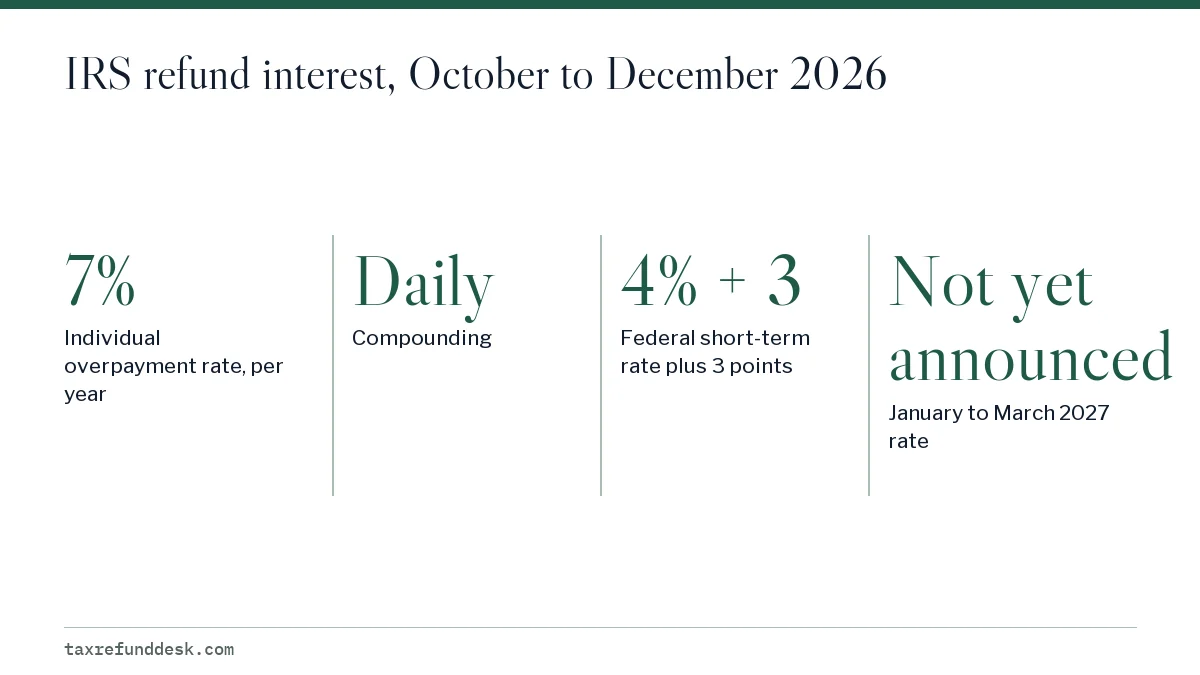
For individuals, the rate the IRS pays on refunds and the rate it charges on unpaid tax are the same, both 7% this quarter. Businesses are treated differently: a corporation earns 6% on overpayments and only 4.5% on the part of an overpayment above $10,000.
| Category | Jan to Mar | Apr to Jun | Jul to Sep | Oct to Dec |
|---|---|---|---|---|
| Individual overpayment (refunds) | 7% | 6% | 7% | 7% |
| Underpayment (individual and corporate) | 7% | 6% | 7% | 7% |
| Corporate overpayment | 6% | 5% | 6% | 6% |
| Corporate overpayment over $10,000 | 4.5% | 3.5% | 4.5% | 4.5% |
How the IRS overpayment interest rate is set each quarter
The IRS overpayment interest rate for individuals is the federal short-term rate plus 3 percentage points. The federal short-term rate is one of the applicable federal rates the IRS publishes each month, based on market yields of short-term US Treasury securities. For October to December 2026 the federal short-term rate used was 4%, which is how the individual rate came to 7%.
The IRS does not pick a new rate every month. It locks one in for each calendar quarter. The fourth-quarter 2026 rate, for example, was based on the federal short-term rate determined during July 2026, the first month of the previous quarter, and it was published in Revenue Ruling 2026-15.
How the rate has moved since 2022
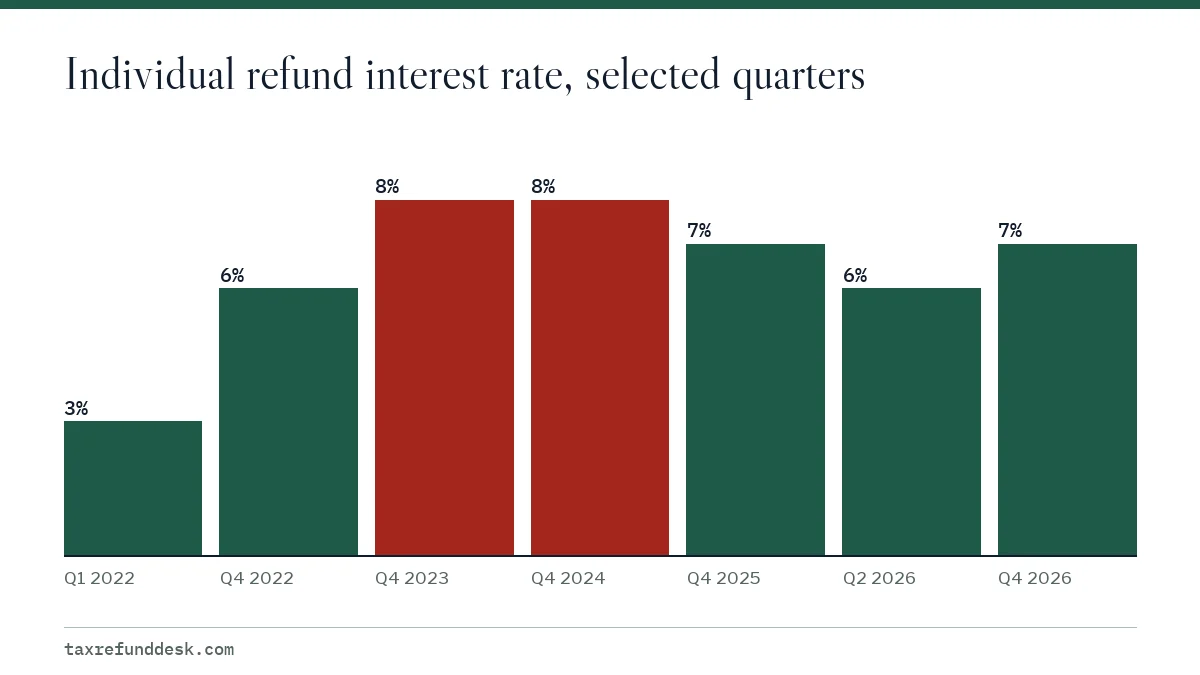
Refund interest tracks short-term interest rates, so it climbed from 3% in early 2022 to a peak of 8% from late 2023 through 2024, and has eased since. The chart below uses the IRS's published rates for selected quarters.
Has the 2027 refund interest rate been announced?
No. As of September 19, 2026, the refund interest rate for January 1 to March 31, 2027 has not been announced. The IRS usually releases the first-quarter rate in late November. Following the timing used for the October rate, it should be based on the federal short-term rate determined during October 2026.
Any 2027 figure you see before that release is a guess. What is known: whatever the rate turns out to be, it will be the short-term rate plus 3 points for individuals and it will apply to each day of delay in that quarter. Rates for the rest of 2027 should follow the same pattern, with each one published several weeks before its quarter begins, which matters for refunds from the 2027 filing season held into the summer.
| Quarter | Applies to | Expected announcement, based on 2026 timing |
|---|---|---|
| Q1 2027 | January 1 to March 31 | Late November 2026 |
| Q2 2027 | April 1 to June 30 | Late February 2027 |
| Q3 2027 | July 1 to September 30 | Late May 2027 |
| Q4 2027 | October 1 to December 31 | Late August 2027 |
Is refund interest compounded?
Yes. The IRS states that the interest it pays on overpayments is compounded daily. Each day, the day's interest is added to the balance, and the next day's interest is figured on that larger amount. At a 7% annual rate, daily compounding produces an effective yield of about 7.25% over a full year.
In practice the difference is small for typical refunds. On $1,000 held a full year at 7%, simple interest would be $70.00 while daily compounding gives about $72.50.
Refund interest calculator: work it out yourself
You can estimate refund interest with a phone calculator or spreadsheet using the quarterly rate and the number of days interest runs. The IRS figures the official amount, so treat your number as a check rather than a claim.
- Find the start date. For an on-time return it is the due date; for a late return it is the date the IRS received it. See interest on late refunds for the full rule and the 45-day window.
- Split the days by quarter. Count the days in each quarter from the start date until the refund date.
- Get the daily rate for each quarter: the annual rate divided by 365. At 7% that is 0.0001918 per day.
- Compound: multiply the refund by (1 + daily rate) raised to the number of days, one quarter at a time.
- Subtract the original refund. What remains is the estimated interest.
Worked example: $5,000 held 100 days at 7%
A $5,000 overpayment that earns interest for 100 days at a steady 7%, grows to $5,000 x (1.0001918)^100, or about $5,096.81. The interest is about $96.81. Simple interest over the same days would be $95.89, so compounding adds less than a dollar here.
| Refund | 30 days | 100 days | 365 days |
|---|---|---|---|
| $1,000 | $5.77 | $19.36 | $72.50 |
| $5,000 | $28.85 | $96.81 | $362.50 |
What refund interest is worth in practice
Refund interest makes up for a delay; it is not a return worth waiting for. The IRS says most e-filed refunds are issued within 21 days, well inside its interest-free window, so they carry no interest at all. Interest shows up mainly on refunds held for review, on returns filed late, and on amended returns, which the IRS often takes months to process (see amended return processing time).
Any refund interest you receive is taxable in the year paid; whether refund interest is taxable explains the Form 1099-INT. For how the refund itself reaches you, see IRS refund direct deposit.
Common questions
What interest rate does the IRS pay on refunds right now?
For individuals, 7% a year compounded daily for October 1 to December 31, 2026. The same 7% applied from July 1 to September 30, 2026.
Is the IRS refund interest rate the same as the rate it charges?
For individuals, yes. The overpayment rate and the underpayment rate are both the federal short-term rate plus 3 points, 7% for the fourth quarter of 2026. Corporations earn a lower rate on overpayments.
When will the IRS announce the 2027 interest rate?
The first-quarter 2027 rate is not yet announced. The IRS usually releases it in late November, a few weeks before January 1.
Why was the refund interest rate 6% in spring 2026?
The rate for April to June 2026 was based on a federal short-term rate of 3%, one point lower than the quarters around it. It went back to 7% on July 1, 2026 when the short-term rate returned to 4%.
Does the rate change if my refund is delayed across two quarters?
Yes. Each quarter's rate applies only to the days in that quarter. A refund held from April into July 2026, for example, earned 6% for the April to June days and 7% from July 1.
Sources
- IRS: Interest rates remain the same for the fourth quarter of 2026 (IR-2026-98) irs.gov
- IRS: Quarterly interest rates irs.gov
- IRS: Interest irs.gov
We check figures against these official pages. Rules change; confirm anything that affects a deadline or payment with the agency before you act.
Tell us what happened
Describe your situation and our editors will use it to improve this guide. If you leave your email, we may reply with a pointer to the right page or official contact. We never share your details.
Related guides
 IRS Refund Direct Deposit: Rules, Options and Limits
IRS refund direct deposit is now the standard way individual refunds are paid: since September 30, 2025 the IRS has been phasing…
Amended Return Processing Time: How Long 1040-X Takes
The IRS amended return processing time is 8 to 12 weeks from receipt, and some Form 1040-X filings take up to 16 weeks, according…