
Topic
Tax refund delayed: 7 causes, how long each takes and what to do
A tax refund delay means the IRS has pulled your return out of automatic processing, most often for an EITC or ACTC hold until mid-February, an error it must correct, an identity check, an income or withholding review, missing bank details or a debt offset. Most delays come with a letter that tells you whether to act or wait, and Taxpayer Advocate guidelines put IRS reviews at 45 to 180 days.
10 guides in this topic Updated October 20, 2026
- Government Shutdown and Tax Refunds: What Gets DelayedNot all tax refunds are delayed due to a government shutdown. In the 2025 lapse, the IRS kept paying refunds on e-filed, error-free Form 1040 returns…
- IRS CP05 Notice: Refund Held While Income Is VerifiedAn IRS CP05 notice tells you the IRS needs more time to verify the income, federal withholding, tax credits or business income on your return, so you…
- IRS CP05A Notice: Documents Needed to Release Your RefundAn IRS CP05A notice means the IRS is holding your refund until you prove the wages you reported and the federal tax withheld from them. Reply with a…
- IRS Hardship Refund Request: How to Ask for a Faster RefundAn IRS hardship refund request is a phone call or Form 911 asking the IRS to release a delayed refund early because the wait is causing real harm, su…
- IRS Letter 12C: Missing Information Holding Your RefundIRS Letter 12C means the IRS cannot finish processing your return until you supply something that is missing or unclear, often Form 8962 for the prem…
- IRS Rule Changes That Can Delay Tax Refunds for MillionsThe IRS rule changes that cause tax refund delays for millions of filers are mostly about how money is paid, not how tax is figured. Paper refund che…
- PATH Act Refund Hold: Why EITC and ACTC Refunds WaitA PATH Act refund is any refund on a return that claims the Earned Income Tax Credit or the Additional Child Tax Credit. Federal law bars the IRS fro…
- Refund Delayed Beyond Normal Timeframe: What It MeansAn IRS refund delayed beyond normal timeframe is one that has passed the 21-day e-file window, or 6 weeks for a paper return, without being issued. I…
- Tax Refund Delayed 6 Months or More: Next Steps to TakeA tax refund delayed 6 months is almost always stuck in a manual queue: identity theft cases, unanswered IRS letters, amended returns, examinations o…
- Why Is My Tax Refund Taking So Long? 9 Real ReasonsA tax refund usually takes longer than the IRS's 21-day e-file window (6 weeks or more for paper) because of one of nine things: a signature or math…

Tax refund delayed: the short answer
The IRS says most e-filed refunds arrive within 21 days, and mailed returns take 6 weeks or more from the day the IRS receives them. If your tax refund is delayed past those windows, the return has almost always been set aside for one of a handful of reasons, and the IRS usually mails a letter or notice that names the reason.
That letter decides your next move. Some delays clear on their own if you wait. Others stay frozen until you verify your identity, add a bank account or send documents. Knowing which kind you have saves weeks.
Delays are not rare. The National Taxpayer Advocate's 2026 mid-year report to Congress says more than 14 million individual returns were suspended during processing in the 2026 season, and more than one million taxpayers waited past the normal processing time, about 5 and a half weeks on average.
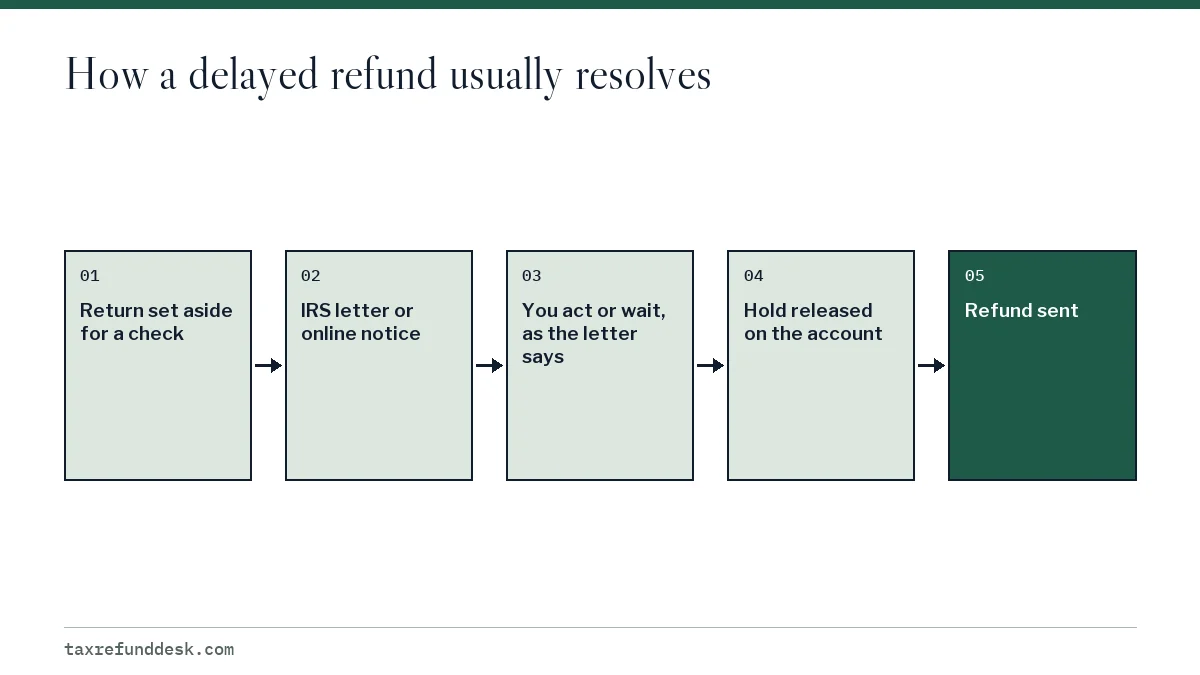
Why is my tax refund delayed? The most common reasons
The IRS and the Taxpayer Advocate Service (TAS) list the same core causes. The table below pairs each one with what you usually see and the typical added wait. For a symptom-by-symptom way to find your own cause, see why is my tax refund taking so long.
| Cause | What you usually see | Typical added time |
|---|---|---|
| EITC or ACTC claimed | Status stays at received until late February | No refund before February 15; most arrive by early March |
| Math error or missing entry | CP11 or CP12 notice with a changed amount | 4 to 6 weeks after a CP12 if you agree |
| Identity check | Letter 5071C, 4883C, 5747C or a CP5071 notice | Up to 9 weeks after you verify |
| Income or withholding review | CP05 or CP05A notice | 60 days, longer if documents are requested |
| Missing forms or information | Letter 12C | About 6 to 8 weeks after you reply |
| No valid bank account | CP53E notice | Frozen until you add an account, or a paper check after 6 weeks |
| Debt owed | Offset notice from the Bureau of the Fiscal Service or a CP49 | Refund reduced or taken |
Some causes are rule-driven rather than error-driven. The paper check phase-out that began on September 30, 2025 means a return filed without bank details now leads to a frozen refund instead of an automatic check. Our page on IRS rule changes that delay refunds covers those changes for the 2027 season.
Holds you can fix and holds you must wait out
Every IRS refund delay falls into one of two groups. Treating a wait-out hold as something to fix wastes time on hold with the IRS, and treating a fix-it hold as something to wait out can leave a refund frozen for months.
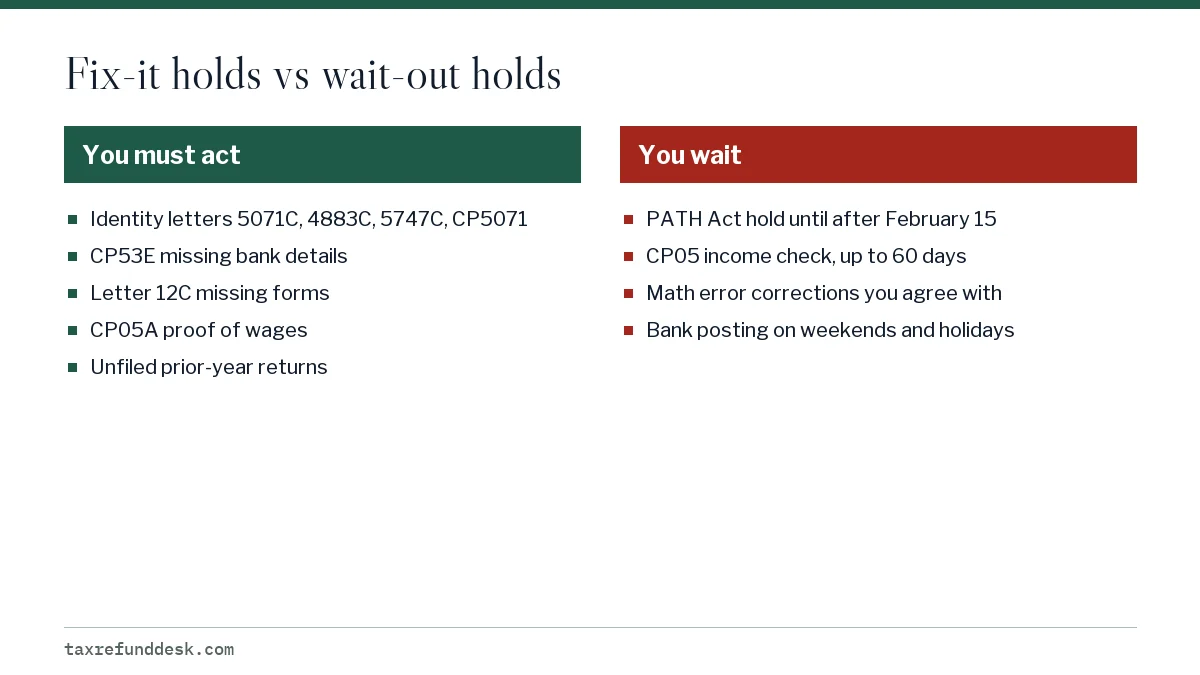
Holds that need action from you
- Identity verification letters: verify online at irs.gov/verifyreturn where the letter allows it, or by phone or in person, as the letter directs.
- CP53E: add or update a bank account in your IRS online account within 30 days. You get one chance to do this online.
- Letter 12C: send the missing forms or explanation within 20 days. Do not file Form 1040-X in reply.
- CP05A: send at least 3 pay stubs (including the year-end stub) or an employer letter on company letterhead showing wages and federal withholding, by the date on the notice.
- Unfiled prior-year returns: file them. TAS says a missing return generally takes about 90 days to process once filed.
Holds you can only wait out
- The PATH Act refund hold on EITC and ACTC returns. Neither the IRS nor TAS can release the refund before February 15.
- A CP05 notice, which asks for no reply if you filed the return.
- A math error correction you agree with. The corrected refund follows without a reply.
How long can the IRS hold a refund?
There is no single legal limit for a review, but TAS publishes guideline timeframes that match what most people experience. Count from the event in the second column, not from the day you filed.
| Situation | Clock starts | Guideline |
|---|---|---|
| Standard refund, no problems | Filing | Under 21 days |
| IRS asked for information and you sent it | Your reply | About 60 days |
| Prior-year return was missing | Filing the missing return | About 90 days |
| Amended return | Filing Form 1040-X | About 120 days |
| IRS review of the return | Start of the review | 45 to 180 days |
Long holds carry one small benefit. The IRS generally has 45 days to issue a refund without paying interest, and after that overpayment interest runs. The rate for individuals is 7% a year, compounded daily, for the quarter starting October 1, 2026. Any interest owed is paid as part of the same refund payment, which your transcript shows under TC 846.
If a status tool or your online account says the refund is past its expected date, our page on a refund delayed beyond the normal timeframe explains what that wording means and how long the wait after it usually runs.
Letters that come with federal tax refund delays
The notice or letter number is printed in a corner of the page, usually the top or bottom right. Match it here, then follow the linked page. Always confirm a letter is genuine by checking it against IRS.gov or your IRS online account before you send anything.
| Letter or notice | What it means | Your move |
|---|---|---|
| CP05 | IRS is verifying income, withholding or credits | Wait up to 60 days; no reply needed if you filed |
| CP05A | IRS needs proof of wages and withholding | Send documents by the notice date |
| Letter 12C | Forms or details are missing from the return | Reply within 20 days |
| 5071C, 4883C, 5747C, CP5071 | Identity must be confirmed | Verify as the letter directs |
| CP53E | Bank details missing, invalid or rejected | Add an account online within 30 days |
| CP12 | IRS fixed errors and changed the refund | Nothing if you agree; about 60 days to dispute |
More detail on the letters: CP05A notice, Letter 12C. If the refund arrives smaller than expected rather than late, the cause is usually an offset for a debt, which is mailed as a separate notice from the Bureau of the Fiscal Service.
What to do about IRS refund delays, in order
- Count the days. Use 21 days from e-file acceptance or 6 weeks from IRS receipt of a paper return. Inside that window, a delay is not yet a delay.
- Check Where's My Refund or your IRS online account once a day at most. The tools update overnight.
- Read your mail and the notices section of your online account. Match any code to the table above.
- If no letter has arrived, pull your account transcript. A TC 570 means a hold is on the account, and a later TC 571 releases it.
- Respond to any letter by its deadline, keep a copy, and note the date you replied. Most timeframes run from that date.
- If you face a financial hardship, or the IRS has missed its own stated timeframe, contact TAS.
Getting help from TAS with a delayed refund
The Taxpayer Advocate Service is an independent office inside the IRS. It can take a refund case when the problem is causing financial difficulty, when you have tried the normal IRS channels without a fix, or when an IRS system or process is not working as it should. TAS lists its intake number, 877-777-4778, on its held or stopped refunds page.
TAS cannot speed up the February 15 PATH Act date, and it cannot skip identity verification for you. Where it helps most is a case that has sat untouched after you did everything asked. For a hardship request, see how to ask for a hardship refund, which covers what counts as hardship and what to have ready.
Common questions
Why is my tax refund delayed this year?
The most common reasons are an EITC or ACTC claim, a math error, an identity check, an income or withholding review, and missing direct deposit details. Most of these trigger a letter or an online notice that names the cause.
How long can the IRS hold my refund?
TAS guidelines put reviews at 45 to 180 days, about 60 days after you send requested information, and about 120 days for amended returns. There is no fixed cap, so a hold can run past 180 days, which is why escalating through TAS matters when a case stalls.
Who can help with a delayed tax refund?
Start with the IRS through the number or address on your letter. If the delay is causing financial hardship, or the IRS has not fixed it through normal channels, the Taxpayer Advocate Service can open a case.
Does a delayed refund mean I am being audited?
Usually not. Most refund delays are pre-refund reviews or verification checks, not examinations. An audit comes with its own formal letter and, on the transcript, a TC 420.
Will I get interest if my refund is delayed?
Generally yes if the IRS takes more than 45 days after the due date or the date it received your return, whichever is later. The individual overpayment rate is 7% a year, compounded daily, for the quarter starting October 1, 2026.