
Topic
IRS reject codes: what each e-file rejection means and how to clear it
IRS reject codes are short business-rule codes, such as IND-031-04 or IND-507-01, that the IRS e-file system sends back when a return fails an automated check. A rejected return has not been filed. You fix the named item and resubmit, and a return rejected on or before the April deadline counts as on time if the corrected version is resubmitted by the fifth calendar day after that deadline.
11 guides in this topic Updated September 19, 2026
- E-file Rejection Grace Period: 5 Days to Resubmit (2027)The e-file rejection grace period gives you until the fifth calendar day after the due date to resubmit a rejected return and keep it on time, if the…
- IRS Reject Code F8962-070: Missing Form 8962 and 1095-AThe F8962-070 reject code means your e-filed return did not include Form 8962, Premium Tax Credit, even though IRS records show you need it, usually…
- IRS Reject Code IND-031-04: Prior-Year AGI Mismatch FixIRS reject code IND-031-04 means the prior-year information used to verify the primary taxpayer's identity, either last year's AGI or last year's sel…
- IRS Reject Code IND-181-01: Invalid IP PIN and How to FixIND-181-01 means the Identity Protection PIN (IP PIN) entered for the primary taxpayer failed IRS validation because it was wrong, incomplete or not…
- IRS Reject Code IND-507-01: Dependent Claimed ElsewhereIND-507-01 means the Social Security number of a dependent on your return was already used on another return the IRS accepted for the same tax year.…
- IRS Reject Code IND-517-02: Dependent SSN Already UsedThe IND-517-02 rejection code means a Social Security number you listed as a dependent is already the primary or spouse SSN on another return. Usuall…
- IRS Reject Code IND-996: Invalid Dependent IP PIN FixThe IND-996 reject code means the Identity Protection PIN (IP PIN) entered for a dependent or other qualifying person on your return did not match th…
- Return Rejected for IP PIN (IND-181-01)? How to Fix ItA tax return rejected due to IP PIN means the IRS has an Identity Protection PIN on file for you, your spouse or a dependent, and the e-file had no P…
- Return Rejected: Dependent Already Claimed by Someone ElseWhen a tax return is rejected because a dependent was already claimed, another return using that child's Social Security number reached the IRS first…
- Tax Return Rejected Because of AGI: How to Fix It FastA tax return rejected because of AGI means the prior-year adjusted gross income you typed to sign the e-file did not match the figure the IRS holds.…
- Tax Return Rejected: What It Means and How to RefileA tax return rejected by the IRS has not been filed and is not being processed, so no refund is on the way yet. The fix is usually one field, such as…
What are IRS reject codes?
An IRS reject code is the label the Modernized e-File (MeF) system attaches to a return that broke one of its business rules. The code tells you which rule failed and whose information caused it. The IRS publishes plain-language explanations for many of these codes on its Free File Fillable Forms reject pages, and the same business-rule codes come back to every e-file product, so the meaning does not change with the software you used.
Most individual codes follow one pattern. The prefix names the form or record (IND for individual income tax return rules, F8962 for Form 8962), the middle number is the rule, and the last two digits are the version of that rule. IND-031-04 and IND-032-04 are the same check applied to the primary taxpayer and the spouse.
A rejection usually comes back within a day or two of transmitting. It is an automated screen, not a review by an IRS employee, and it does not mean the IRS suspects you of anything. It simply means the return was never entered into processing.
Read the video transcript
IRS reject codes: what each e-file rejection means and how to clear it
IRS reject codes are short business-rule codes, such as IND-031-04 or IND-507-01, that the IRS e-file system sends back when a return fails an automated check.
Rejected return status: Not filed until a corrected version is accepted.
Resubmission window after the deadline: 5 calendar days (e-file) or 10 calendar days after the reject notice (paper).
Most common identity codes: IND-031-04 (prior-year AGI), IND-181-01 (IP PIN).
The table below covers the codes the IRS explains on its own pages and that individual filers run into most.
Identity codes are the largest group because every e-filed Form 1040 has to be signed electronically.
The IRS lets each Social Security number appear only once as a dependent across accepted returns for a tax year.
Where do I find my IRS reject code? It appears in the rejection email or message from whatever you used to e-file, usually in a format like IND-031-04.
How e-file rejections work, and does a rejected return count as filed?
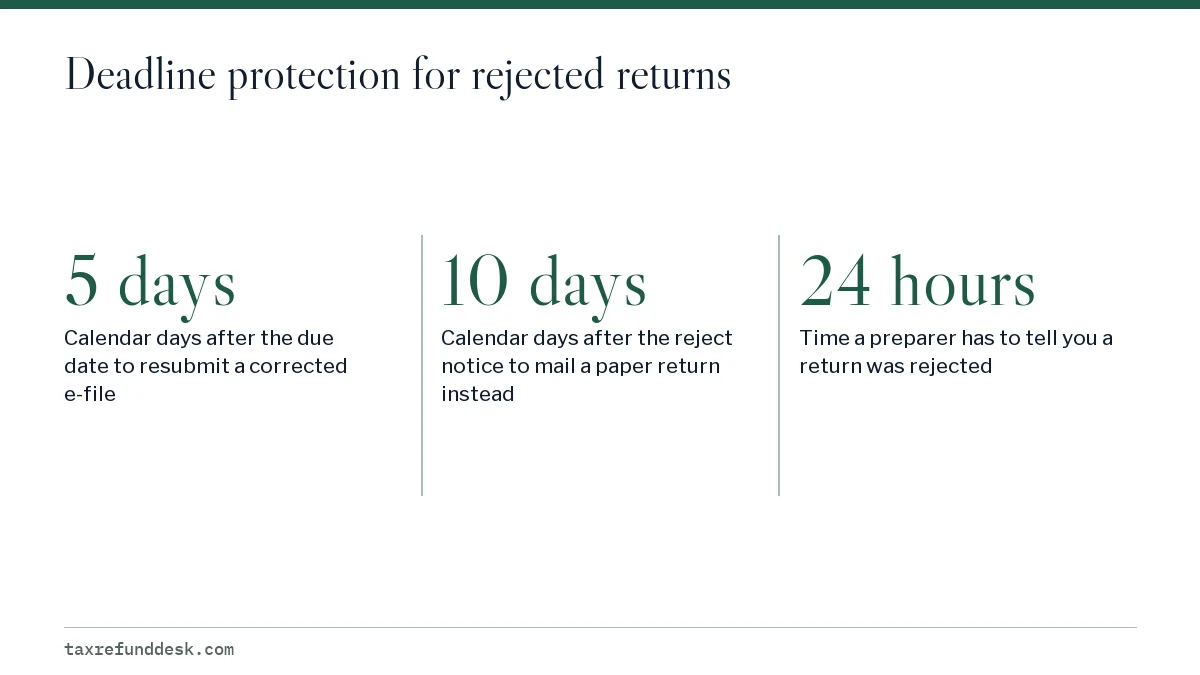
No. A rejected return is treated as not filed. Publication 1345 (Rev. 12-2025), the IRS rulebook for e-file providers, requires preparers to tell taxpayers within 24 hours that their return was not filed and to give them the business rule and the steps to correct it.
The same publication gives the timing protection that matters most near a deadline. A return first transmitted on or before its due date is considered timely if you correct it and it is resubmitted by the fifth calendar day after the due date. If you switch to paper instead, the paper return is timely if you file it by the later of the due date or 10 calendar days after the IRS notified you of the rejection, with a short note explaining why it is late. Our e-file rejection grace period guide works through the dates.
Two other effects are easy to miss. First, if your state return was linked to the federal one, the IRS stops the state submission when there is no accepted federal return, so the state return also has to go again. Second, the refund clock has not started. See what a rejected tax return means for your refund for the practical timing.
IRS reject codes list: the most common codes and what fixes them
The table below covers the codes the IRS explains on its own pages and that individual filers run into most. Each row gives the rule in plain words and the fix the IRS names.
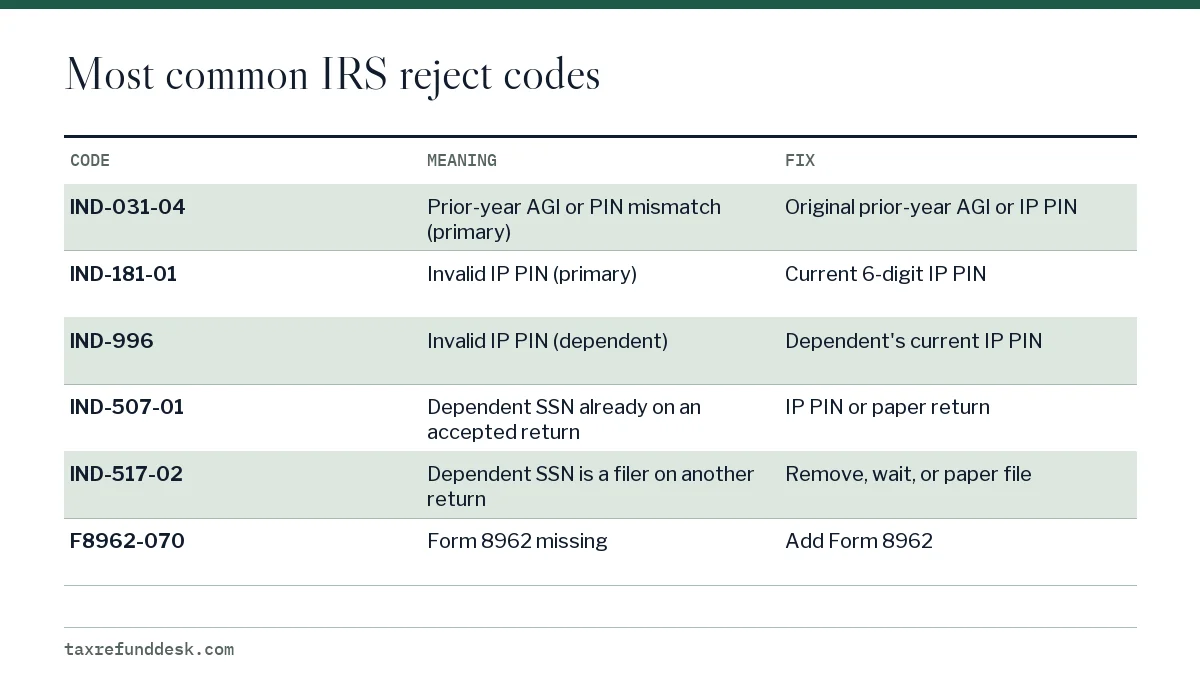
| Code | What failed | Whose record | IRS fix |
|---|---|---|---|
| IND-031-04 | Prior-year AGI or prior-year PIN does not match | Primary taxpayer | Enter the exact original prior-year AGI or PIN, or use an IP PIN |
| IND-032-04 | Prior-year AGI or prior-year PIN does not match | Spouse | Same as IND-031-04, using the spouse's figures |
| IND-181-01 | IP PIN entered is not valid | Primary taxpayer | Re-enter the current-year 6-digit IP PIN or retrieve it |
| IND-183-01 | Required IP PIN missing or invalid | Spouse | Enter the spouse's 6-digit IP PIN |
| IND-996 | IP PIN entered is not valid | Dependent or qualifying person | Enter the dependent's current IP PIN |
| IND-507-01 | Dependent SSN already used on another accepted return | Dependent | Check the SSN; if correct, add the primary taxpayer's IP PIN or file on paper |
| IND-517-02 | Dependent SSN is the filer or spouse SSN on another return | Dependent | Remove the dependent, wait for their amended return, or file on paper |
| F8962-070 | Form 8962 (Premium Tax Credit) is missing | Return attachment | Add Form 8962 and resubmit |
Identity and AGI codes: IND-031-04, IND-032-04, IND-181-01 and IND-183-01
Identity codes are the largest group because every e-filed Form 1040 has to be signed electronically. The signature is checked against something only the IRS and the real taxpayer should know: last year's adjusted gross income (AGI), last year's five-digit self-select PIN, or a current Identity Protection PIN (IP PIN).
Prior-year AGI codes
IND-031-04 fires when the primary taxpayer's prior-year AGI or PIN does not match, and IND-032-04 fires for the spouse. The figure must come from the return as you originally filed it, not from a Form 1040-X or an IRS math-error correction. For the 2027 season, that means the AGI on line 11a of your 2025 Form 1040. The full walkthrough is on our IND-031-04 page, and the tricky cases (changed filing status, late or unprocessed returns, first-time filers) are on the AGI mismatch page.
IP PIN codes
IND-181-01 means the primary taxpayer's IP PIN was wrong, from an earlier year, or incomplete. IND-183-01 is the spouse version, and IND-996 covers a dependent's IP PIN. An IP PIN is 6 digits and changes every calendar year, so last year's number always fails. Our IP PIN rejection page and the IND-181-01 explainer show how to get the current number.
Dependent and SSN codes: IND-507-01 and IND-517-02
The IRS lets each Social Security number appear only once as a dependent across accepted returns for a tax year. When a second return lists the same number, the second one is rejected. Which code you get depends on how the number was used on the first return.
- IND-507-01: another accepted return already claims the same person as a dependent. The IRS fix is to confirm the SSN and, if it is right, e-file with the primary taxpayer's current IP PIN. See our IND-507-01 guide.
- IND-517-02: the dependent's SSN is the primary or spouse SSN on another return. Usually the dependent filed their own return and did not indicate that someone else can claim them.
- Either way, you can file on paper and let the IRS sort out the competing claims. The full process, including the CP87A notice, is on our dependent already claimed page.
Form-specific codes: when a required form is missing
Some codes point to a form rather than a person. F8962-070 is the one most filers see: the IRS records show advance premium tax credit was paid for Marketplace health coverage, but the return has no Form 8962, Premium Tax Credit, to reconcile it. The fix is to add Form 8962 using the figures on Form 1095-A, then resubmit.
Form-level codes usually follow the same naming style: the form number, then the rule number. When the prefix is a form, look up the named form first. The rule text almost always says that the form is missing, that a required line is blank, or that two lines disagree.
How do I fix a reject code and resubmit?
Fix only what the code names, then send the same return again. You do not need to start a new return, and resubmitting the corrected version does not create a duplicate filing because the rejected one was never filed.
- Write down the full code, including the last two digits, and the date of the rejection notice.
- Read the IRS explanation for that code and note whose record failed: primary, spouse or dependent.
- Gather the source document: your original prior-year return, IRS online account records, the current IP PIN, or Social Security cards.
- Correct that one field. Do not change unrelated entries, which can trigger a new rejection.
- If you scheduled a tax payment from your bank account, check that the payment date is still valid; the IRS reject pages note it may need re-dating.
- Resubmit and wait for the new acknowledgment. Keep a copy of the rejection and acceptance notices.
- If the same code returns twice with data you know is right, file on paper or use an IP PIN instead of repeating the same entry.
Resubmitting near the deadline
The statutory due date for tax year 2026 returns is Thursday, April 15, 2027. Applying the Publication 1345 rule to that date, a return first sent by April 15, 2027 and rejected would still be timely if a corrected e-file is resubmitted by Tuesday, April 20, 2027. The IRS has not yet published its 2027 filing season calendar; it usually does so in January.
If you filed an extension, the same five-day cushion runs from the extended due date instead. Missing the window does not stop you from filing. It only means the return is late, which matters for penalties if you owe and does not matter if you are due a refund.
Common questions
Where do I find my IRS reject code?
It appears in the rejection email or message from whatever you used to e-file, usually in a format like IND-031-04. If you used a preparer, ask them for the business rule number and its explanation, which Publication 1345 requires them to give you.
Is an e-file rejection the same as an IRS audit?
No. A rejection is an automated format and identity check that happens before the IRS accepts the return. Nobody has reviewed your income or deductions yet; the rejected submission simply never entered processing.
How many times can I resubmit a rejected return?
The IRS does not publish a limit for resubmitting a rejected original return. The practical limit is time: if the same code keeps coming back with data you have verified, switch to an IP PIN or a paper return rather than repeating the same entry.
Why did my state return get rejected when only the federal was wrong?
When a state return is linked to the federal return, the IRS denies the state submission if there is no accepted federal return under that submission. Once the federal return is accepted, resend the state return.
Do reject codes change every year?
The core identity and dependent rules, such as IND-031 and IND-507, have stayed stable, but the IRS updates business rules for each season and the version digits at the end can change. Always read the explanation that came with your rejection.
Can I just mail my return instead of fixing the reject code?
Yes. Any return that cannot be e-filed can be printed, signed and mailed. Paper returns take longer; the IRS says to allow 6 weeks or more for a refund from a mailed return.