
Topic
Tax refund timeline: how long each filing method takes
Most federal tax refunds for e-filed returns are issued within 3 weeks (21 days) of the e-file date, while mailed paper returns take 6 weeks or more from the day the IRS receives them. Returns claiming EITC or ACTC cannot be refunded before February 15, and reviews, identity checks or missing bank details add weeks.
11 guides in this topic Updated September 18, 2026
- EITC Refund Date: When PATH Act Refunds Arrive in 2027Your EITC refund date cannot fall before February 15, because the PATH Act bars the IRS from refunding any return that claims the Earned Income Tax C…
- Filed on April 15: When Will Your Tax Refund Arrive?If you e-file on April 15, expect your refund about 3 weeks (21 days) later, the same IRS guideline that applies all season, which points to about Ma…
- How Long Does It Take to Get Your Tax Refund? TimelinesMost people get their tax refund within 3 weeks (21 days) of e-filing a correct return with direct deposit, according to the IRS. A mailed return nee…
- IRS Refund Schedule Chart: Estimated Dates by Filing WeekThe IRS does not publish an official refund schedule chart. It gives one benchmark, most e-filed refunds within 3 weeks of e-filing, and a personal d…
- Late Tax Return Refund: Timing and the 3-Year DeadlineYou can still get a late tax return refund if you file within 3 years of the return's original due date; after that the money is lost. The IRS says a…
- Paper Return Refund Time: How Long Mailed Returns TakeIRS processing times for paper returns run 6 weeks or more, counted from the day the IRS receives your envelope, not the day you mail it. Where's My…
- Tax Refund Changes 2027: What's New This Filing SeasonFour changes shape refunds in the 2027 filing season: refunds on returns filed without bank details are frozen under the paper check phase-out; Sched…
- Tax Refund Direct Deposit: How Long Until It Hits Your BankA tax refund by direct deposit usually reaches your account about 3 weeks (21 days) after you e-file: that is the IRS guideline for most e-filed refu…
- Tax Refund How Long After Accepted: Typical Wait TimesMost tax refunds arrive about three weeks after an e-filed return is accepted, because the IRS says to expect a refund within 3 weeks (21 days) of th…
- Tax Refund Status 2027: When to Check and Expected DatesYou can check your 2027 tax refund status in Where's My Refund about 24 hours after you e-file your tax year 2026 return, once the IRS opens the seas…
- Tax Season 2027 Start Date: Projected Jan 25 OpeningThe tax season 2027 start date is not announced yet, but if the IRS follows its last three seasons it will begin accepting tax year 2026 returns on M…
The tax refund timeline in one table
Your tax refund timeline starts on the day you file, not the day you expect the money. For a correct, e-filed current-year return with direct deposit, the IRS says most refunds go out within 3 weeks from the date you e-filed. A paper return runs on a slower clock: 6 weeks or more counted from the date the IRS receives the envelope.
The table below gives the day count for the common cases; the rest of the page explains what moves a return onto a slower track.
| Situation | When status appears | Typical time to refund |
|---|---|---|
| E-filed current-year return, direct deposit | About 24 hours after e-filing | Within 21 days for most filers |
| E-filed prior-year return | About 3 days after e-filing | Varies; allow longer than current-year returns |
| Mailed paper return | About 4 weeks after mailing | 6 weeks or more from IRS receipt |
| Return claiming EITC or ACTC | About 24 hours after e-filing | Not before February 15; past seasons pointed to early March |
| After sending information the IRS requested | Varies | About 60 days |
| Amended return (Form 1040-X) | About 3 weeks after submitting | 8 to 12 weeks, some up to 16 |
Sources: Tax Topic 152, Where's My Refund and the Taxpayer Advocate Service page on held or stopped refunds.
Read the video transcript
How long will your refund take?
Most refunds from e-filed returns are issued within 21 days of the e-file date, according to the IRS.
A mailed paper return takes six weeks or more from the day the IRS receives it.
By law, returns claiming the earned income credit or additional child tax credit cannot be refunded before February 15.
After identity verification, a refund can take up to nine weeks from the date you verify.
An amended return on Form 1040-X takes eight to twelve weeks, and sometimes up to sixteen.
The IRS has not yet announced when the 2027 filing season opens. We update the guide when it does.
Typical timeline by filing method
E-file with direct deposit
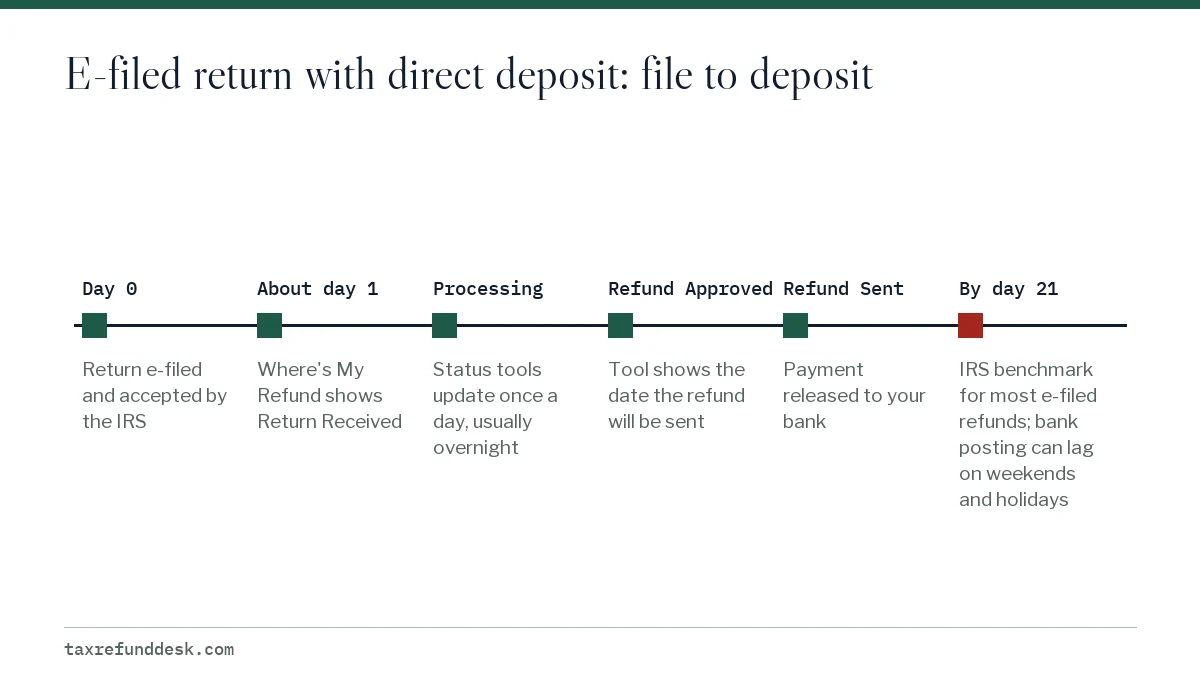
This is the shortest path. Your software or preparer transmits the return, the IRS accepts it, and Where's My Refund shows Return Received about a day later. Once processing finishes, the tool moves to Refund Approved and shows a date, then to Refund Sent when Treasury releases the payment.
The status tools refresh once a day, usually overnight, so checking every hour does not reveal anything new. After the IRS sends the money, your bank still has to post it, and banks may not post deposits on weekends or federal holidays. Our guide to what happens after your return is accepted walks through each step in more detail.
Paper return
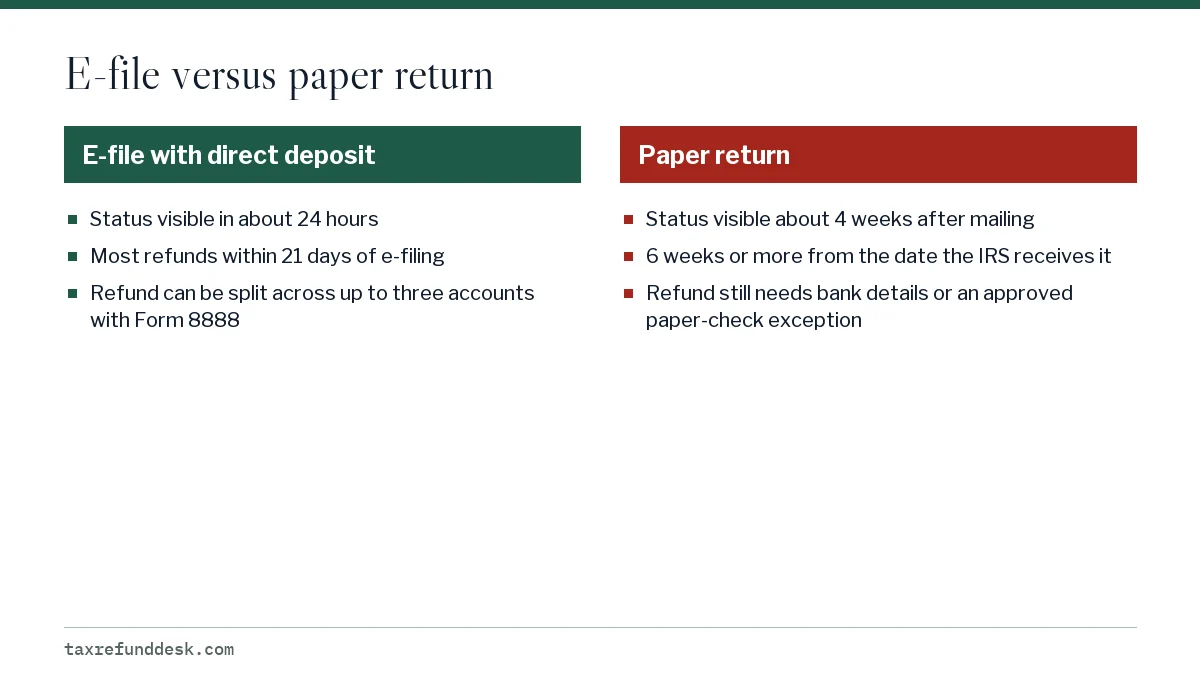
A mailed return has to be opened, scanned and keyed before it reaches the same processing systems as an e-filed one. That is why the IRS quotes 6 weeks or more, and why Where's My Refund will not show anything for about 4 weeks after you mail it. The paper return refund time page covers mailing tips and what to do if the 6 weeks pass.
E-file without bank details
Since September 30, 2025, the IRS has been phasing out paper refund checks for individuals under Executive Order 14247. A return filed without valid bank information is still processed, but the refund is frozen and the IRS mails a CP53E notice. You then have 30 days to add an account or request a paper-check exception in your IRS online account; if you do nothing, a paper check goes out after 6 weeks.
Federal tax refund timeline: key dates in the 2027 season
Tax year 2026 returns are filed in the 2027 season. As of September 18, 2026, the IRS has not announced when it will start accepting them. It usually announces the opening date in early January, and the last three seasons opened on a Monday in the final week of January.
| Date | What it means | Status |
|---|---|---|
| Early January 2027 | IRS announces opening day and EITC/ACTC guidance | Expected, based on past seasons |
| Late January 2027 | IRS begins accepting tax year 2026 returns | Not yet announced |
| February 15, 2027 | Earliest date EITC/ACTC refunds can be issued (also the Washington's Birthday federal holiday) | Set by law; holiday is a calendar fact |
| Late February 2027 | Where's My Refund shows dates for early EITC/ACTC filers | Not yet announced |
| April 15, 2027 (Thursday) | Statutory filing deadline for tax year 2026 | Set by law; IRS confirmation usually in January |
For the full season calendar, see tax refund dates for 2027. For the opening-day question on its own, including how past seasons were announced, see the 2027 tax season start date.
Is it always 21 days? What stretches the timeline
No. Twenty-one days is the IRS benchmark for a clean e-filed return, not a promise. Tax Topic 152 lists the usual reasons a refund runs slow: a return that was not signed, math errors, claims for the Earned Income Tax Credit or Additional Child Tax Credit, amended returns, and injured spouse claims on Form 8379 that need a person to process them.
The Taxpayer Advocate Service adds holds of its own: unfiled returns from earlier years, name or address mismatches, reviews of wages, withholding or credits, and offsets for debts. Each one moves you onto a longer guideline.
| What happened | Guideline |
|---|---|
| Standard refund, no issues | Under 21 days |
| You sent information the IRS asked for | About 60 days after you respond |
| You filed missing prior-year returns | About 90 days after filing them |
| You filed an amended return | About 120 days |
| IRS review of the return | 45 to 180 days depending on complexity |
The PATH Act hold
If your return claims EITC or ACTC, federal law stops the IRS from issuing the refund before February 15, and the whole refund waits, not just the credit. Neither the IRS nor the Taxpayer Advocate Service can release it early, even for hardship. In the 2026 season, the IRS said most early EITC and ACTC refunds would be in accounts by March 2, 2026. The EITC refund date page tracks this each season.
Identity checks and reviews
A verification letter such as 5071C or a CP5071 notice pauses the return until you confirm your identity. After successful verification, the IRS says it can take up to 9 weeks to receive the refund. A CP05 notice, which means the IRS is checking income, withholding or credits, asks you to allow up to 60 days before contacting it.
How to estimate your refund date
No chart can tell you your exact date, because the IRS sets it return by return. You can still build a realistic window in a few minutes.
- Find your e-file date or, for a paper return, the date the IRS likely received it (allow a few days for mail).
- Add 21 days for an e-filed return or 42 days for a paper return.
- If you claimed EITC or ACTC and filed before mid-February, replace that result with the IRS's published date for early filers once it is announced.
- If your date falls on a weekend or federal holiday, expect the deposit on the next business day your bank posts.
- Check Where's My Refund once a day. When it shows Refund Approved with a date, that date replaces your estimate.
Worked example: you e-file on Tuesday, February 2, 2027 with no credits that trigger a hold. Adding 21 days gives Tuesday, February 23, 2027, so a deposit by that date is the IRS benchmark. If you mailed the same return and it reached the IRS on February 8, the 6-week mark would be March 22, 2027. The IRS refund schedule chart repeats this calculation for every acceptance week of the season.
Tax refund timeline 2026: what the last season showed
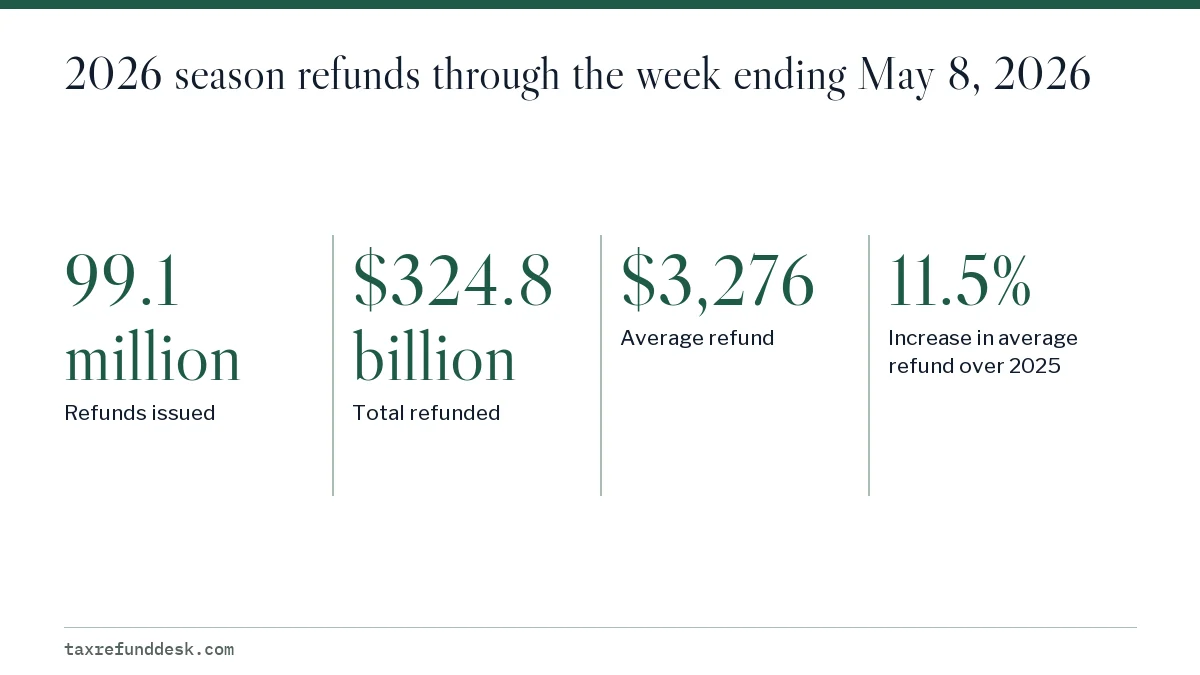
The 2026 season opened on January 26, 2026 with about 164 million individual returns expected and a deadline of April 15, 2026. Through the week ending May 8, 2026, the IRS had issued 99.1 million refunds worth $324.8 billion, and the average refund was $3,276, up 11.5% from $2,939 at the same point in 2025.
Most of those refunds followed the normal timeline, but not all. The IRS summary of the National Taxpayer Advocate's 2026 mid-year report says more than 14 million individual returns were suspended during processing, and more than one million taxpayers waited past normal processing times, about 5 and a half weeks on average. It also counts about 4 million notices sent for missing or incorrect direct deposit details.
Those numbers point to the two biggest controllable risks for the next season: a return that trips a review, and a return with bad or missing bank details. Our overview of what changes for 2027 refunds covers both, and how long a tax refund takes breaks down the wait for each special case.
When to act instead of waiting
- Direct deposit missing: if the money has not arrived 5 days after the 21-day period, you can request a refund trace.
- Paper check missing: a trace is appropriate if the check has not arrived within 6 weeks of mailing your return.
- Letter or notice received: respond by the date printed on it; the refund stays on hold until you do.
- Serious financial hardship: the Taxpayer Advocate Service may be able to help, except with the February 15 PATH Act date, which it cannot override.
Common questions
Is it always 21 days to get a tax refund?
No. Twenty-one days is the IRS guideline for most e-filed returns with no problems. Paper returns, EITC or ACTC claims, identity checks, reviews and amended returns all run longer.
Does filing early speed up my tax refund?
Filing early gets you into the queue sooner, so a clean e-filed return filed in late January can be paid in February. It does not help EITC or ACTC filers get paid before February 15, because the law sets that date.
Why is my refund timeline different from someone who filed the same day?
The IRS processes each return separately. Credits claimed, identity filters, missing bank details, offsets and which bank receives the deposit all change the date, even for returns accepted on the same day.
Does Where's My Refund update on weekends?
The IRS says its refund status tools update once a day, usually overnight. Banks may not post deposits on weekends or federal holidays, so money sent on a Friday can appear the next business day.
How long does a refund take after filing missing prior-year returns?
The Taxpayer Advocate Service guideline is about 90 days after you file the missing returns. Refunds are often held until all required earlier returns are on file.