
How long does it take to get your tax refund?
Short answer
Most people get their tax refund within 3 weeks (21 days) of e-filing a correct return with direct deposit, according to the IRS. A mailed return needs 6 weeks or more from IRS receipt. After an identity check, the refund can take up to 9 weeks from verification, and amended returns take 8 to 12 weeks, some up to 16.
- 01E-filed, direct deposit
- Usually within 3 weeks of e-filing
- 02Mailed return
- 6 or more weeks from IRS receipt
- 03After identity verification
- Up to 9 weeks
- 04Form 1040-X
- 8 to 12 weeks, up to 16
- 05Trace a missing deposit
- 5 days after the 21-day period
The short answer: how long does it take to get your tax refund
For most people, the answer is under three weeks. The IRS says it issues most refunds for e-filed returns within 3 weeks from the date you e-filed, and it pays fastest when you choose direct deposit. That window covers the IRS processing time; your bank may take a little longer to post the money.
The answer changes sharply if your return goes down a different path. The chart below compares the benchmark for each case: 21 days for a clean e-file, the 6-week minimum for paper, and the Taxpayer Advocate Service guidelines of about 60, 90 and 120 days for returns that need follow-up.
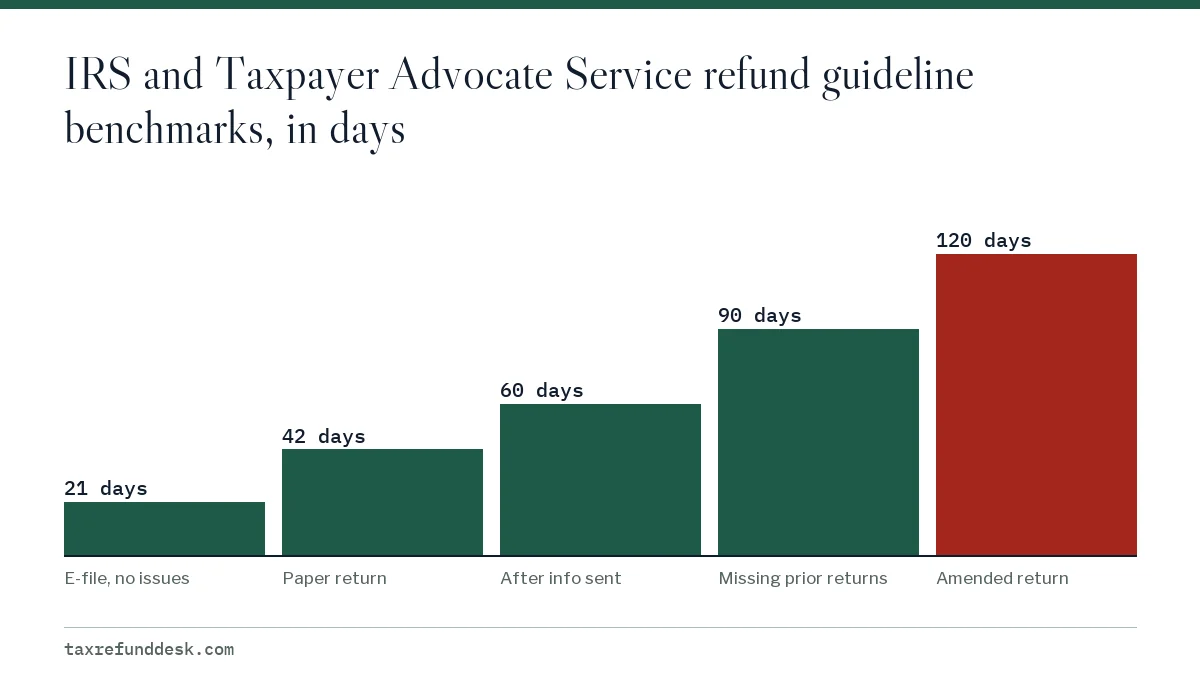
Figures come from IRS Tax Topic 152 and the Taxpayer Advocate Service. If you want dates rather than day counts, the IRS refund schedule chart converts these guidelines into calendar windows by acceptance week.
Tax refund: how long to process versus how long to receive
People often mix up two separate waits. Processing time is how long the IRS needs to accept, check and approve the return. Receiving time is how long the money takes to reach you after the IRS sends it.
- Processing: starts at e-filing (or IRS receipt of a paper return) and ends when Where's My Refund changes to Refund Sent.
- Receiving: starts at Refund Sent and ends when your bank posts the deposit. Banks may not post on weekends or federal holidays.
- Status updates: the IRS refund tools update once a day, usually overnight, so the status you see at noon is the same one you would see at 6 p.m.
If Where's My Refund says Refund Sent but your account shows nothing, the problem is usually on the receiving side. Contact your bank first, then wait until 5 days after the 21-day period before asking the IRS for a trace.
E-file with direct deposit
This is the case the 21-day figure describes. You will see your status about 24 hours after e-filing a current-year return, or about 3 days after e-filing a prior-year return. Most clean returns move from Return Received to Refund Approved without any action from you.
How long does a tax refund take with direct deposit on a joint return?
The processing time is the same for joint and single returns. The difference is where the money can go: the IRS will only deposit a refund into an account in your name, your spouse's name or a joint account, and it will not put more than three electronic refunds into one account. A deposit that breaks either rule can be rejected and frozen, which adds weeks.
Splitting the refund
Form 8888 lets you divide a direct deposit among up to three accounts at US financial institutions. It does not slow processing when the account details are right, but each extra account is one more routing number that could be mistyped.
Paper returns and paper checks
A mailed return takes 6 or more weeks from the date the IRS receives it, and Where's My Refund will show nothing for about 4 weeks after mailing. The clock does not start when you drop the envelope in the mailbox, so add a few days of transit time to any estimate.
Paper checks are now the exception. The IRS began phasing out paper refund checks for individuals on September 30, 2025. If you file without valid bank details, the IRS freezes the refund and mails a CP53E notice. You get 30 days to add an account or claim a paper-check exception online; with no response, the IRS mails a paper check after 6 weeks. Our CP53E notice guide explains each option.
A CP53 notice is different: it means a direct deposit could not be made and a check is on its way. The IRS says to allow 4 weeks from the notice date for that check.
Returns that take longer than 21 days
Some returns are pulled off the fast track on purpose. The table shows the wait the IRS or Taxpayer Advocate Service gives for each case and what, if anything, you need to do.
| Case | Typical wait | What you do |
|---|---|---|
| EITC or ACTC claimed | Nothing before February 15; most early filers paid by early March in recent seasons | Nothing; the hold is set by law |
| Identity verification letter (5071C, 4883C, CP5071) | Up to 9 weeks after you verify | Verify online, by phone or in person as the letter says |
| CP05 income or credit review | Allow up to 60 days | Wait unless the IRS asks for documents |
| CP12 refund changed | 4 to 6 weeks if you agree | Respond by the notice date (generally 60 days) if you disagree |
| Injured spouse, Form 8379 | About 11 weeks e-filed, 14 weeks paper, 8 weeks filed later | File the form with or after the joint return |
| Amended return, Form 1040-X | 8 to 12 weeks, some up to 16 | Track it in Where's My Amended Return after about 3 weeks |
The EITC and ACTC hold applies to the entire refund, not just the credit portion, and even the Taxpayer Advocate Service cannot release it before February 15. See the PATH Act refund hold page for how the date is set. For identity letters, refund timing after identity verification explains why the IRS suggests waiting 2 to 3 weeks before checking status.
Why do some refunds take longer than 21 days without any letter?
A refund can stall with no notice at all while the IRS fixes a math error, matches wages and withholding, or waits on a prior-year return that was never filed. Unsigned paper returns also sit until the problem is resolved. The Taxpayer Advocate Service guideline for reviews runs from 45 to 180 days depending on complexity.
Timing by when you file
The processing clock is the same all season, but the date you file changes the calendar result. A clean return e-filed in the first week of the season can be paid in mid-February, while one filed on deadline day lands in early May.
Deadline filers face the busiest weeks of the year, so the refund timing for returns filed on April 15 page covers that case separately. For the season as a whole, start with the tax refund timeline overview.
What to do if your refund is taking too long
- Confirm how you filed and the date: e-file date, or the date the IRS likely received your paper return.
- Check Where's My Refund with your SSN or ITIN, filing status and exact whole-dollar refund.
- Look for mail from the IRS or the Bureau of the Fiscal Service. A notice usually explains a hold, change or offset.
- If a direct deposit is still missing 5 days after the 21-day period, or a paper check has not come within 6 weeks, start a refund trace.
- If the delay is causing serious financial hardship, contact the Taxpayer Advocate Service, which may be able to help, although it cannot release an EITC or ACTC refund before February 15.
Common questions
How long does a tax refund take with direct deposit?
Most e-filed refunds with direct deposit are issued within 3 weeks of the e-file date. Your bank may take longer to post the money, because banks may not post deposits on weekends or federal holidays.
How long does a paper return refund take?
The IRS says 6 or more weeks from the date it receives your mailed return. Status in Where's My Refund appears about 4 weeks after you mail it.
Why do some refunds take longer than 21 days?
Common reasons include EITC or ACTC claims, math errors, identity verification, income or credit reviews, missing bank details, amended returns and injured spouse claims. Any of these moves the return to a longer guideline.
How long does it take to get a tax refund after the IRS accepts the return?
Acceptance means the return passed initial e-file checks. Most refunds follow within 3 weeks of e-filing, and acceptance normally happens soon after you file, so the 21-day guideline still applies.
Can calling the IRS make my refund come faster?
Calling does not change processing on a normal return. It is worth contacting the IRS once Where's My Refund tells you to, or after the full processing time has passed.
Sources
- Tax Topic 152, Refund information irs.gov
- Refunds irs.gov
- Taxpayer Advocate Service: held or stopped refunds taxpayeradvocate.irs.gov
- Understanding your CP53E notice irs.gov
- Understanding your Letter 4883C or 6330C irs.gov
- Where's My Amended Return irs.gov
We check figures against these official pages. Rules change; confirm anything that affects a deadline or payment with the agency before you act.
Tell us what happened
Describe your situation and our editors will use it to improve this guide. If you leave your email, we may reply with a pointer to the right page or official contact. We never share your details.
Related guides
 Tax Refund Timeline: How Long Each Filing Method Takes
Most federal tax refunds for e-filed returns are issued within 3 weeks (21 days) of the e-file date, while mailed paper returns t…
IRS Refund Schedule Chart: Estimated Dates by Filing Week
The IRS does not publish an official refund schedule chart. It gives one benchmark, most e-filed refunds within 3 weeks of e-fili…
Filed on April 15: When Will Your Tax Refund Arrive?
If you e-file on April 15, expect your refund about 3 weeks (21 days) later, the same IRS guideline that applies all season, whic…
Tax Refund Direct Deposit: How Long Until It Hits Your Bank
A tax refund by direct deposit usually reaches your account about 3 weeks (21 days) after you e-file: that is the IRS guideline f…
PATH Act Refund Hold: Why EITC and ACTC Refunds Wait
A PATH Act refund is any refund on a return that claims the Earned Income Tax Credit or the Additional Child Tax Credit. Federal…