
Tax refund by direct deposit: how long until it reaches your bank
Short answer
A tax refund by direct deposit usually reaches your account about 3 weeks (21 days) after you e-file: that is the IRS guideline for most e-filed refunds, and your bank then posts the money on its own schedule. Banks may not post on weekends or federal holidays, so a Friday send can land the next business day. If it is missing 5 days after the 21-day window, request a trace.
- 01IRS sends most e-filed refunds
- Within 21 days of e-filing
- 02Bank posting
- Not on weekends or federal holidays at many banks
- 03Missing deposit
- Trace after 21 days plus 5 days
- 04Deposits per account
- No more than 3 refunds into one account
- 05Rejected deposit
- Usually frozen until you act (CP53E)
Tax refund how long direct deposit takes, from sent to posted
The IRS recommends e-filing with direct deposit as the fastest way to get a refund, and it tells e-filers to expect their refund 3 weeks (21 days) from the date they e-filed. What happens after the IRS sends the money is a separate, shorter step that your bank controls.
Think of the wait in two parts. The first part is IRS processing, which ends when Where's My Refund changes to Refund Sent. The second part is bank posting, which ends when the deposit shows in your balance. This page is about that second part and the problems that can stretch it.
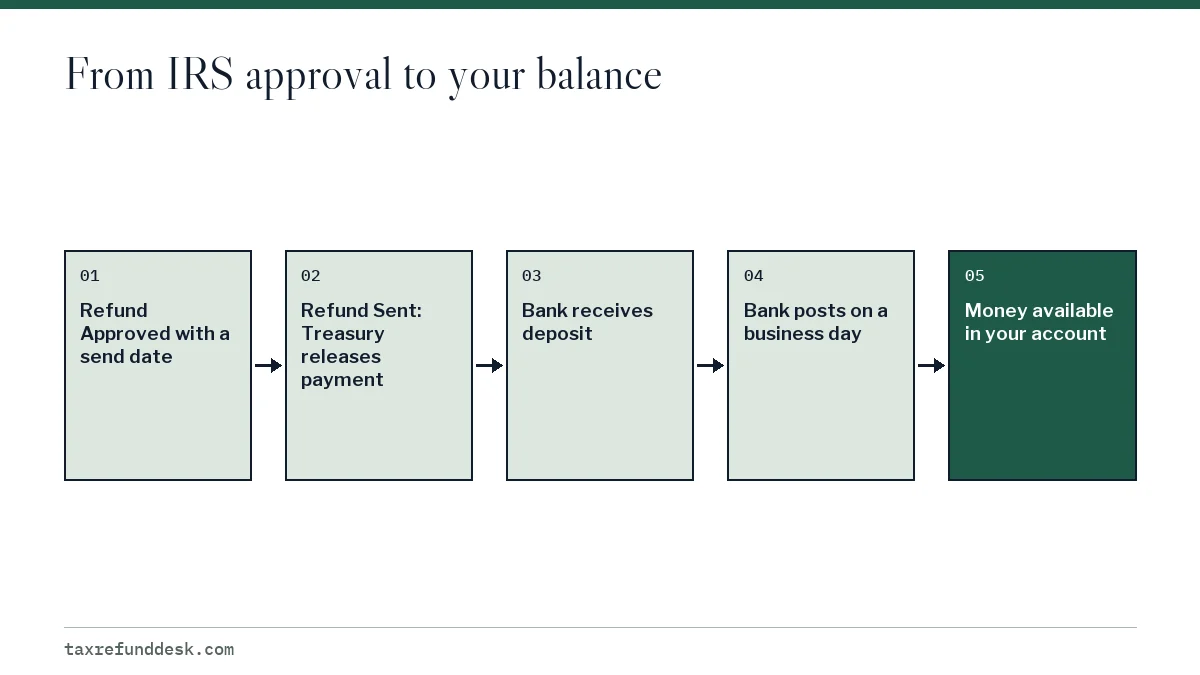
IRS direct deposit time: what the send date means
When your refund is approved, Where's My Refund shows a date. That is the day Treasury releases the payment to your bank, not a guarantee of when your balance changes. The IRS does not publish a time of day for refund deposits, and the status tools update only once a day, usually overnight.
Your bank decides when to make an incoming federal payment available, which is why two people with the same send date can see the money on different days.
Do banks release refunds early?
Some banks and financial apps advertise early access to incoming deposits, while others post on the scheduled date. The IRS does not control this, so the only reliable answer is your bank's own deposit policy.
Direct deposit refund dates around weekends and holidays
The IRS warns that banks may not post deposits on weekends or federal holidays. A refund marked sent on a Friday may not appear until Monday, and if Monday is a holiday, until Tuesday.
| Send date shown | Common posting day | Why |
|---|---|---|
| Tuesday | Tuesday or Wednesday | Normal business day |
| Friday | Friday or Monday | Weekend in between |
| Friday before a Monday holiday | Friday or Tuesday | Weekend plus federal holiday |
| Day before a mid-week holiday | Same day or day after the holiday | Holiday closes processing |
In the 2027 season this matters most for credit filers. February 15, 2027, the first day EITC and ACTC refunds may be released, is itself a federal holiday. See the EITC refund date page for what is and is not announced.
Tax refund: how long does it take by direct deposit to a prepaid card or app
You can send a refund to a prepaid debit card or a mobile account that has its own routing and account numbers. The IRS lists these as alternatives for people without a traditional bank account now that paper checks are being phased out. Timing works the same way: the IRS sends on the approved date, and the card company posts on its own schedule.
Two rules trip people up here:
- The account must be in your name, your spouse's name, or be a joint account. A refund sent to someone else's card can be rejected.
- The IRS will not deposit more than three electronic refunds into the same account. A fourth refund aimed at that account is not deposited there, which delays that filer's money.
If you want to divide the money, Form 8888 lets you split a refund among up to three accounts.
Why is my refund sent but not in my bank?
If Where's My Refund says Refund Sent and your balance has not changed, work through these checks in order.
- Count business days. Weekends and federal holidays do not count for posting.
- Compare the account and routing numbers on your filed return with your bank's details. The IRS says it is not responsible for account errors made by you or your preparer.
- Check whether a refund transfer or advance product was involved, since the money then passes through the provider's account first.
- Look for a Bureau of the Fiscal Service offset notice if the deposit came in smaller than expected.
- If nothing arrives 5 days after the 21-day processing window, start a trace; see refund sent but not in bank.
Getting the shortest direct deposit time next season
Most delays at this stage come from account details, not the IRS. Before you file in 2027, confirm your routing and account numbers against a bank statement or your bank's app, not a check from an old account. Keep the account open until the refund posts.
For the full season picture, including how long processing takes before the send date, see the tax refund timeline and how long after acceptance refunds usually take.
Common questions
What time does the IRS deposit refunds?
The IRS does not publish a deposit time. It releases the payment on the date shown in Where's My Refund, and your bank decides when during the day the money becomes available.
Why is my refund sent but not in my bank?
Usually because the bank has not posted it yet, especially over a weekend or holiday. If the deposit is still missing 5 days after the 21-day processing window, request a refund trace.
Do banks release tax refunds early?
Some banks and apps advertise early access to incoming deposits, while others wait for the scheduled date. The IRS has no say in this, so check your own bank's deposit policy.
Will Where's My Refund show when my bank posts the deposit?
No. The IRS tool stops at Refund Sent and cannot see your bank account. Whether a pending credit appears before the money posts is up to your bank, so use your bank's app or statement for that last step.
Can I change my direct deposit account after filing?
Where's My Refund does not offer a way to change it. If your bank rejects the deposit or the account information was missing, the IRS freezes the refund and sends a CP53E notice, which gives you one chance to add or fix an account through your IRS online account.
Sources
- Tax Topic 152, Refund information irs.gov
- When to expect your refund if you claimed the EITC or ACTC irs.gov
- Direct deposit refunds and refund offsets, Taxpayer Advocate Service taxpayeradvocate.irs.gov
- Understanding your CP53E notice irs.gov
- Questions and answers about Executive Order 14247 irs.gov
We check figures against these official pages. Rules change; confirm anything that affects a deadline or payment with the agency before you act.
Tell us what happened
Describe your situation and our editors will use it to improve this guide. If you leave your email, we may reply with a pointer to the right page or official contact. We never share your details.
Related guides
 Tax Refund Timeline: How Long Each Filing Method Takes
Most federal tax refunds for e-filed returns are issued within 3 weeks (21 days) of the e-file date, while mailed paper returns t…