
Refund sent but not in bank: what the gap means
Short answer
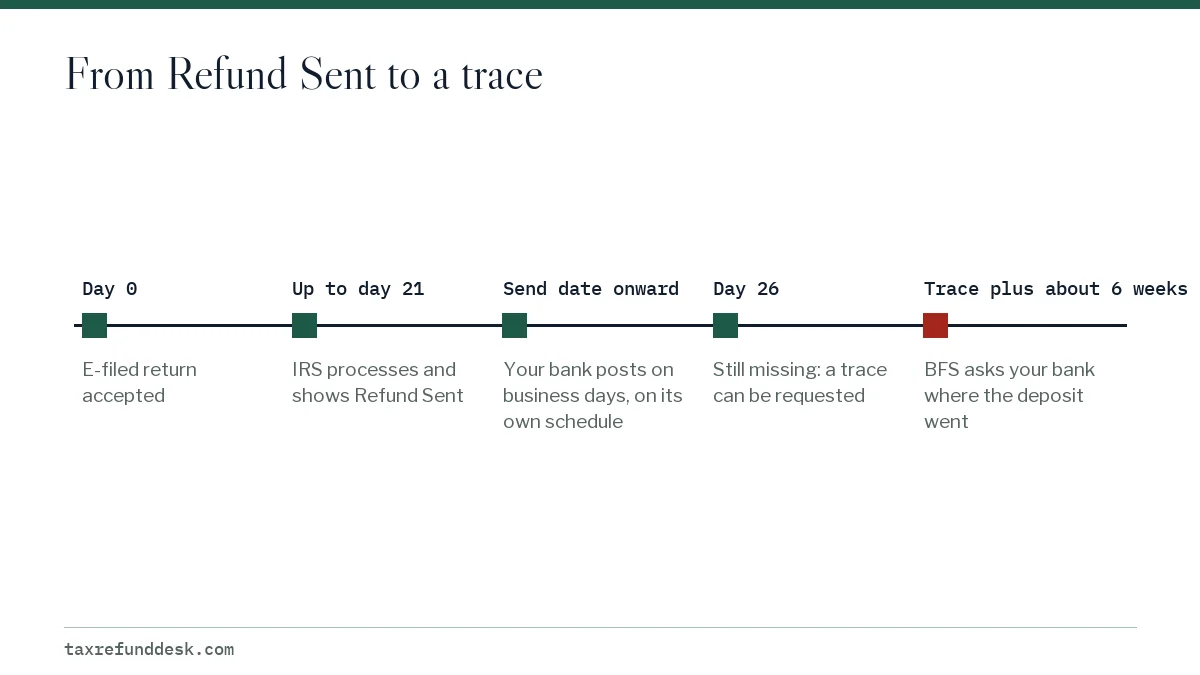
A refund sent but not in your bank is normal for a few business days, because Refund Sent only means Treasury released the payment; your bank posts it on its own schedule and not on weekends or federal holidays at many banks. If the deposit is still missing 5 days after the 21-day processing window, request a direct deposit trace.
- 01Refund Sent means
- Treasury released the payment, not that your bank posted it
- 02Trace a missing deposit after
- 21 days plus 5 days
- 03BFS letter to your bank
- Within about 6 weeks of a trace
- 04Refunds allowed per account
- No more than 3
- 05Account errors by you or a preparer
- The IRS takes no responsibility
Why a refund can be sent but not in the bank
When a refund is sent but not in the bank, the IRS part of the job is finished and the bank part has not happened yet. Refund Sent is the last stage in Where's My Refund. It confirms that the Treasury released the payment on the date shown, but the IRS tool cannot see your account, so it never changes to show that the money posted.
Most gaps close on their own within a few business days. A gap that lasts longer usually points to one of four things: a weekend or holiday, an account detail that does not match, a refund product that routes money through a third party, or a deposit that the bank rejected.
Refund sent to bank: how long until it posts?
The IRS does not publish a posting time because each bank sets its own. What the IRS does say is that banks may not post deposits on weekends or federal holidays, so count business days, not calendar days, from the send date.
| Business days since the send date | What it usually means | Action |
|---|---|---|
| 0 to 2 | Normal posting lag | Wait; check your bank app once a day |
| 3 to 5 | Possible hold, mismatch or third-party routing | Check account numbers and any refund transfer product |
| More than 5, and 26 days since e-filing | Deposit may be lost, rejected or misdirected | Call your bank, then request a trace |
The formal line comes from the Taxpayer Advocate Service: you can request a trace for a direct deposit that has not arrived 5 days after the 21-day processing period. If you e-filed on February 20, 21 days later is March 13, and a trace becomes available from March 18.
Tax refund not showing in bank account: checks to run yourself
Before contacting anyone, pull up a copy of the return you filed and your bank's own account details side by side. Most missing deposits come from something visible on that comparison.
- Match the routing number and account number digit by digit. A savings account entered as checking, or the reverse, can also cause a rejection.
- Confirm the account is in your name, your spouse's name, or a joint account. The IRS can deposit refunds only into those accounts.
- Count how many federal refunds went to that account this year. The IRS will not deposit more than three electronic refunds into one account.
- Check whether you chose a refund transfer, refund advance or fee deduction when filing. Then the deposit goes first to the provider's bank, which forwards what is left.
- Look for a smaller deposit than expected. A deposit reduced by a Treasury offset is still a deposit, and the Bureau of the Fiscal Service (BFS) mails a notice explaining it; see tax refund offset.
What if my bank says it has no deposit?
Ask the bank specific questions rather than just asking whether the refund arrived. Front-line staff often search only posted transactions, while a federal deposit can sit in a pending or returned state that needs a back-office check.
- Was an incoming ACH deposit from the U.S. Treasury received and then returned?
- Was the account closed, frozen or restricted on the send date?
- Does the name on the deposit match the name on the account?
- Is there a hold on the deposit, and when does it release?
If the bank confirms it returned the deposit, the IRS now usually freezes the refund instead of mailing a check. You should then receive a CP53E notice asking you to add or update a bank account; the closed account page covers that path.
Where's My Refund says sent but not received: can I trace a direct deposit?
Yes. A trace works for direct deposits as well as checks. After you request it, BFS sends your financial institution a letter, within about 6 weeks, asking it to confirm where the deposit went. If the bank shows the money was never credited, the trace is how the payment gets recovered or reissued.
Single, head of household and married filing separately filers can start the trace online in Where's My Refund. Joint filers use Form 3911. The full process, including timelines, is in the IRS refund trace guide, and the broader checklist is on the tax refund not received page.
Wrong or closed accounts
A wrong digit can send the money to a stranger's valid account. The IRS says it is not responsible for account errors made by you or your preparer, so recovery runs through the receiving bank and a trace; see refund sent to the wrong account.
A closed account usually causes the bank to reject the deposit. The refund is not lost in that case, but it will not move again until you give the IRS working bank details or qualify for a paper check.
Common questions
How long after Where's My Refund says sent will I see my money?
The IRS does not publish a posting time; your bank sets it. Count business days from the send date, because banks may not post deposits on weekends or federal holidays.
Will Where's My Refund update once my bank gets the refund?
No. Refund Sent is the final stage, and the IRS tool has no view of your bank account. Use your bank's app or statement to confirm the deposit.
Can the IRS tell me which account my refund went to?
Where's My Refund does not display account numbers. If you need to confirm the account used, check the copy of your filed return or your tax software; if the deposit is missing, a trace asks the bank to confirm where it went.
Why did only part of my refund reach my bank?
A partial deposit usually means an offset for a debt such as past-due child support or state tax, or an IRS adjustment. BFS mails a notice for offsets, and the IRS mails a notice such as CP12 for its own changes.
Should I file my return again if the deposit never came?
No. Filing a second return does not reissue a refund and can slow things down. Request a trace instead once the waiting period has passed.
Sources
- Lost or stolen refund, Taxpayer Advocate Service taxpayeradvocate.irs.gov
- Tax Topic 152, Refund information irs.gov
- Direct deposit refunds and refund offsets, Taxpayer Advocate Service taxpayeradvocate.irs.gov
- When to expect your refund if you claimed the EITC or ACTC irs.gov
We check figures against these official pages. Rules change; confirm anything that affects a deadline or payment with the agency before you act.
Tell us what happened
Describe your situation and our editors will use it to improve this guide. If you leave your email, we may reply with a pointer to the right page or official contact. We never share your details.
Related guides
 Tax Refund Not Received: Steps to Find a Missing Refund
If your tax refund was not received, first confirm in Where's My Refund that the IRS actually sent it. A direct deposit counts as…
IRS Refund Trace: How to Track Down a Missing Refund
An IRS refund trace is a request asking the IRS and the Bureau of the Fiscal Service to find out what happened to a refund that w…
IRS Refund Received in Error: How to Return It Safely
If you have an IRS refund received in error, return it promptly: write Void on the back of an uncashed check and mail it within 2…
Refund Sent to a Closed Account? What Happens and How Long
A tax refund sent to a closed bank account is normally not lost: the bank rejects the deposit and the money goes back to the Trea…
Refund Sent to Wrong Bank Account? How to Get It Back
A refund sent to the wrong bank account usually comes back: the bank rejects the deposit, the money returns to the IRS, and the I…
Tax Refund Direct Deposit: How Long Until It Hits Your Bank
A tax refund by direct deposit usually reaches your account about 3 weeks (21 days) after you e-file: that is the IRS guideline f…