
Tax refund sent to a closed bank account: what happens and how to get it back
Short answer
A tax refund sent to a closed bank account is normally not lost: the bank rejects the deposit and the money goes back to the Treasury. Under the paper check phase-out, the IRS now usually freezes that refund instead of mailing a check, and sends a CP53E notice giving you 30 days to add a working account in your IRS online account. If you do nothing, it mails a paper check after 6 weeks.
- 01Rejected deposits
- Usually frozen, not mailed as checks
- 02Notice you should expect
- CP53E (or CP53 if a check is being mailed)
- 03Time to add a new account
- 30 days from the CP53E
- 04No response to CP53E
- Paper check after 6 weeks
- 05Status update after adding an account
- 2 to 5 business days
What happens if my refund goes to a closed account?
A refund sent to a closed bank account does not disappear. A bank generally cannot credit a deposit to an account that no longer exists, so it rejects the payment and the money returns to the Treasury. The IRS then holds the refund until you tell it where to send the money.
That second step is what changed recently. Before the paper check phase-out, a rejected deposit was typically turned into a mailed check. Now the Taxpayer Advocate Service (TAS) says the IRS freezes most direct deposits that a bank rejects and does not automatically reissue them as paper checks. You have to act.
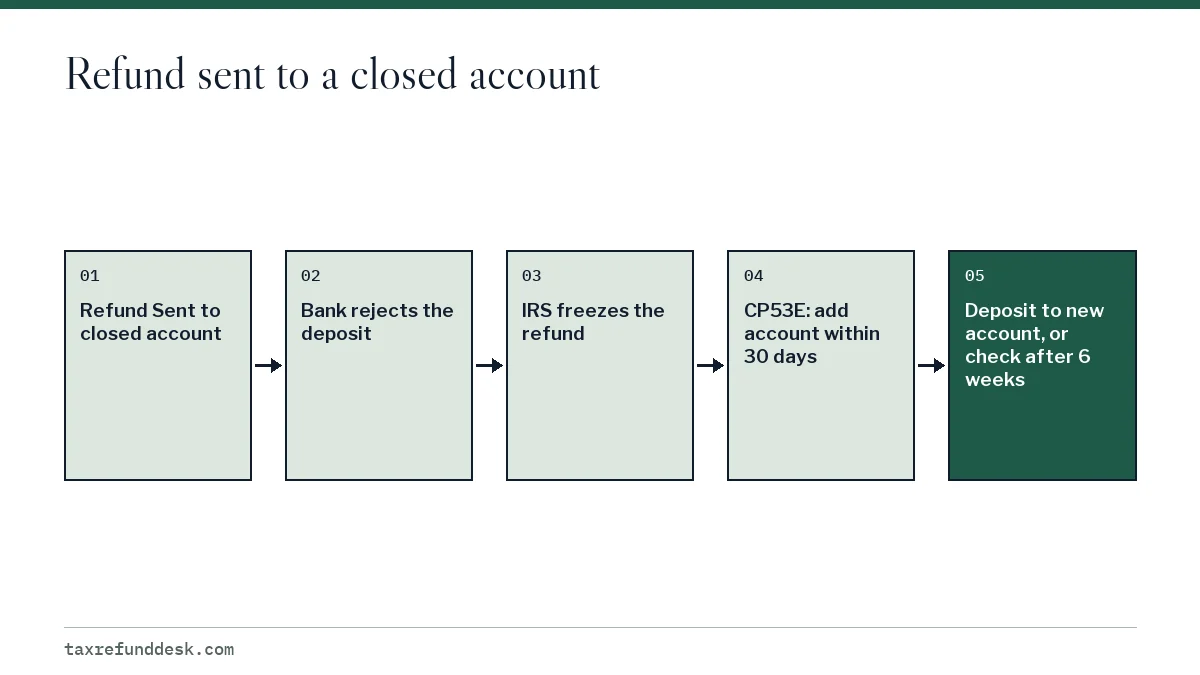
What the bank does with a deposit to a closed account
Each bank decides how it handles an incoming federal payment for a closed account, and the IRS does not publish a standard return time. In most cases the payment is rejected rather than posted, and nothing appears in your old account history.
Call or message the bank and ask two questions: was a deposit from the U.S. Treasury received for that account on or after the send date, and was it returned? A clear yes on the return is useful, because it means the money is back with the government and the next step is on the IRS side.
Refund sent back to the IRS: how returned deposits are handled now
Executive Order 14247, signed March 25, 2025, directs federal agencies to stop issuing paper checks, and the IRS began phasing out paper refund checks for individuals on September 30, 2025. Rejected deposits are now treated like returns filed without bank details: the refund is frozen until you add an account or qualify for a paper check.
| Step | Before September 30, 2025 | Now |
|---|---|---|
| Bank rejects deposit | Money returns to Treasury | Money returns to Treasury |
| IRS default action | Usually mailed a paper check | Usually freezes the refund |
| Notice you receive | CP53, check on the way | CP53E, add a bank account |
| Your action | Wait for the check | Add an account online within 30 days |
TAS notes that some rejection reasons fall outside the freeze policy, which is why a few people still receive a CP53 and a mailed check instead.
IRS direct deposit rejected: CP53 and CP53E notices
Which notice you get tells you what the IRS is doing with your money. Read the notice number in the top corner before you do anything else.
| Notice | What it means | What you do | Timing |
|---|---|---|---|
| CP53 | The IRS could not direct deposit the refund and is mailing a check | Make sure your address is current | Check should arrive within 4 weeks of the notice date |
| CP53E | Bank information was missing, invalid or rejected, and the refund is on hold | Add or update a bank account in your IRS online account, or choose a paper-check exception | Respond within 30 days; paper check after 6 weeks if you do nothing |
Step-by-step help for each is on the CP53E notice and CP53 notice pages.
How long does a returned deposit take to reach you?
The IRS does not publish how long it takes for a rejected deposit to come back and for the notice to be generated, so the wait before the letter arrives varies. After the notice, the clock is clearer.
- CP53E and you add an account: the refund status updates in 2 to 5 business days, then the deposit follows.
- CP53E and you do nothing: the IRS issues a paper check after 6 weeks.
- CP53: the check should arrive within 4 weeks of the notice date.
Worked example: a CP53E dated June 1 gives you until July 1 to act. Add a new account on June 5, and the status should update within 2 to 5 business days, so roughly a week later. If you ignore the notice, expect a mailed check about 6 weeks later, around mid-July.
Updating your bank account with the IRS
The only way to add or change the account after a CP53E is through your IRS Individual Online Account. The IRS says its employees cannot update bank information by phone, and you get one chance to add or update the account online, so check the numbers twice.
- Sign in to, or create, your IRS Individual Online Account on IRS.gov.
- Open Notifications on the Account Home page.
- Choose the Add bank account notification.
- Enter routing and account numbers for an open account in your name, your spouse's name or a joint account.
- Allow 2 to 5 business days for the refund status to update.
Detailed screens and troubleshooting are on the update bank info in your IRS online account page.
Closed account versus wrong account
A closed account and a wrong account look the same on Where's My Refund, but they end differently. A closed account usually bounces the money back to the Treasury. A wrong but valid account number can deliver your refund to someone else, and the IRS will not simply resend it; see refund sent to the wrong account.
If you end up with a paper check and do not cash it in time, see expired refund check. For every other kind of missing refund, start at tax refund not received.
Common questions
Will the IRS mail a check if my bank account is closed?
Not automatically in most cases. The IRS now freezes most rejected deposits and sends a CP53E asking you to add a working account. It mails a paper check only if you do not respond within 6 weeks, qualify for an exception, or the rejection falls outside the freeze policy.
Can I call the IRS to give them a new bank account?
No. The IRS says its employees cannot update bank account information. After a CP53E you add the account yourself in your IRS online account, and you get one chance to do it.
I closed my account after filing. Should I tell the IRS right away?
Where's My Refund does not offer a way to change deposit details after filing. Keep the old account open until the refund posts if you can; if the deposit is rejected, respond to the CP53E notice when it arrives.
Does a closed account change the amount of my refund?
No. A rejected deposit is held at its full amount. Only an offset or an IRS adjustment changes the amount, and each comes with its own notice.
Sources
- Direct deposit refunds and refund offsets, Taxpayer Advocate Service taxpayeradvocate.irs.gov
- Understanding your CP53E notice irs.gov
- Understanding your CP53 notice irs.gov
- IRS to phase out paper tax refund checks irs.gov
- Lost or stolen refund, Taxpayer Advocate Service taxpayeradvocate.irs.gov
We check figures against these official pages. Rules change; confirm anything that affects a deadline or payment with the agency before you act.
Tell us what happened
Describe your situation and our editors will use it to improve this guide. If you leave your email, we may reply with a pointer to the right page or official contact. We never share your details.
Related guides
 Tax Refund Not Received: Steps to Find a Missing Refund
If your tax refund was not received, first confirm in Where's My Refund that the IRS actually sent it. A direct deposit counts as…
Refund Sent to Wrong Bank Account? How to Get It Back
A refund sent to the wrong bank account usually comes back: the bank rejects the deposit, the money returns to the IRS, and the I…
Expired IRS Refund Check: 1-Year Limit and How to Reissue
An IRS refund check is good for one year from the issue date printed on it; after that it expires, and federal law bars it from b…
IRS CP53E Notice: Add Bank Details to Release Your Refund
A CP53E notice tells you the IRS owes you a refund but is holding it because your bank information was missing, invalid or reject…
IRS CP53 Notice: Direct Deposit Failed, Check in the Mail
A CP53 notice means the IRS could not direct deposit your refund, so it is mailing you a paper check instead. The IRS says the ch…
Update Refund Bank Info in Your IRS Online Account
You can add or change the IRS direct deposit account for a refund online only when the IRS has frozen that refund and sent a CP53…