
IRS refund check for a deceased person: who can claim it and how
Short answer
An IRS refund check for a deceased person can be claimed by a surviving spouse on a joint return, a court-appointed personal representative, or another person who will distribute it under state law. Everyone except a surviving spouse filing jointly, or a representative attaching a court certificate to the original return, must file Form 1310, Statement of Person Claiming Refund Due a Deceased Taxpayer.
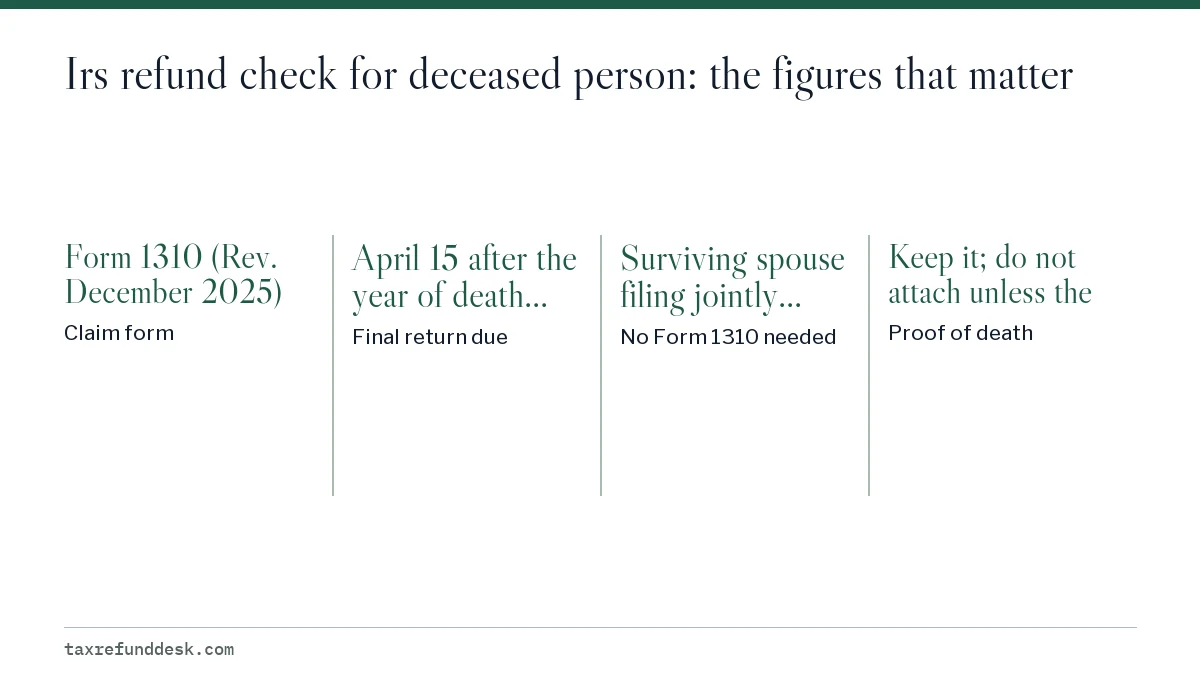
- 01Claim form
- Form 1310 (Rev. December 2025)
- 02Final return due
- April 15 after the year of death (April 15, 2027 for 2026 deaths)
- 03No Form 1310 needed
- Surviving spouse filing jointly; representative attaching a court certificate to the original return
- 04Proof of death
- Keep it; do not attach unless the IRS asks
- 05Joint-name check reissue
- Return it marked VOID with Form 1310 and a written request
Who can claim a refund for someone who died?
Three kinds of people can claim a federal refund owed to someone who has died: a surviving spouse, a personal representative appointed or certified by a court, and, where there is neither, another person who agrees to pay out the refund under the laws of the state where the decedent lived. Form 1310 sorts claimants into these three groups as lines A, B and C.
| Claimant | Typical situation | Form 1310? |
|---|---|---|
| Surviving spouse, joint return | Filing the final joint return for the year of death | No |
| Surviving spouse with a joint-name check | The IRS already issued a check in both names | Yes, line A |
| Court-appointed personal representative, original return | Executor or administrator files the decedent's Form 1040 with the court certificate | No |
| Court-appointed personal representative, amended return or Form 843 | Claiming a refund on Form 1040-X or Form 843 | Yes, line B, with court certificate |
| Anyone else | No will, no court appointment, or an heir handling a small estate | Yes, line C, plus Part II |
A personal representative, for IRS purposes, is the executor or administrator appointed or certified by a court. The Form 1310 instructions say a copy of the will alone is not accepted as proof that you are the representative.
Do I need Form 1310?
You need Form 1310 unless you fit one of two exceptions. According to the December 2025 Form 1310 instructions and IRS Publication 559, you skip it if you are a surviving spouse filing an original or amended joint return with the decedent, or a court-appointed or certified personal representative filing the decedent's original return with a copy of the court certificate attached.
Line C claimants must answer Part II
If you check line C, you answer three yes-or-no questions: whether the decedent left a will, whether a court has appointed or will appoint a personal representative, and whether you will pay out the refund according to the laws of the decedent's state. If a representative has been or will be appointed, that person must file for the refund instead. If you answer no to the state-law question, the IRS will not pay until you send a court certificate or other evidence that state law entitles you to the money.
Proof of death
Line C filers must have proof of death: a copy of the death certificate, or a formal notice from a government office such as the Department of Defense. Do not attach it. Keep it with your records and send it only if the IRS asks.
Filing the final return to claim a refund for a deceased taxpayer
A refund for a deceased taxpayer is normally claimed on the decedent's final Form 1040 or 1040-SR, which reports income from January 1 to the date of death. The IRS says a return must be filed to get back withheld tax or estimated payments, even if the decedent's income was too low to require a return.
- Collect the decedent's W-2s, 1099s and records of estimated payments for the year of death.
- Prepare Form 1040 or 1040-SR as you would for a living person, claiming every credit the decedent qualifies for.
- Write DECEASED, the decedent's name and the date of death across the top of a paper return.
- In the name and address area, enter the decedent's name; for a non-joint return, put the personal representative's name and address in the address field.
- Sign as described below, and attach Form 1310 or the court certificate as your situation requires.
- File by the regular due date, or request an extension; the representative can do this for the decedent.
The final return is due on the same date the decedent's return would have been due had they lived. For someone who died at any point in 2026, that is April 15, 2027, a Thursday. Returns for decedents can be e-filed, and Form 1310 can be e-filed when it is attached to an electronically filed Form 1040, 1040-SR, 1040-NR or 1040-SS.
Who signs the final return
- A court-appointed personal representative signs; on a joint return, the surviving spouse also signs.
- With no representative, a surviving spouse on a joint return signs and writes "Filing as surviving spouse" in the signature area.
- With no representative and no surviving spouse, the person in charge of the decedent's property signs as "personal representative".
A personal representative can also file Form 56, Notice Concerning Fiduciary Relationship, to tell the IRS they are acting for the decedent or the estate. Publication 559 covers the representative's wider duties.
Worked example: a refund with no will and no executor
Suppose a widowed mother died in October 2026. Her employer withheld $2,180 of federal income tax during the year, and her final return shows a tax of $940, so a $1,240 refund is due. She left no will, and no court has appointed anyone. Her son lives in the same state and will share the money with his sister as their state's law directs.
- The son prepares her 2026 Form 1040, marked DECEASED with her name and date of death.
- He completes Form 1310, checks line C, and answers Part II: no will, no representative appointed or expected, and yes, he will distribute the refund under state law.
- He signs the return as personal representative, being the person in charge of her property, and signs Part III of Form 1310.
- He files both by April 15, 2027 and keeps a copy of the death certificate in case the IRS asks for it.
- Once the IRS accepts the claim, it pays the refund to him as the claimant, and he splits it with his sister as state law requires.
Refund figures here are illustrative. The steps come from the Form 1310 instructions and Publication 559.
What if the refund check is in the deceased person's name?
What you do depends on whose names are on the check. Do not sign the decedent's name to deposit it; that is endorsing a payment for someone who can no longer sign.
Check in both spouses' names
A surviving spouse can have a joint-name check reissued in their name alone. Mark the check VOID, and return it with Form 1310 (line A checked) and a written request for reissue to your local IRS office or the service center where you filed. The IRS then mails a new check in your name.
Check in the decedent's name only
The IRS forms describe a reissue procedure only for joint-name checks. If a check is payable to the decedent alone, ask the bank handling the estate whether it will accept it for the estate account; if it will not, call the number on any IRS notice you have, or the IRS, and ask how to return it for reissue to the claimant. Have Form 1310 ready, since the IRS pays a decedent's refund only to a person it recognizes as entitled.
Direct deposit refund for a deceased taxpayer
IRS rules allow a refund to be deposited only into an account in the taxpayer's own name, a spouse's name, or a joint account. If the decedent's individual account has been closed, the bank will usually return the deposit, and the IRS then handles it as a returned deposit. Watch for a CP53-series notice, and see the CP53E notice guide if the refund is frozen for missing bank details.
How long does a refund for a deceased person take?
The IRS does not publish a separate processing time for returns with Form 1310. Standard IRS timelines are about 3 weeks for an e-filed return and 6 weeks or more for a mailed return, and returns that need manual review take longer, according to IRS Tax Topic 152.
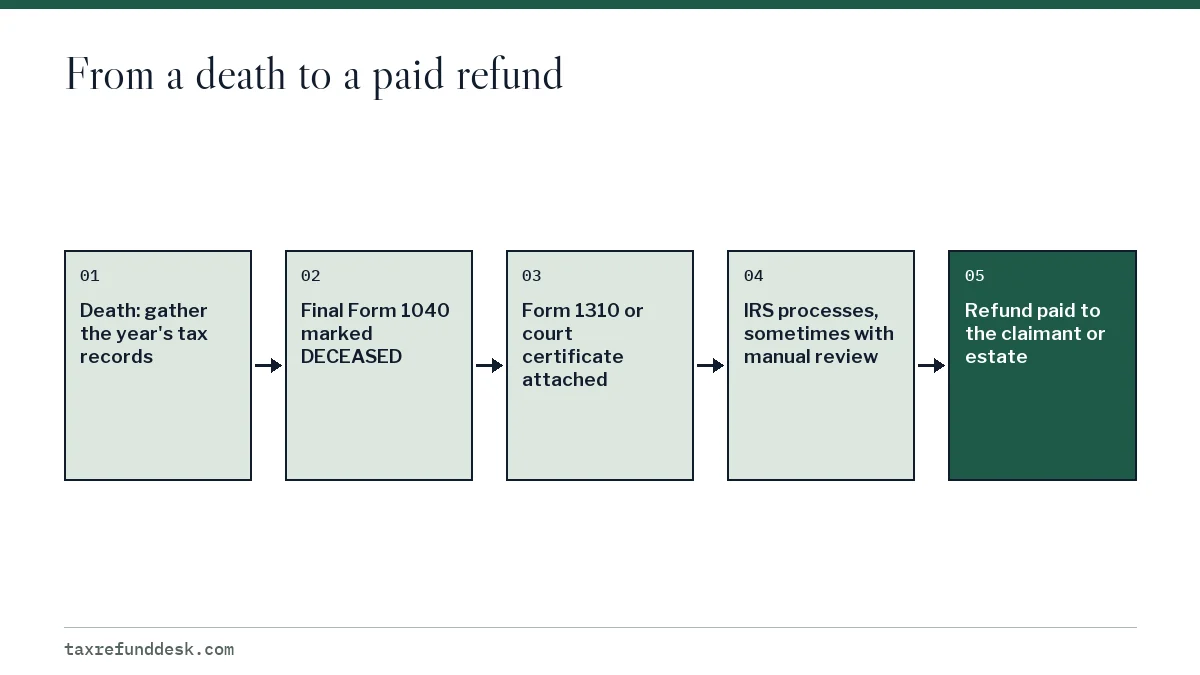
Expect paper filing to be the slower path. A final return with Form 1310 attached, or a line C claim, may need a person at the IRS to review it. If nothing arrives after the normal window has passed, the tax refund not received guide explains how to check status and when a trace makes sense.
There is also an outer deadline. Publication 559 notes the normal period to claim a refund is 3 years after the return was filed or 2 years after the tax was paid, whichever is later, so an older unfiled year may still be claimable if you act in time.
Common mistakes that hold up a decedent's refund
- Attaching a death certificate that nobody asked for, instead of keeping it on file.
- Sending a copy of the will as proof of authority; the IRS requires a court certificate for a personal representative.
- Checking line C when a court has already appointed an executor, who must file instead.
- Forgetting to mark the paper return DECEASED with the name and date of death.
- Filing one Form 1310 for a joint return when both spouses have died; each spouse needs a separate Form 1310, both attached to the return.
- Depositing a check made out to the decedent by signing their name.
Step by step
Identify who can claim
Decide whether you are a surviving spouse, a court-appointed representative, or another claimant under state law.
Gather records
Collect W-2s, 1099s, estimated payment records, the court certificate if any, and proof of death to keep on file.
Prepare the final return
File Form 1040 or 1040-SR for the year of death, marked DECEASED with the name and date of death on paper returns.
Add Form 1310 if required
Attach Form 1310 unless you are a surviving spouse filing jointly or a representative attaching a court certificate to the original return.
File by the due date
File by April 15 of the year after death, e-filing where possible.
Distribute the refund
Pay the refund to the estate or heirs as state law requires.
Common questions
Can I cash a tax refund check made out to my deceased parent?
No, you should not sign a deceased person's name. The refund must go to someone entitled to it, which usually means filing Form 1310 or acting as the court-appointed representative, and having the payment made to you or the estate.
Does a surviving spouse need Form 1310?
Not when filing an original or amended joint return with the deceased spouse. A surviving spouse does use Form 1310, line A, to have a check issued in both names reissued in their name alone.
Can Form 1310 be e-filed?
Yes, when it is attached to an electronically filed Form 1040, 1040-SR, 1040-NR or 1040-SS. If you send it separately, mail it to the service center where the original return was filed.
Do I need a court appointment to claim a small refund for a deceased relative?
Not always. If no representative has been or will be appointed, you can claim as a line C filer on Form 1310, as long as you will distribute the refund under your state's law.
When is the final tax return due for someone who died in 2026?
April 15, 2027, the same date their return would have been due had they lived. An extension can be requested on the decedent's behalf.
What if both spouses on a joint return have died?
Complete a separate Form 1310 for each spouse and attach both to the return, according to the Form 1310 instructions.
Sources
- Form 1310 (Rev. December 2025) with instructions irs.gov
- About Form 1310 irs.gov
- Publication 559, Survivors, Executors, and Administrators irs.gov
- File the final income tax returns of a deceased person irs.gov
- Tax Topic 152, Refund information irs.gov
We check figures against these official pages. Rules change; confirm anything that affects a deadline or payment with the agency before you act.
Tell us what happened
Describe your situation and our editors will use it to improve this guide. If you leave your email, we may reply with a pointer to the right page or official contact. We never share your details.
Related guides
 Tax Refund Not Received: Steps to Find a Missing Refund
If your tax refund was not received, first confirm in Where's My Refund that the IRS actually sent it. A direct deposit counts as…
IRS Refund Received in Error: How to Return It Safely
If you have an IRS refund received in error, return it promptly: write Void on the back of an uncashed check and mail it within 2…
IRS CP53E Notice: Add Bank Details to Release Your Refund
A CP53E notice tells you the IRS owes you a refund but is holding it because your bank information was missing, invalid or reject…
Refund Sent to a Closed Account? What Happens and How Long
A tax refund sent to a closed bank account is normally not lost: the bank rejects the deposit and the money goes back to the Trea…
Lost IRS Refund Check: How to Get a Replacement Check
To replace a lost refund check from the IRS, request a refund trace once 4 weeks have passed since the check was issued. If the c…