
Topic
IRS refund direct deposit: the rules, limits and your options
IRS refund direct deposit is now the standard way individual refunds are paid: since September 30, 2025 the IRS has been phasing out paper refund checks under Executive Order 14247. The deposit must go to a U.S. account in your name, your spouse's name or a joint account, and no more than three electronic refunds can land in one account.
8 guides in this topic Updated September 19, 2026
- Does the IRS Pay Interest on Late Refunds? The 45-Day RuleYes. The IRS pays interest on a late refund when it takes longer than its administrative window, typically 45 days, to issue it. Interest then genera…
- Form 8888: How to Split Your Tax Refund Into AccountsForm 8888, Allocation of Refund, tells the IRS to split one federal refund by direct deposit into two or three accounts at US financial institutions,…
- Get an IRS Refund Without a Bank Account: Your OptionsYou can get an IRS refund without a bank account by having it deposited to a prepaid debit card or mobile app account that has its own routing and ac…
- IRS Paper Refund Checks: Phase-Out Rules and ExceptionsThe IRS began phasing out paper checks for individual tax refunds on September 30, 2025, under Executive Order 14247. It still mails a check in limit…
- IRS Refund Interest Rate: Current Quarter and 2027 OutlookThe IRS refund interest rate for individuals is 7% a year, compounded daily, for the quarter from October 1 to December 31, 2026, unchanged from July…
- Is IRS Refund Interest Taxable? 1099-INT and Where to ReportYes, refund interest is taxable income, even though the federal refund itself is not. IRS Publication 550 treats interest on tax refunds as taxable i…
- Refund Advance Loan: How It Works and What to CheckA refund advance loan is a short-term loan that a tax preparation company arranges against part of your expected federal refund, repaid automatically…
- Update Refund Bank Info in Your IRS Online AccountYou can add or change the IRS direct deposit account for a refund online only when the IRS has frozen that refund and sent a CP53E notice. You then h…
How IRS refund direct deposit works now
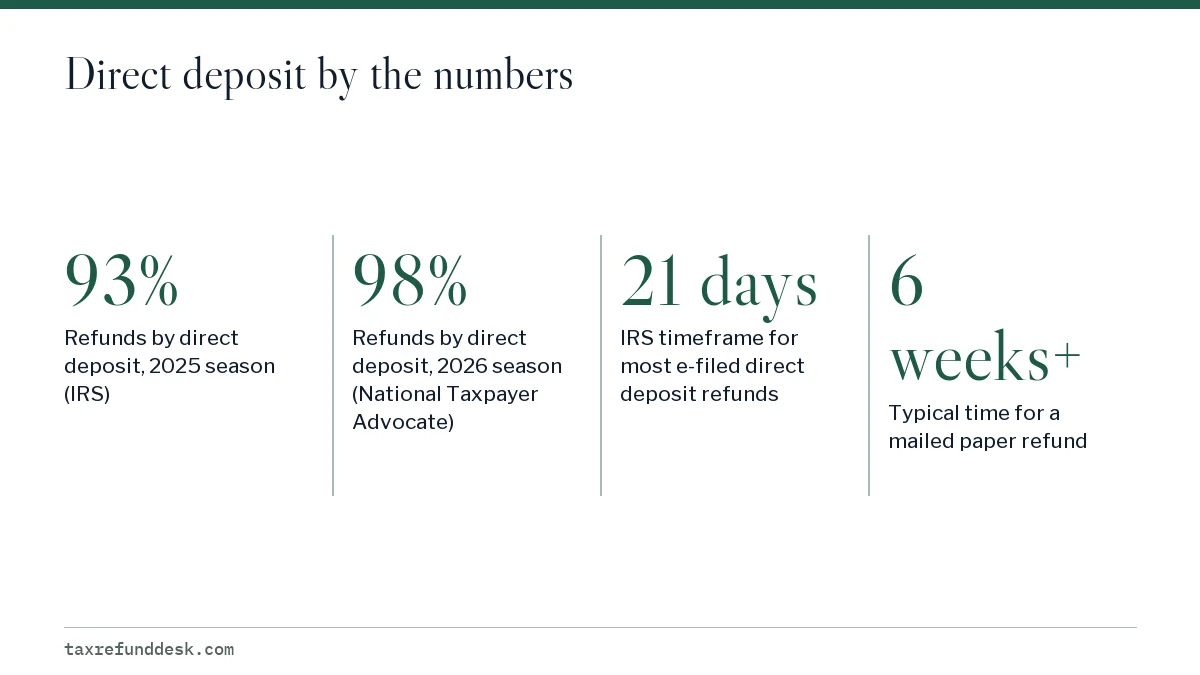
IRS refund direct deposit means the Treasury sends your federal refund electronically to a bank account, prepaid card or app account using the routing and account numbers you put on your return. It is the fastest delivery method: the IRS says most e-filed returns with direct deposit and no problems are refunded within 21 days.
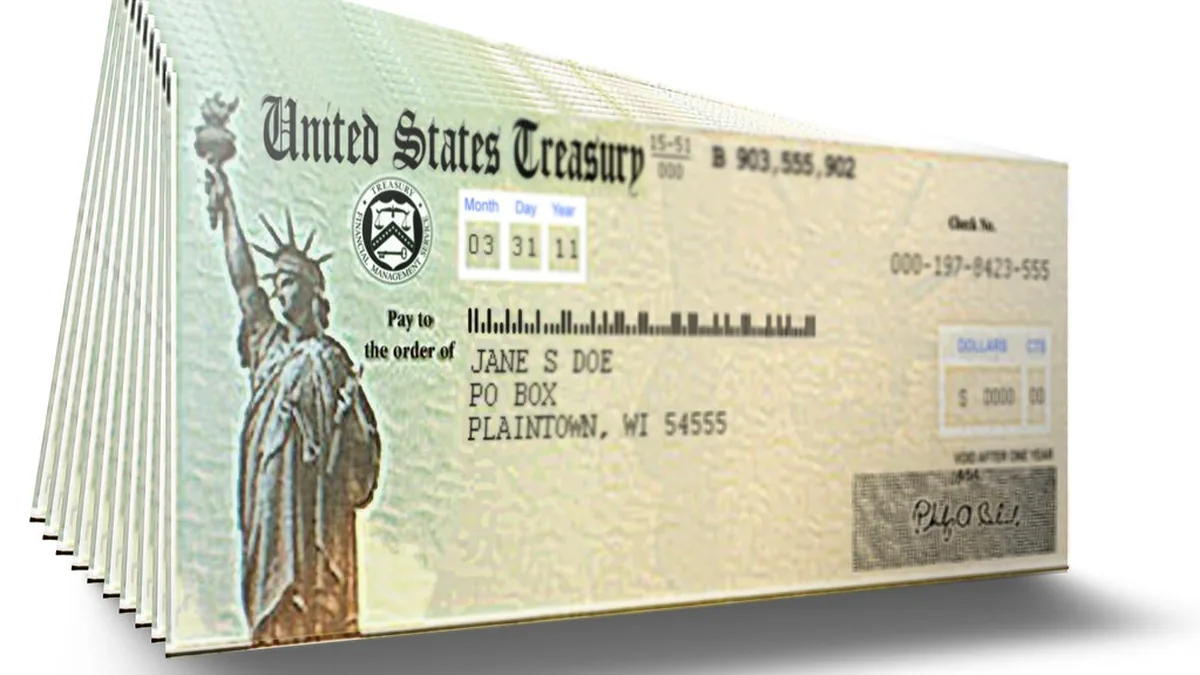
Direct deposit is no longer just the faster choice. Executive Order 14247, signed March 25, 2025, told federal agencies to stop paying by paper check, and the IRS began phasing out paper refund checks for individuals on September 30, 2025. The full history and the remaining exceptions are on IRS paper checks phase-out.
Does the IRS only do direct deposit now?
Almost, but not completely. The IRS still accepts returns with no bank details, and it has not changed how you file. What changed is what happens next: the IRS processes the return, then holds the refund until you give it an account or qualify for a paper check.
According to the Taxpayer Advocate Service, a refund on a return filed without bank information is temporarily frozen. The IRS then mails a CP53E notice, and you have 30 days to add an account in your IRS Individual Online Account or pick a paper-check exception. If you do nothing, the IRS issues a paper check after 6 weeks.
Which accounts can receive a direct deposit tax refund?
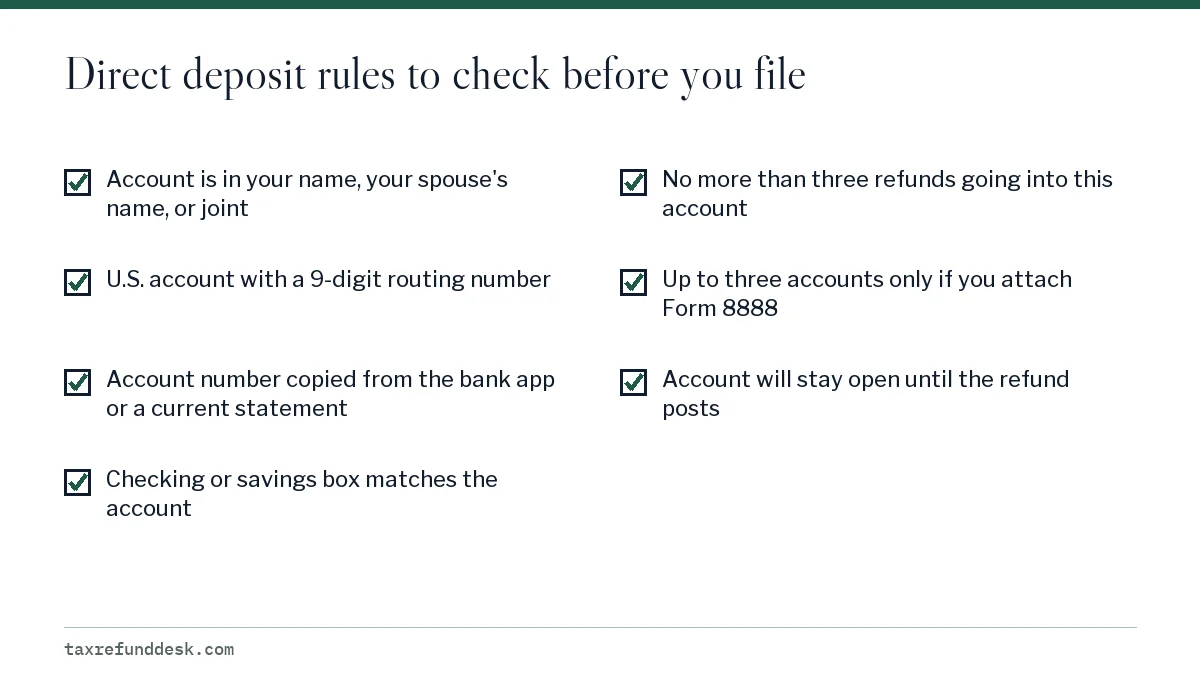
A direct deposit tax refund can go to any U.S. account that has a routing number and an account number, as long as the account belongs to you. The IRS direct deposit page lists checking and savings accounts, individual retirement arrangements (IRAs), and prepaid debit cards or mobile app accounts that issue routing and account numbers.
| Rule | What it means in practice |
|---|---|
| Name on the account | Yours, your spouse's, or a joint account with both names |
| Location | A U.S. bank or U.S.-affiliated account; foreign accounts are not accepted |
| Refunds per account | No more than three electronic refunds into one account or card |
| Numbers needed | 9-digit routing number plus the account number |
| Account type | Checking or savings box on the return must match the account |
The three-refund cap matters most for families and for preparers who route several returns into one card. A fourth refund aimed at the same account is not deposited. Under the rules in place for the 2026 season, the Taxpayer Advocate Service reports that most deposits refused by a bank are frozen rather than reissued automatically as checks, so the taxpayer has to act.
Can my refund go to someone else's account?
No. The IRS says a refund should be deposited only into an account in your own name, your spouse's name, or both names if it is joint. A parent's, partner's or friend's account does not qualify, even with their permission.
Banks can reject a deposit when the name on the return does not match the account holder. When that happens the money comes back to the IRS, and you are left waiting for a notice. The IRS also says it is not responsible for account errors made by you or your preparer, which is why a deposit to the wrong account can take months to sort out and may require a refund trace on Form 3911.
Splitting a refund and other IRS direct deposit information
You can divide one refund among up to three accounts by attaching Form 8888, Allocation of Refund. Each account must meet the same ownership rule, and the total of the three amounts must equal the refund on your return. The mechanics, and what happens when an offset shrinks a split refund, are on Form 8888 split refunds.
Where the IRS direct deposit information goes on your return
On Form 1040 the routing number, account type and account number go in the refund section just below the amount you want refunded. Tax software shows the same fields on its refund screen. Copy the numbers from your bank's app or a recent statement, not from a check you have not used in years, because banks merge and change routing numbers.
Changing the account after you file
Once an e-filed return is accepted, you cannot edit its bank details. The exception is a refund the IRS has frozen and flagged with a CP53E notice: then you get one chance to add or replace the account in your online account. The step-by-step version is at update bank info in your IRS online account.
If you do not have a bank account
You still have electronic options. The IRS points unbanked filers to prepaid debit cards and mobile payment apps that provide routing and account numbers, and to FDIC GetBanked and MyCreditUnion.gov for finding low-cost accounts. The costs and trade-offs are compared on how to get a refund without a bank account.
A paper check is still possible under limited exceptions for hardship, legal or procedural requirements, or cases where no electronic option exists. Expect it to be slower: mailed refunds generally take 6 weeks or more, and a refund frozen for missing bank details adds the 6-week wait after a CP53E.
Getting money early and getting paid interest
Two other refund decisions sit next to direct deposit. Some preparers offer a loan against your expected refund, which the lender repays out of the deposit; read how a refund advance loan works before signing one.
At the other end, if the IRS takes too long, it may owe you. The IRS generally has 45 days to pay a refund without interest, and after that interest runs at the overpayment rate, which is 7% a year, compounded daily, for the quarter beginning October 1, 2026 (see the current refund interest rate). See interest on late refunds for how it is calculated and whether refund interest is taxable.
What changes for direct deposit in the 2027 season?
The 2027 filing season covers tax year 2026 returns, and the statutory deadline is Thursday, April 15, 2027. As of September 2026, the IRS has not announced the 2027 opening date or any new direct deposit procedures; it usually publishes the season calendar in January. Plan on the 2026 rules continuing: include bank details, or expect a frozen refund and a CP53E.
- Check that the account will still be open in February and March 2027.
- Confirm your routing number with your bank if it has merged or been acquired this year.
- If you have no account, set up a card or app with routing and account numbers before you file.
- Create your IRS Individual Online Account now, since it is where a CP53E is answered.
Common questions
Does the IRS require direct deposit for tax refunds?
Direct deposit is now the default, not a legal requirement for filing. The IRS still processes returns without bank details, but it freezes the refund and sends a CP53E asking for an account. A paper check is issued only under limited exceptions or if you do not respond within the notice period.
How many tax refunds can go into one bank account?
Three. The IRS will not deposit more than three electronic refunds into one account or prepaid card in a year, so a fourth refund aimed at the same account will not be deposited.
Can I put my tax refund in my boyfriend's or parent's account?
No. The account must be in your name, your spouse's name, or a joint account that includes you. A deposit to another person's account is likely to be rejected and delayed.
Is direct deposit faster than a paper check for tax refunds?
Yes. The IRS says most e-filed refunds with direct deposit arrive within 21 days, while mailed checks take 6 weeks or more. In 2025 the IRS said paper checks were over 16 times more likely than electronic payments to be lost, stolen, altered or delayed.
Can I change my direct deposit information after my return is accepted?
Generally no. The only online route is when the IRS freezes the refund and sends a CP53E; then you get one chance to add or update the account in your IRS Individual Online Account within 30 days.
Sources
- Questions and answers about Executive Order 14247
- IRS to phase out paper tax refund checks starting with individual taxpayers
- Get your refund faster: direct deposit to one, two or three accounts
- Direct deposit refunds and refund offsets, Taxpayer Advocate Service
- National Taxpayer Advocate issues 2026 mid-year report to Congress
- Tax Topic 152, Refund information