
IRS paper checks: how the refund check phase-out works
Short answer
The IRS began phasing out paper checks for individual tax refunds on September 30, 2025, under Executive Order 14247. It still mails a check in limited cases: hardship, legal or procedural requirements, no electronic option, or when a taxpayer does not answer a CP53E notice within 30 days, in which case a check follows after 6 weeks.
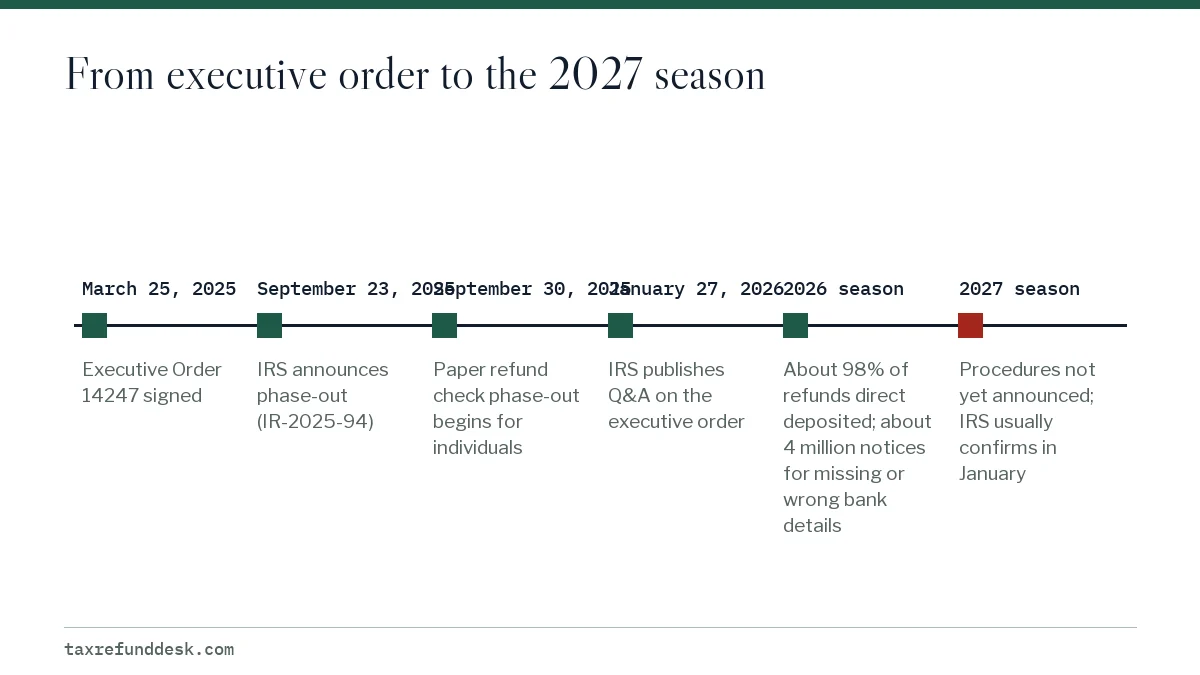
- 01Executive Order 14247 signed
- March 25, 2025
- 02Paper refund check phase-out began
- September 30, 2025
- 03Share of refunds paid by check, 2025 season
- 7% (IRS)
- 04Paper checks vs electronic payments
- Over 16 times more likely to be lost, stolen, altered or delayed (IRS)
- 05Check after an unanswered CP53E
- Issued after 6 weeks
Is the IRS phasing out paper checks?
Yes. The IRS is phasing out paper checks for individual refunds, a process that started on September 30, 2025. The legal basis is Executive Order 14247, Modernizing Payments To and From America's Bank Account, signed March 25, 2025, which directs federal agencies to move payments to electronic methods. The IRS announced the change in news release IR-2025-94 on September 23, 2025.
The phase-out is not a ban. IRS paper checks still go out in a smaller set of cases, and nobody loses a refund by filing without bank details. What changed is the default: a refund with nowhere electronic to go now waits instead of being printed as a check automatically.
Why the IRS is not issuing paper checks by default
The IRS gave two reasons in its September 2025 announcement: cost and loss. It said paper checks are more than 16 times more likely than electronic payments to be lost, stolen, altered or delayed, and that checks take 6 weeks or more to arrive compared with under 21 days for most e-filed direct deposits.
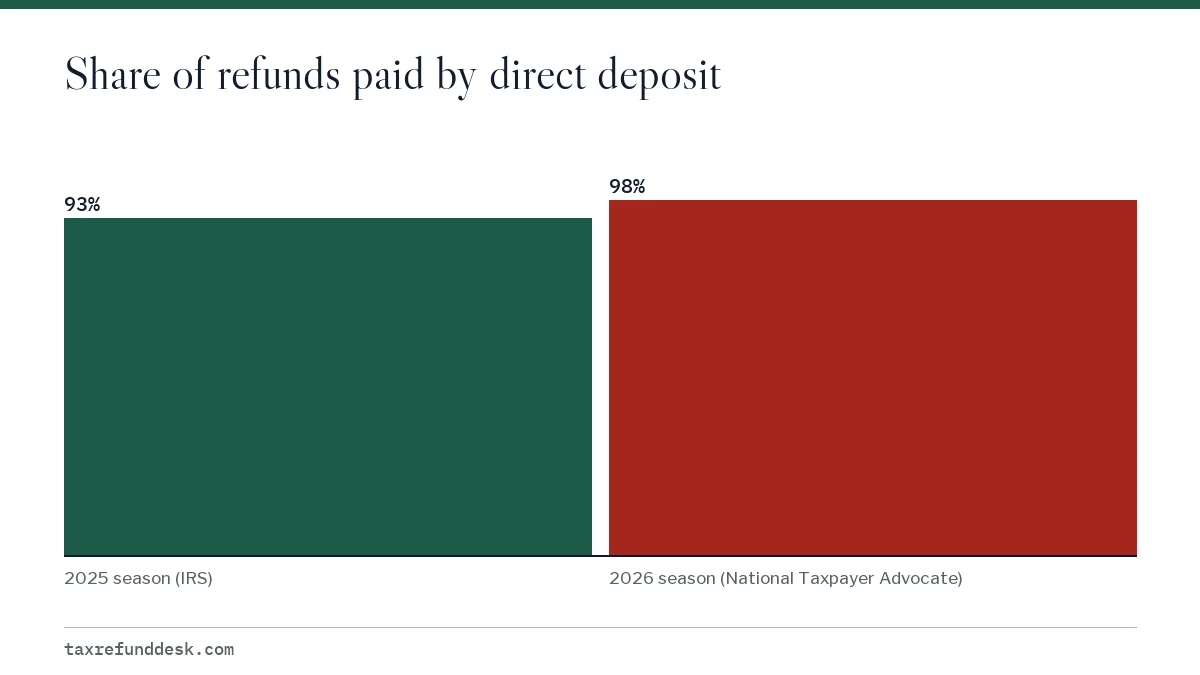
Checks were already a small share of refunds. Of 93.5 million individual refunds in the 2025 season, the IRS says 93% (about 87 million) went by direct deposit and 7% by check. In the 2026 season, the first under the phase-out, the National Taxpayer Advocate reports that about 98% of refunds were direct deposited.
How IRS paper checks work for 2027 returns
For tax year 2026 returns filed in the 2027 season, expect the process used in 2026 unless the IRS announces otherwise; as of September 2026 no new 2027 procedure has been published. The IRS usually confirms season details in January. Filing itself does not change: the IRS Q&A on the executive order says it is making no changes to how returns are filed, so paper returns are still accepted.
- You file a return that shows a refund but has no bank details, or has details the bank rejects.
- The IRS processes the return and freezes the refund.
- The IRS mails a CP53E notice. You have 30 days from the notice date to act.
- You add an account in your IRS Individual Online Account, or request a paper-check exception there.
- If you do nothing, the IRS issues a paper check after 6 weeks, mailed to the address on your return.
A worked example shows the cost of waiting. A paper return mailed in mid-February is not even visible in Where's My Refund for about 4 weeks. Add processing, a CP53E, and the 6-week fallback, and a check-by-default refund can land in summer rather than spring. Adding an account when the notice arrives cuts that to the 2 to 5 business days the IRS gives for the status to update.
Who can still get a paper check from the IRS?
The IRS says it will issue a limited number of paper checks where no alternative is available. Its Q&A on Executive Order 14247 frames the exceptions in three groups.
| Exception | Examples that may fit |
|---|---|
| Hardship | A person who cannot open or use any account or card, for example because of age, disability or location |
| Legal or procedural requirement | Situations where the law or an IRS procedure calls for a check |
| No electronic option available | No bank, card or app can receive the payment |
The IRS has not published a detailed list of qualifying facts, so the examples in the right-hand column are illustrations rather than IRS categories. The National Taxpayer Advocate's 2026 mid-year report names the groups most affected by the change: unbanked and underbanked people, lower-income filers, some older taxpayers, and people living overseas.
How to request an IRS paper checks refund exception
The request is made through your IRS Individual Online Account after a CP53E arrives. The notice creates an account notification where you can either enter bank details or choose the paper-check exception.
The Taxpayer Advocate's report found the 2026 process had gaps: many recipients had no online account, the notice left out information needed for a waiver request, and a phone alternative existed that the notice did not mention. If you cannot create an online account and you face hardship, the Taxpayer Advocate Service may be able to help.
Does the IRS still mail refund checks in other situations?
Yes, in a few. The CP53E page says that if the account you add is rejected, the IRS will issue a paper check. A CP53 notice also still exists: it tells you the IRS could not deposit the refund and is mailing a check, which should arrive within 4 weeks of the notice date.
Replacement checks for lost or uncashed refunds also continue under the refund trace process. And if a check is delayed long enough, interest may apply; the IRS generally pays interest when a refund goes out more than 45 days after the due date or filing date, whichever is later. Whether that interest is taxable is covered on is refund interest taxable.
For the full set of deposit rules, including the three-refund limit per account, start at the IRS refund direct deposit guide.
Common questions
Will the IRS still send paper checks in 2027?
In limited cases, yes. As of September 2026 the IRS has announced no change for the 2027 season, so expect checks only for exceptions such as hardship or no electronic option, or after an unanswered CP53E notice.
What happens if I file my taxes without bank information?
The IRS processes the return but freezes the refund and mails a CP53E. You have 30 days to add an account or request a paper-check exception in your online account; with no response, a paper check is issued after 6 weeks.
Can I still file a paper tax return if paper checks are ending?
Yes. The IRS says the executive order does not change how returns are filed. Only the way refunds are paid, and eventually how payments to the IRS are made, is moving to electronic.
Why is my IRS refund coming as a paper check?
Usually because the bank rejected the deposit, you did not answer a CP53E within the notice period, or you qualified for an exception. A CP53 notice confirms a check is being mailed and says to allow 4 weeks.
Does the paper check phase-out apply to payments I send the IRS?
The IRS still accepts checks for payments, but it strongly encourages electronic payment and says reliance on checks will be reduced over time, with exceptions for hardship and legal requirements.
Sources
- IRS to phase out paper tax refund checks starting with individual taxpayers irs.gov
- Questions and answers about Executive Order 14247 irs.gov
- Understanding your CP53E notice irs.gov
- Understanding your CP53 notice irs.gov
- National Taxpayer Advocate issues 2026 mid-year report to Congress irs.gov
- Interest, IRS irs.gov
We check figures against these official pages. Rules change; confirm anything that affects a deadline or payment with the agency before you act.
Tell us what happened
Describe your situation and our editors will use it to improve this guide. If you leave your email, we may reply with a pointer to the right page or official contact. We never share your details.
Related guides
 IRS Refund Direct Deposit: Rules, Options and Limits
IRS refund direct deposit is now the standard way individual refunds are paid: since September 30, 2025 the IRS has been phasing…
Get an IRS Refund Without a Bank Account: Your Options
You can get an IRS refund without a bank account by having it deposited to a prepaid debit card or mobile app account that has it…
IRS CP53E Notice: Add Bank Details to Release Your Refund
A CP53E notice tells you the IRS owes you a refund but is holding it because your bank information was missing, invalid or reject…
Update Refund Bank Info in Your IRS Online Account
You can add or change the IRS direct deposit account for a refund online only when the IRS has frozen that refund and sent a CP53…
Is IRS Refund Interest Taxable? 1099-INT and Where to Report
Yes, refund interest is taxable income, even though the federal refund itself is not. IRS Publication 550 treats interest on tax…