
Form 8888: how to split your tax refund into two or three accounts
Short answer
Form 8888, Allocation of Refund, tells the IRS to split one federal refund by direct deposit into two or three accounts at US financial institutions, such as a checking account, a savings account and an IRA. Each deposit must be at least $1 and the total must equal your refund. Since the December 2025 revision it no longer buys savings bonds.
- 01Maximum accounts
- 3
- 02Minimum per deposit
- $1
- 03Current revision
- December 2025 (continuous use)
- 04Refunds allowed into one account per year
- 3
- 05Savings bond purchases
- Discontinued
What Form 8888 does
Form 8888 is the IRS form that divides a single federal income tax refund among two or three accounts. Its full name is Form 8888, Allocation of Refund, and it attaches to Form 1040, 1040-SR, 1040-SS or 1040-NR. If you want the whole refund in one account, skip it and enter the bank details on your return instead.
The accounts can be at a bank, credit union, brokerage or mutual fund company in the United States. Besides checking and savings accounts, the form instructions allow a traditional IRA, Roth IRA or SEP IRA (not a SIMPLE IRA), a health savings account (HSA), an Archer MSA, or a Coverdell education savings account.
What changed in the December 2025 revision
- The option to send part of a refund to TreasuryDirect or buy paper savings bonds is gone. The form now only splits a direct deposit refund.
- Line 4 is marked reserved for future use, so the form holds three deposit lines and a total.
- The form became a continuous-use form: the IRS updates it only when needed, so the calendar year field is filled in by you.
- The instructions point to Executive Order 14247, under which the IRS generally stopped issuing paper refund checks from October 2025 unless an exception applies.
If you e-file, your tax software builds the split for you from its refund screen; you do not fill in a separate paper form. The IRS direct deposit page describes Form 8888 as the route for paper filers.
How many accounts can you split a tax refund into?
You can split a tax refund into a maximum of three accounts with Form 8888. Each of lines 1a, 2a and 3a must be at least $1, and line 5 must equal the refund shown on your return, to the dollar. A mismatch on line 5 can delay the refund.
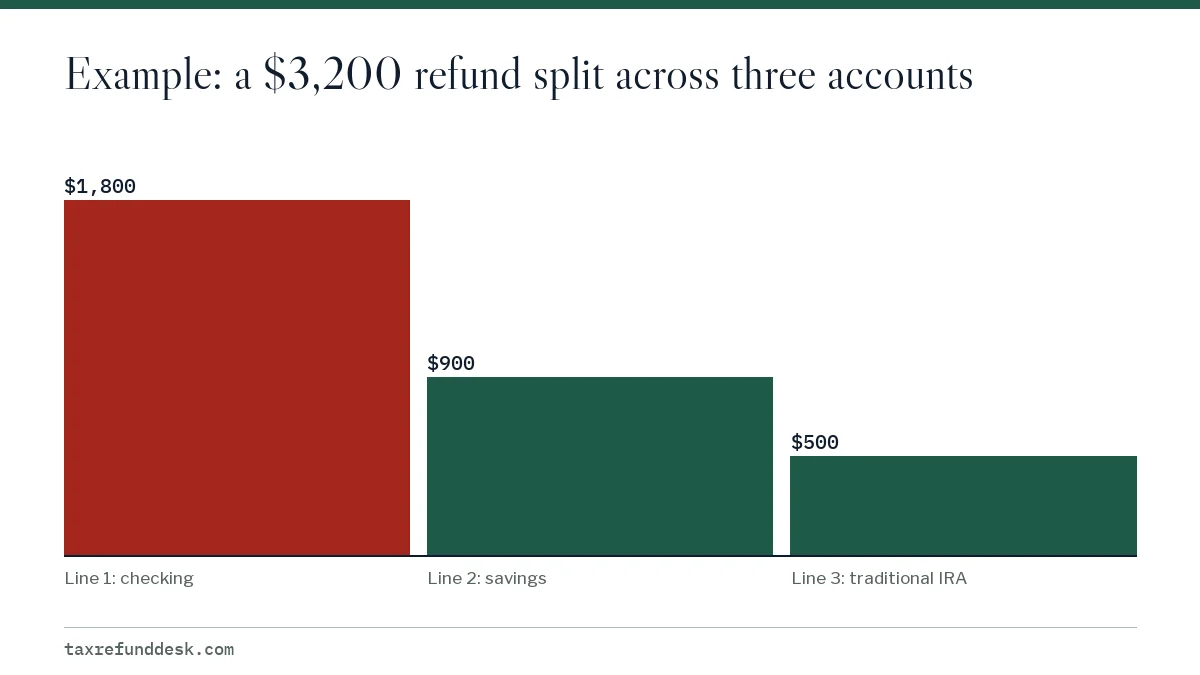
In the example above, a $3,200 refund is split $1,800 to checking on line 1, $900 to savings on line 2 and $500 to a traditional IRA on line 3. The order matters, because the IRS takes corrections and some offsets from the last line first, as explained below.
Form 8888 instructions, line by line
The Form 8888 instructions ask for the same four pieces of information for each account: an amount, a routing number, an account type and an account number. Here is what each field needs, based on the December 2025 instructions.
| Lines | What goes there | Rule to watch |
|---|---|---|
| 1a, 2a, 3a | Dollar amount for each account | At least $1 each |
| 1b, 2b, 3b | Routing number | Nine digits; the first two must be 01 to 12 or 21 to 32 |
| 1c, 2c, 3c | Checking or Savings box | Check one box only; for an IRA or HSA, ask the institution which box |
| 1d, 2d, 3d | Account number | Up to 17 letters and numbers; keep hyphens, drop spaces and symbols |
| 4 | Reserved | Leave blank |
| 5 | Total of lines 1a, 2a and 3a | Must equal the refund on your return |
Where to find the right routing number
The routing number printed on a check is not always the one your bank uses for incoming electronic deposits. Ask the bank for its direct deposit routing number if your deposit slips show a different number, if the account is a savings account without checks, or if your checks say they are payable through another institution.
Do not correct the form by hand
The IRS rejects an allocation where any number or letter on lines 1a through 3d has been crossed out or covered with correction fluid. If you make a mistake on a paper Form 8888, print a clean copy.
Rules for each account on a split tax refund
Every account on a split tax refund must be in your name, your spouse's name, or both if it is a joint account. The instructions specifically warn against routing part of a refund to a tax preparer's account to pay the preparation fee.
- Three-refund limit. No more than three electronic refunds can go to one account or prepaid debit card in a year. The IRS says taxpayers over the limit get a notice and a paper refund instead.
- Joint refunds. If you file jointly and split the refund, your spouse may receive part of it, and a bank may refuse to put a joint refund into an account held by one person.
- Injured spouse claims. You cannot split a refund across accounts if you file Form 8379, Injured Spouse Allocation. See injured spouse relief.
- US accounts only. The institution must be in the United States.
Can you split a refund onto a prepaid card?
Yes, a reloadable prepaid debit card can be one of the accounts if the card provider issues it a routing number and an account number and the card is in your name. The IRS tells you to confirm with the card provider which numbers to use. The card still counts toward the three-refund limit. For other options without a bank, see getting a refund without a bank account.
Extra steps for an IRA deposit
Open the IRA before you file, and tell the trustee or custodian which tax year the deposit is for. Otherwise it can treat a deposit made in 2027 as a 2027 contribution. If you claim the deposit as a 2026 contribution, check that it actually reached the IRA by the April 2027 due date, not counting extensions; if it did not, you must amend your return and remove the deduction.
What happens if one account rejects the deposit?
If one or two deposits are rejected but at least one goes through, the rejected amount is added to the last valid account on the form. For example, if you leave the account number off line 3, the line 3 amount goes into the line 2 account, and lines 1 and 2 are paid as listed.
The Form 8888 instructions list these common reasons a deposit is rejected:
- The name on the account does not match the name on the refund and the bank will not accept a mismatch.
- A joint refund is sent to an individual account and the bank does not allow it.
- Three tax refunds have already gone to that account or prepaid card this year.
- The routing or account number is invalid.
- Numbers on lines 1a through 3d were crossed out or whited out.
If every account rejects the refund
When no account accepts the money, the Taxpayer Advocate Service reported in April 2026 that the IRS now freezes most rejected direct deposits instead of automatically mailing a check, and you must act to release it. Watch for a CP53E notice, which gives you one chance to add a working account online; see the CP53E notice and updating bank info in your IRS online account. The IRS is not responsible for a refund lost to a wrong account number, which is covered in refund sent to the wrong account.
How offsets and math errors change a split refund
Offsets and math error corrections are not spread evenly across your accounts. The instructions set a fixed order, and the order depends on who takes the money.
| Change to the refund | Account affected first | Then |
|---|---|---|
| Math error increases the refund | The last account listed gets the extra | Not applicable |
| Math error decreases the refund | Line 3 | Line 2, then line 1 |
| IRS offset for past-due federal tax | Line 3 | Line 2, then line 1 |
| Bureau of the Fiscal Service offset (state tax, child support, spousal support, federal non-tax debt) | Account with the lowest routing number | Next lowest, then highest |
| Math error appeal upheld | Refund paid to line 1 | Not applicable |
Worked example with the $3,200 split
Say the IRS offsets $600 for a past-due federal tax balance. The $500 IRA deposit on line 3 is cancelled and the line 2 savings deposit drops from $900 to $800. Checking still gets $1,800.
Now say instead the Bureau of the Fiscal Service takes $600 for a state tax debt under the Treasury Offset Program. That comes out of whichever of the three accounts has the lowest routing number, regardless of line order. If that is the IRA, the IRA deposit disappears and $100 comes from the next-lowest routing number. More on how these debts are collected is in tax refund offsets.
When a split refund is the wrong choice
A split refund works best when you expect the full refund and no offsets. If you know a state tax debt or child support balance will be taken, the reductions follow routing numbers rather than your line order, so a planned IRA or HSA contribution may never arrive. If you plan to borrow against the refund, read how a refund advance loan works first, since the advance is repaid out of the refund deposit. For single-account direct deposit rules, see IRS refund direct deposit.
Step by step
Confirm you qualify
Make sure you want two or three accounts, all in your name or your spouse's, and that you are not filing Form 8379.
Collect account details
Get the direct deposit routing number and full account number for each account from the bank, not from an old check.
Order the accounts
Put the account you would accept the whole refund in on the last line you use.
Enter the amounts
Enter at least $1 on each of lines 1a, 2a and 3a, and check one account type box per line.
Check the total
Make line 5 equal the refund on your return and the sum of the deposit lines.
Attach and file
Attach Form 8888 to your paper return, or complete the split screen in your tax software before e-filing.
Common questions
Can I use Form 8888 to buy savings bonds with my refund?
No. The December 2025 revision states the savings bond purchase program through tax refunds has been discontinued, both for TreasuryDirect deposits and paper bonds. Form 8888 now only splits a direct deposit.
Do I need Form 8888 if I e-file?
Not as a separate paper form. Tax software asks how you want the refund split and sends the allocation with your e-filed return.
Can I split my refund between my account and my child's account?
No. Every account must be in your name, your spouse's name, or a joint account of the two of you.
Can I change the Form 8888 split after filing?
Not once an e-filed return is accepted. The only later chance to add bank details is if the IRS freezes the refund and sends a CP53E notice.
What happens if line 5 does not match my refund?
Line 5 must equal both the refund on your return and the sum of lines 1a, 2a and 3a. If it does not, the refund may be delayed.
Can I split a refund into an HSA?
Yes. An HSA is one of the account types the Form 8888 instructions list. Ask the HSA custodian whether to check Checking or Savings, and tell it which tax year the deposit is for if you are counting it as a contribution.
Sources
- IRS: About Form 8888, Allocation of Refund irs.gov
- Form 8888 (Rev. December 2025) with instructions irs.gov
- IRS: Direct deposit of refunds to one, two or three accounts irs.gov
- Taxpayer Advocate Service: Direct deposit refunds and refund offsets taxpayeradvocate.irs.gov
We check figures against these official pages. Rules change; confirm anything that affects a deadline or payment with the agency before you act.
Tell us what happened
Describe your situation and our editors will use it to improve this guide. If you leave your email, we may reply with a pointer to the right page or official contact. We never share your details.
Related guides
 IRS Refund Direct Deposit: Rules, Options and Limits
IRS refund direct deposit is now the standard way individual refunds are paid: since September 30, 2025 the IRS has been phasing…
Update Refund Bank Info in Your IRS Online Account
You can add or change the IRS direct deposit account for a refund online only when the IRS has frozen that refund and sent a CP53…
Refund Advance Loan: How It Works and What to Check
A refund advance loan is a short-term loan that a tax preparation company arranges against part of your expected federal refund,…
Tax Refund Offset: Why Your Refund Was Taken and Next Steps
A tax refund offset happens when the government uses some or all of your federal refund to pay a past-due debt, such as child sup…
IRS CP53E Notice: Add Bank Details to Release Your Refund
A CP53E notice tells you the IRS owes you a refund but is holding it because your bank information was missing, invalid or reject…