
Injured spouse Form 8379: how to get your share of a joint refund back
Short answer
Injured spouse Form 8379 lets a spouse on a joint return recover their share of a refund that was, or will be, taken for the other spouse's past-due debt. You can attach it to the joint return or file it later. The IRS says to allow about 11 weeks if e-filed with the return, 14 weeks on paper, and 8 weeks if filed on its own.
- 01Form
- Form 8379, Injured Spouse Allocation
- 02Covers debts for
- Federal tax, state income tax, state unemployment, child support, federal non-tax debt
- 03Processing, e-filed with return
- About 11 weeks
- 04Processing, paper with return
- About 14 weeks
- 05Processing, filed separately later
- About 8 weeks
- 06Deadline
- 3 years from the return due date, or 2 years from paying the tax, whichever is later
What injured spouse Form 8379 does
Injured spouse Form 8379 is the IRS form a married person files when a joint refund pays a debt that belongs only to the other spouse. The IRS treats the refund as belonging to both of you, so an offset can take all of it. The injured spouse allocation splits the refund back into two shares and returns the one tied to your own income, withholding and credits.
The form does not cancel the debt or reduce what your spouse owes. It only protects your part of the overpayment. Your spouse's share still goes to the creditor.
An injured spouse claim is not handled by the agency that received the money. The IRS reviews the form, figures each share and pays the injured spouse. That is why it is a different path from disputing an offset, which is covered in our tax refund offset guide.
Who qualifies as an injured spouse?
Part I of the form walks you through eligibility. In practice you need all three of the following.
- You filed, or will file, a joint return with the spouse who owes the debt.
- All or part of your share of the overpayment was, or is expected to be, applied to your spouse's legally enforceable past-due federal tax, state income tax, state unemployment compensation debt, child support, or federal non-tax debt such as a student loan.
- You are not legally obligated to pay that debt yourself, which the form asks directly in Part I.
The third condition is where most claims fail. If you co-signed the loan, owe the state tax jointly, or the debt is a joint federal tax balance from a year you filed together, you are liable and do not qualify. You also need a share of the refund, meaning you had income tax withheld, made estimated payments, or are allocated a refundable credit. The instructions warn that filing Form 8379 when no past-due debt exists will only delay your refund.
Community property states
If you lived in Arizona, California, Idaho, Louisiana, Nevada, New Mexico, Texas, Washington or Wisconsin, the IRS applies that state's community property rules instead of looking only at who earned what. Under those rules, 50% of a joint overpayment, other than the earned income credit, is generally applied to a spouse's non-federal-tax debts such as child support, student loans or state tax. The earned income credit is split by each spouse's earned income. IRS revenue rulings 2004-71 through 2004-74 set the details by state, and Publication 555 explains who is subject to community property law.
Read the video transcript
Injured spouse Form 8379: how to get your share of a joint refund back
Injured spouse Form 8379 lets a spouse on a joint return recover their share of a refund that was, or will be, taken for the other spouse's past-due debt.
Form: Form 8379, Injured Spouse Allocation.
Covers debts for: Federal tax, state income tax, state unemployment, child support, federal non-tax debt.
Processing, e-filed with return: About 11 weeks.
Part I of the form walks you through eligibility. In practice you need all three of the following.
You have three ways to file. The best one depends on whether you already know the debt exists.
Part III of the form asks you to divide each item on the joint return between the two of you, as if you had filed separate returns.
Filing the injured spouse claim with the return or later
You have three ways to file. The best one depends on whether you already know the debt exists.
| When you file | How | Best for |
|---|---|---|
| With the original joint return | Attach to the return; e-file or paper | You know your spouse has a past-due debt |
| After the refund was taken | Mail Form 8379 by itself | The offset notice came as a surprise |
| With an amended return | Attach to Form 1040-X | You are already amending that year |
Filing with the return lets the IRS split the refund before any offset. If you attach it to a paper joint return, write Injured Spouse in the upper left corner of page 1. When you mail the form alone after a paper return, send it to the same IRS service center that received the return. After an e-filed return, or with a Form 1040-X, mail it to the service center for the area where you live now. Taxpayer Assistance Centers do not accept it.
Injured spouse claim deadline
File within 3 years from the due date of the original return, including extensions, or within 2 years from the date the tax that was later offset was paid, whichever is later. For a tax year 2026 return due April 15, 2027, the 3-year date is April 15, 2030.
How the injured spouse allocation works
Part III of the form asks you to divide each item on the joint return between the two of you, as if you had filed separate returns. The IRS then figures the refund due to the injured spouse from those entries.
- Wages: each spouse reports their own, based on their W-2.
- Items that do not clearly belong to either spouse, such as an early-withdrawal penalty on a joint savings account: divide equally.
- Federal income tax withheld: allocate to the spouse whose W-2, W-2G or 1099 shows it.
- Joint estimated payments: split any way you both agree. If you cannot agree, the IRS divides them in proportion to each spouse's separate tax.
- Child tax credit, credit for other dependents and dependent-based education credits: allocate to the spouse who would have claimed the dependent on a separate return. Leave out the earned income credit; the IRS splits it by earned income.
Some items, such as the student loan interest deduction or the child and dependent care credit, are not allowed on a separate return. For those, use the amount on the joint return and divide it between you.
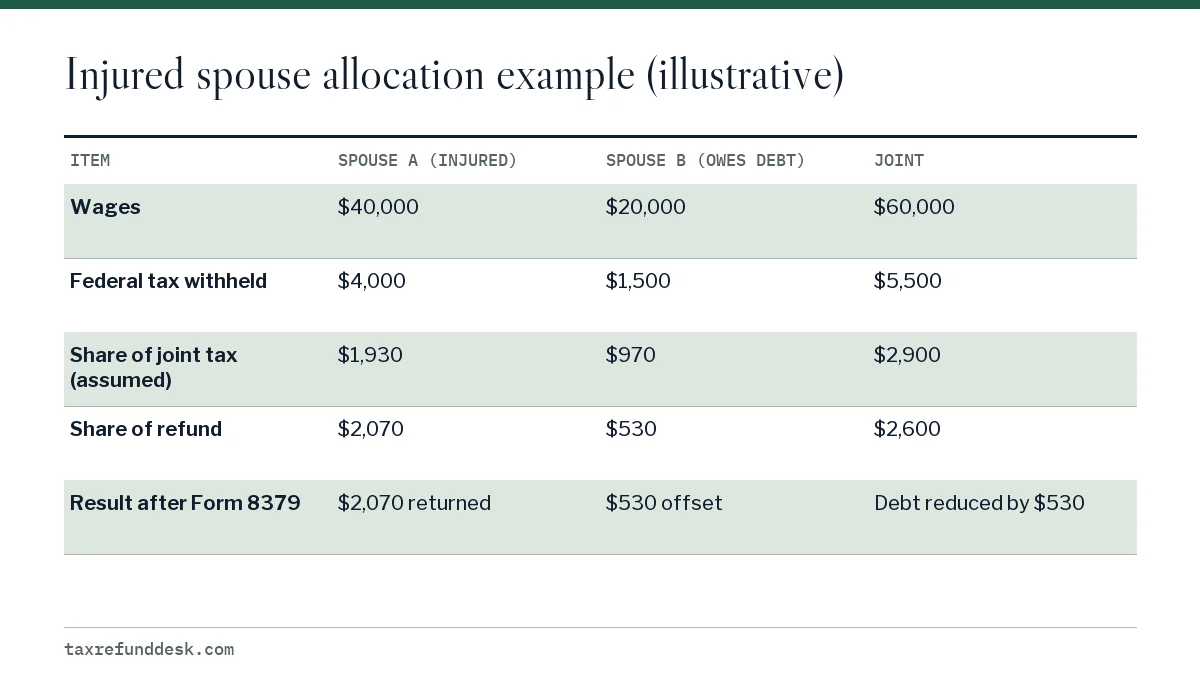
The example is simplified. The IRS, not you, computes each spouse's portion of the joint tax, and credits such as the EITC can shift the result. The point is that the injured spouse's share is built from their own payments and allocated items, not from half of the refund.
Form 8379 processing times
The IRS publishes three timeframes. Injured spouse claims also appear on the IRS list of returns that need manual handling, so they cannot be sped up.
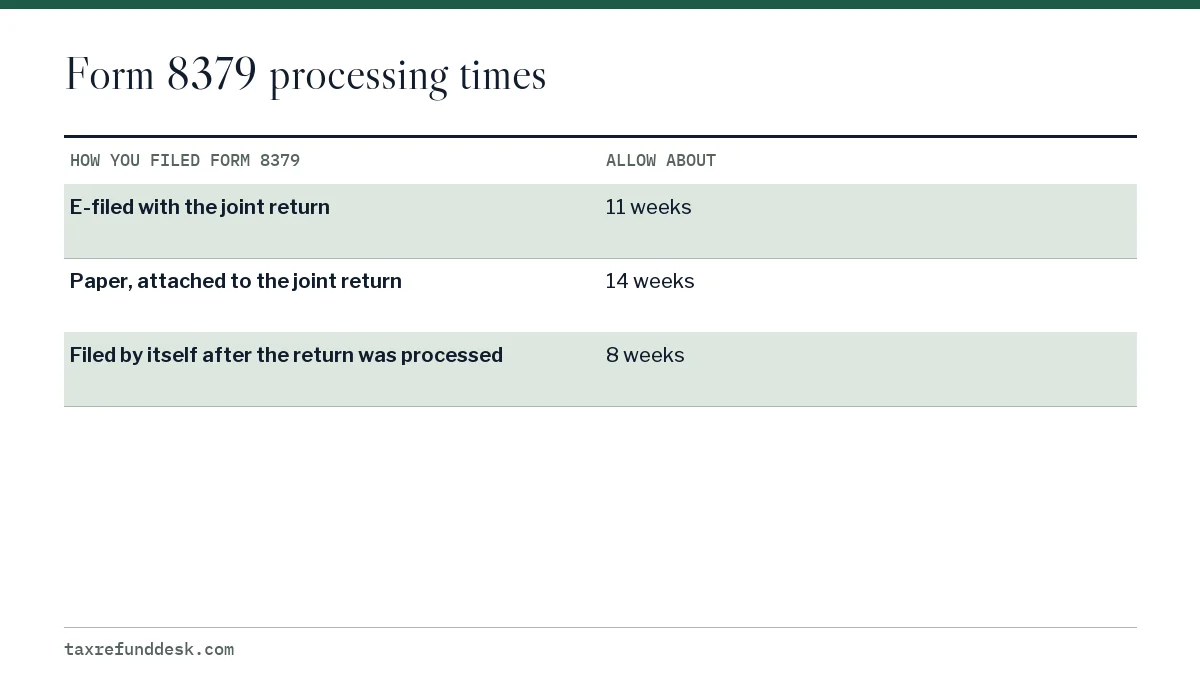
You cannot track an injured spouse claim in Where's My Amended Return, even if you attached it to a Form 1040-X; the IRS excludes these claims from that tool. Where's My Refund may show the joint return, but the injured spouse refund arrives as a separate payment. Check your account transcript for movement if the timeframe passes.
If the IRS approves the claim after the money already went to a creditor, the returned share may show as a reversal on your transcript. Our page on refund offset reversals explains those entries.
Injured spouse vs innocent spouse
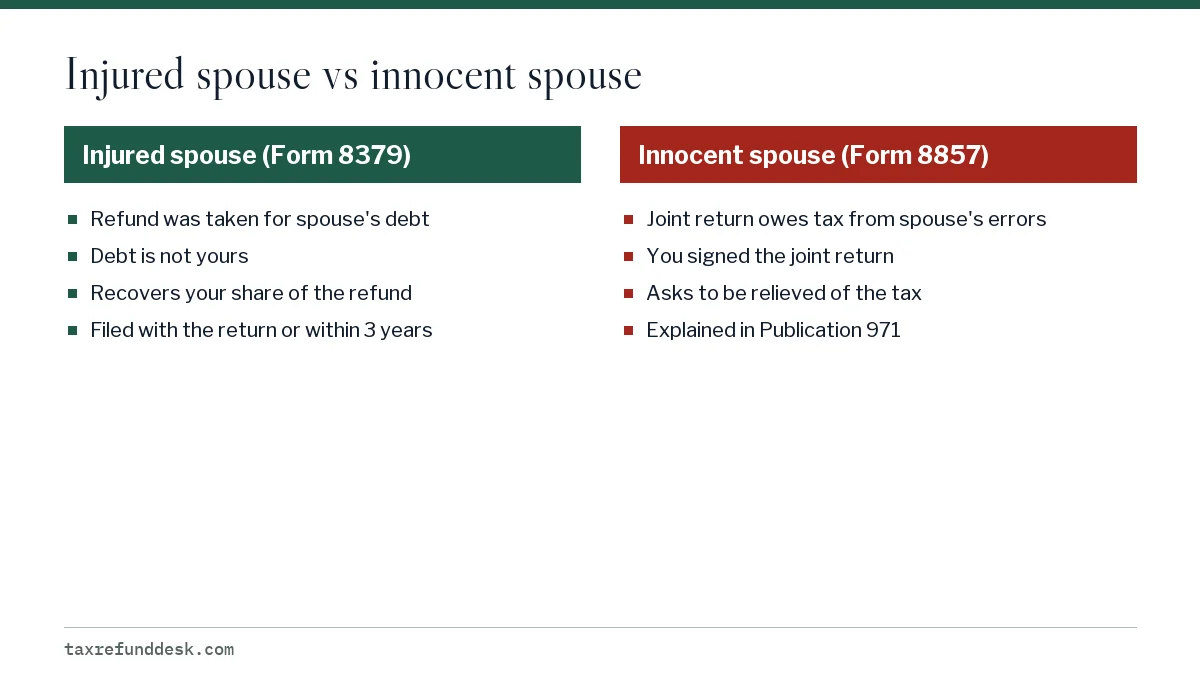
The names are close but the relief is different. Injured spouse relief is about a refund taken for a debt that was never yours. Innocent spouse relief, requested on Form 8857 and explained in Publication 971, is about tax owed on a joint return because of your spouse's errors or omissions.
Common uses for Form 8379 include a spouse's back child support, which we cover in child support refund offsets, and a spouse's defaulted federal student loan, covered in student loan offsets.
Step by step
Confirm you qualify
Check that you filed jointly, that your share of the refund was or will be offset, and that you are not liable for the debt.
Gather documents
Collect the joint return, the offset notice if you have one, and all W-2, W-2G and withholding 1099 forms for both spouses.
Complete Parts I and II
Answer the eligibility questions, including community property residence, and enter both spouses' names and identifying numbers in the order shown on the joint return.
Allocate items in Part III
Split income, adjustments, deductions, credits, withholding and estimated payments between the two of you as if you had filed separately.
Sign and file
Attach the form to the joint return, to a Form 1040-X, or mail it alone to the correct IRS service center with the wage statements.
Wait and track
Allow 8 to 14 weeks depending on how you filed, then check your account transcript if nothing arrives.
Common questions
Who qualifies as an injured spouse?
A spouse who filed a joint return, had their share of the refund applied to the other spouse's past-due debt, and is not legally responsible for that debt. The debt can be federal tax, state income tax, state unemployment, child support or a federal non-tax debt.
How long does Form 8379 take?
About 11 weeks if e-filed with the joint return, about 14 weeks if mailed with a paper return, and about 8 weeks if filed separately after the joint return was processed.
Should I file 8379 with my return or later?
With the return if you already know your spouse owes a debt that can be offset. That lets the IRS split the refund before it is taken. File later only if the offset came as a surprise.
Can I file an injured spouse claim every year?
Yes. The claim covers one tax year, so you file a new Form 8379 for each year the joint refund may be offset for your spouse's debt.
Where do I mail Form 8379 if I file it by itself?
To the IRS service center that processed your paper joint return, or, if you e-filed, to the service center for the area where you live now. Include both spouses' W-2s and any 1099s showing withholding, but not a copy of the joint return.
Does filing Form 8379 hurt my spouse?
No. It does not add to your spouse's debt or change their tax. It only stops your portion of the refund from paying a debt that is not yours.
Sources
- About Form 8379, Injured Spouse Allocation irs.gov
- Instructions for Form 8379 irs.gov
- Tax Topic 203, Reduced refund irs.gov
- Where's My Amended Return irs.gov
- Tax Topic 152, Refund information irs.gov
We check figures against these official pages. Rules change; confirm anything that affects a deadline or payment with the agency before you act.
Tell us what happened
Describe your situation and our editors will use it to improve this guide. If you leave your email, we may reply with a pointer to the right page or official contact. We never share your details.