
Tax refund offset for child support: how it works and what you can do
Short answer
A tax refund offset for child support happens when your state child support agency certifies past-due support to the Treasury, which then takes some or all of your federal refund. States can refer at least $150 in public assistance cases or $500 in other cases. You contest the amount with the state agency, and a spouse who owes nothing can file Form 8379.
- 01Who certifies the debt
- Your state child support (IV-D) agency
- 02Minimum past-due support
- $150 (assistance cases) or $500 (non-assistance cases)
- 03Share of refund that can be taken
- Up to 100%
- 04Joint return hold by the state
- Up to 6 months from notice of offset
- 05Place in payment order
- Right after your own federal tax debt
How a tax refund offset for child support works
Child support is the first non-tax debt paid from a federal refund. Under 26 U.S.C. 6402(c), past-due support comes out after any federal tax you owe and before federal agency debts, state income tax and unemployment debts. If you owe both child support and a student loan, the support is paid first.
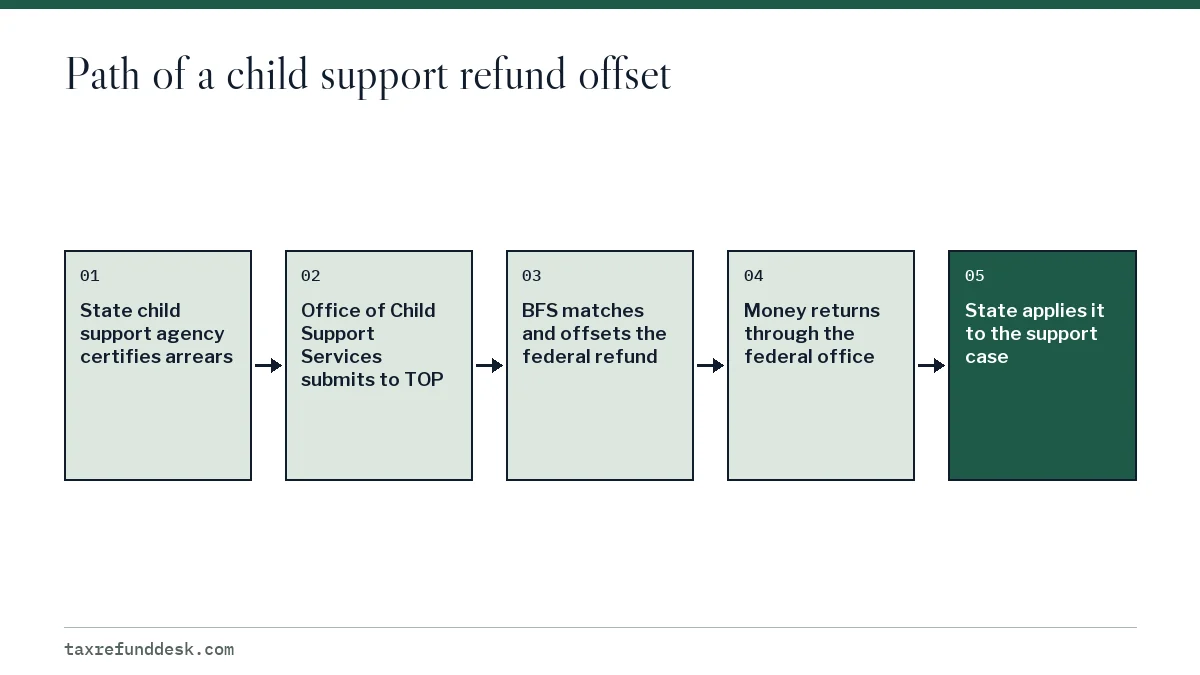
The state does not ask the IRS directly. Your state child support agency certifies the past-due amount, the federal Office of Child Support Services passes it to the Treasury Offset Program, and the Bureau of the Fiscal Service matches it against your refund. The offset money then travels back through the federal office to the state, which applies it to your case.
The minimum amounts states can refer
Federal rule 45 CFR 303.72 sets the floors. A state can refer a case for a child support tax refund offset once past-due support reaches $150 where support is assigned to the state because the family received public assistance. For other cases the state enforces, the floor is $500. States may combine several of your cases to reach either amount.
Can child support take your whole refund?
Yes. The BFS fact sheet allows up to 100% of a federal tax refund to be offset for child support. The only cap is the amount certified as past due, so you keep whatever is left after the arrears are paid.
| Situation | Refund | Past-due support certified | You receive |
|---|---|---|---|
| Arrears smaller than refund | $2,400 | $900 | $1,500 |
| Arrears larger than refund | $2,400 | $6,300 | $0 |
| Arrears larger, joint return with injured spouse claim | $2,400 | $6,300 | Spouse's share after Form 8379 review |
Wage withholding for support is capped at a share of pay, but the refund offset is not. BFS says it cannot stop or reduce a child support collection, so any relief for hardship has to come from the state agency.
Who to contact about a child support offset
Call the state child support agency named on the offset letter. BFS says it cannot help you stop, reduce or manage child support and only withholds money as ordered. The IRS has no details of your support case either.
If you do not have the letter, the Treasury Offset Program line at 800-304-3107 (TTY 800-877-8339) can tell you which agency referred the debt. The IRS lists this line on Tax Topic 203. For how that line works and what it cannot do, see our Treasury Offset Program page.
How to dispute a child support tax refund offset
- Find the pre-offset notice the state mailed. It must explain your right to contest the past-due amount and how to request an administrative review.
- Request the review in writing within the time the notice gives. You can ask for it in the state that referred the debt or, on request, in the state that issued the support order.
- Send proof: payment receipts, canceled checks, a court order that changed or ended support, or custody records.
- If the review finds the offset exceeded what you owed, the state must refund the excess to you promptly under 45 CFR 303.72.
- Keep a copy of the decision in case the same arrears are certified again next year.
Joint returns: holds, injured spouse and a new spouse's share
If you remarried and file jointly, your new spouse's portion of the refund can be taken for your old support debt unless that spouse files Form 8379, Injured Spouse Allocation. The form asks the IRS to split the joint refund so the spouse who owes nothing gets back the part tied to their own income, withholding and credits. Our injured spouse Form 8379 guide walks through the allocation.
Federal rules let the state hold an offset from a joint return instead of paying it out to the family right away. The state may delay distribution until it learns the injured spouse's share has been paid, or for up to 6 months from the offset notice, whichever comes first. That protects the other spouse's money while the IRS reviews the claim.
Timing of the offset and when the other parent gets the money
The offset happens on the day the refund would have been paid, so it follows normal refund timing. An e-filed return usually reaches that point within 21 days, and a paper return in 6 weeks or more. Returns claiming the EITC or ACTC cannot be paid before February 15.
For the parent owed support, the wait is longer. BFS says there can be a lag of two weeks or more before the collecting agency receives offset money, because child support collections pass through the federal Office of Child Support Services. Add the possible 6-month hold on joint-return offsets, and some payments reach the family months after tax season.
A receiving parent who is waiting should ask the state child support office to check with the federal office. BFS points parents to the state office for questions about a specific payment.
Refund offset reversal for child support
A child support refund offset reversal is rare and only happens when the state recalls the certification or finds that more was taken than you owed. It is not automatic when you catch up on payments after the refund was issued. See how returned money shows up on transcripts and in your account in our refund offset reversal guide.
To keep a 2027 refund, work with the state agency before you file. Ask whether paying the arrears below the $150 or $500 floor, or a payment agreement, would lead it to remove the certification. For how student loan debts are treated in the same system, read student loan tax refund offsets, and for the full list of debts see the tax refund offset overview.
Common questions
How much child support do you have to owe to get your taxes taken?
At least $150 in past-due support if the support is assigned to the state because of public assistance, or $500 in other cases the state enforces. States can combine several of your cases to reach those amounts.
Will I get a letter before child support takes my tax refund?
Yes. The state must send advance notice explaining that past-due support will be referred for offset and how to contest the amount or request an administrative review. After the offset, the Bureau of the Fiscal Service mails a second letter.
Can my new spouse get their part of the refund back from child support?
Yes, if you filed jointly and your spouse does not owe the support. Your spouse files Form 8379 to claim their share, either with the joint return or afterward.
Why is the state holding my child support tax refund offset?
When the offset came from a joint return, the state may hold it for up to 6 months from the offset notice, or until the injured spouse's share is paid, so the money can be returned if the other spouse's claim is approved.
Does paying off child support stop the refund offset?
Only if the state reports the change before your refund is issued. The debt stays in the Treasury system until the state tells it to stop collecting, so contact the agency well before you file.
Sources
- 45 CFR 303.72, Requests for collection of past-due support by federal tax refund offset law.cornell.edu
- 26 U.S.C. 6402, Authority to make credits or refunds law.cornell.edu
- BFS, FAQs for debtors in TOP fiscal.treasury.gov
- BFS, I owe child support fiscal.treasury.gov
- Tax Topic 203, Reduced refund irs.gov
- About Form 8379, Injured Spouse Allocation irs.gov
We check figures against these official pages. Rules change; confirm anything that affects a deadline or payment with the agency before you act.
Tell us what happened
Describe your situation and our editors will use it to improve this guide. If you leave your email, we may reply with a pointer to the right page or official contact. We never share your details.