
Can the IRS take my state refund? Yes, in most states
Short answer
Can the IRS take my state refund? Yes. If you owe federal tax and have received a Notice of Intent to Levy, usually the CP504, the IRS can levy your state income tax refund through its State Income Tax Levy Program, which most income tax states join. It works the other way too: a state can take your federal refund for unpaid state income tax through the Treasury Offset Program.
- 01IRS program
- State Income Tax Levy Program (SITLP)
- 02Notice that comes first
- Notice of Intent to Levy, such as CP504
- 03Notices after the levy
- One from the state, one from the IRS with hearing rights
- 04State taking a federal refund
- Treasury Offset Program, run by the Bureau of the Fiscal Service
Can the IRS take my state tax refund for federal taxes?
Yes. The IRS runs the State Income Tax Levy Program, which matches people with unpaid federal tax against state income tax refunds in participating states. When there is a match, the state sends the refund, or the part needed, to the IRS instead of to you. The IRS says the program currently covers individual state refunds only.
Most of the states that have an income tax take part, including large states such as California, New York, Georgia, Illinois, New Jersey, North Carolina, Pennsylvania and Virginia, according to the IRS privacy impact assessment for the program. States without a personal income tax have no refund to levy.
What must happen before the IRS levies a state refund
A state refund levy is not the first step in collection. The tax must have been assessed and billed, you must not have paid it, and the IRS must have sent a Notice of Intent to Levy. The CP504 notice is that notice, and the IRS says in its CP504 explanation that it can seize any state tax refund you are entitled to if you do not pay or make arrangements.
Because a state refund levy can follow the CP504 directly, your right to a collection hearing comes after the levy rather than before it. The IRS sends a notice of that right once the levy has happened.
Can a state take my federal refund?
Yes, through a different system. The Bureau of the Fiscal Service runs the Treasury Offset Program, which can reduce a federal tax refund to pay past-due state income tax, certain state unemployment compensation debts and child support collected by state agencies. The state reports the debt; the Fiscal Service takes the money and sends it to the state.
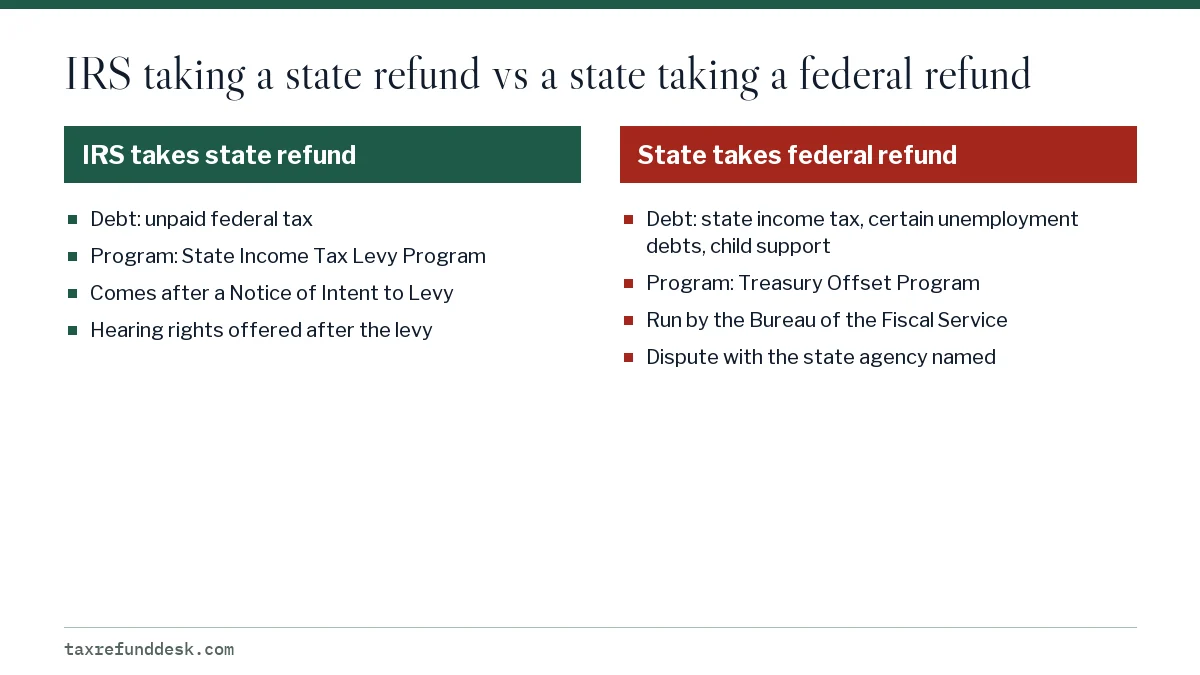
The two systems are easy to confuse because both end with a refund going to a government you owe. The difference is who holds the debt and which refund gets taken. For the federal side in detail, see the Treasury Offset Program and tax refund offset.
State refund reduced to 0: how to tell who took it
A state refund that shrinks or disappears is not always the IRS. States also apply refunds to their own debts, such as past-due state tax from another year, and many run intercept programs for state agency debts and child support. The notice you receive tells you which one happened.
| What was taken | Why | Notice you receive |
|---|---|---|
| State refund | Unpaid federal tax, IRS levy | State notice of the levy, then an IRS notice with hearing rights |
| State refund | State debt or state agency claim | Notice from the state revenue department or the agency |
| Federal refund | Unpaid state income tax | Bureau of the Fiscal Service offset notice naming the state |
| Federal refund | Unpaid federal tax | IRS CP49 notice |
For an IRS levy, participating states must send you a notice that the refund was levied and applied to a federal tax debt, with the amount and a pointer to the IRS. The IRS then issues its own Notice of Levy on Your State Tax Refund, Notice of Your Right to Hearing, unless you already received a pre-levy hearing notice. Check your state's refund tracker as well; our state tax refund status page links to the largest states' tools.
What to do next
The right move depends on which government took the money and whether you owe the debt.
- Identify the notice: IRS, state revenue department, a state agency or the Bureau of the Fiscal Service.
- If the IRS levied your state refund and you believe the federal balance is wrong or already paid, respond to the post-levy hearing notice by its deadline and contact the IRS at the number on that notice.
- If you owe the federal balance, check your IRS online account to confirm the levied amount was credited and see what remains.
- If a state took your federal refund, dispute the debt with the state agency named on the Fiscal Service notice, not with the IRS.
- If the refund was on a joint return and only your spouse owed a federal-side debt, look at Form 8379, injured spouse allocation.
- Before next season, set up a payment arrangement or pay the balance so the 2027 state and federal refunds are not taken again.
If you think an offset was taken in error, see tax refund offset reversal for the situations in which money can be returned and who pays it back.
Can the IRS take my state refund if I am on a payment plan?
Levy is a collection action for unpaid balances that have gone through the notice process. Once you arrange to pay, contact the IRS if a levy notice arrives anyway, and keep your agreement paperwork handy. Separately, a federal refund can still be applied to a federal balance while you are on a plan; the IRS applies refunds to existing federal tax debts.
Whether a specific payment plan stops a particular levy depends on the plan's terms and timing, so confirm with the IRS using the number on your notice. Payment plan options are listed on the IRS payment plans page.
Common questions
Can the IRS take my state refund for back taxes?
Yes, in states that take part in the State Income Tax Levy Program, after the IRS has sent you a Notice of Intent to Levy such as the CP504. The state sends your refund to the IRS and both the state and the IRS notify you afterward.
Can a state take my federal tax refund?
Yes. Through the Treasury Offset Program, a state can collect past-due state income tax, certain unemployment compensation debts and child support from your federal refund. The Bureau of the Fiscal Service sends a notice naming the state agency.
How do I know if the IRS took my state refund?
Your state sends a notice saying the refund was levied for a federal tax debt, and the IRS follows with a notice of your right to a hearing. The levied amount also appears as a payment on your IRS account.
Why is my state refund 0?
Either the IRS levied it for unpaid federal tax, or your state applied it to a state debt such as back state tax or an agency claim. The notice from your state says which one applies.
Does the IRS take state refunds in every state?
No. It takes them only in states that join the levy program, which includes most states with a personal income tax. States without an income tax have no state refund to levy.
Sources
- Federal and state levy programs irs.gov
- Understanding your CP504 notice irs.gov
- What is a levy irs.gov
- SITLP privacy impact assessment irs.gov
- Tax Topic 203, Reduced refund irs.gov
- Treasury Offset Program fiscal.treasury.gov
We check figures against these official pages. Rules change; confirm anything that affects a deadline or payment with the agency before you act.
Tell us what happened
Describe your situation and our editors will use it to improve this guide. If you leave your email, we may reply with a pointer to the right page or official contact. We never share your details.