
Does the IRS pay interest on late refunds?
Short answer
Yes. The IRS pays interest on a late refund when it takes longer than its administrative window, typically 45 days, to issue it. Interest then generally counts from the latest of the filing due date, the date a late return arrived, or the date the return became processable, at 7% a year compounded daily for October to December 2026.
- 01Interest-free window
- Typically 45 days
- 02Rate, Oct 1 to Dec 31, 2026
- 7% a year, compounded daily
- 03Earliest start date for an on-time return
- The filing due date (April 15, 2026 for 2025 returns)
- 04Claim for missing interest
- Form 843, within 6 years
- 05Transcript code for interest
- TC 776
Does the IRS pay interest on late refunds? The 45-day rule
The IRS does pay interest on late refunds, but only after it runs past its interest-free processing window. According to the IRS interest page, the agency has administrative time, typically 45 days, to issue a refund without adding interest. If the refund goes out on day 44, you get the refund and nothing more. If it goes out later, interest is added automatically; you do not have to ask for it.
Refund interest is the amount the IRS adds to an overpayment of tax to compensate you for the time it held your money past that window. It is set by law at the federal short-term rate plus 3 percentage points for individuals and changes each quarter (see the current refund interest rate).
When does IRS delayed refund interest start and stop?
IRS delayed refund interest starts on the latest of four dates listed on the IRS interest page: the return's filing due date, the date a late-filed return was received, the date the IRS could process the return, or the date the tax was paid. It stops on the date the IRS refunds the overpayment or applies it to another tax debt.
| Your situation | 45-day window counted from | If the window is missed, interest runs from |
|---|---|---|
| On-time e-filed or paper return | The due date (April 15) | The due date |
| Return filed after the due date | The date the IRS received it | The date the IRS received it |
| Return missing a signature or key information | The date it became processable | The date it became processable |
| Refund applied to another tax year or a debt | Not paid out as cash | Stops on the date the IRS applies it |
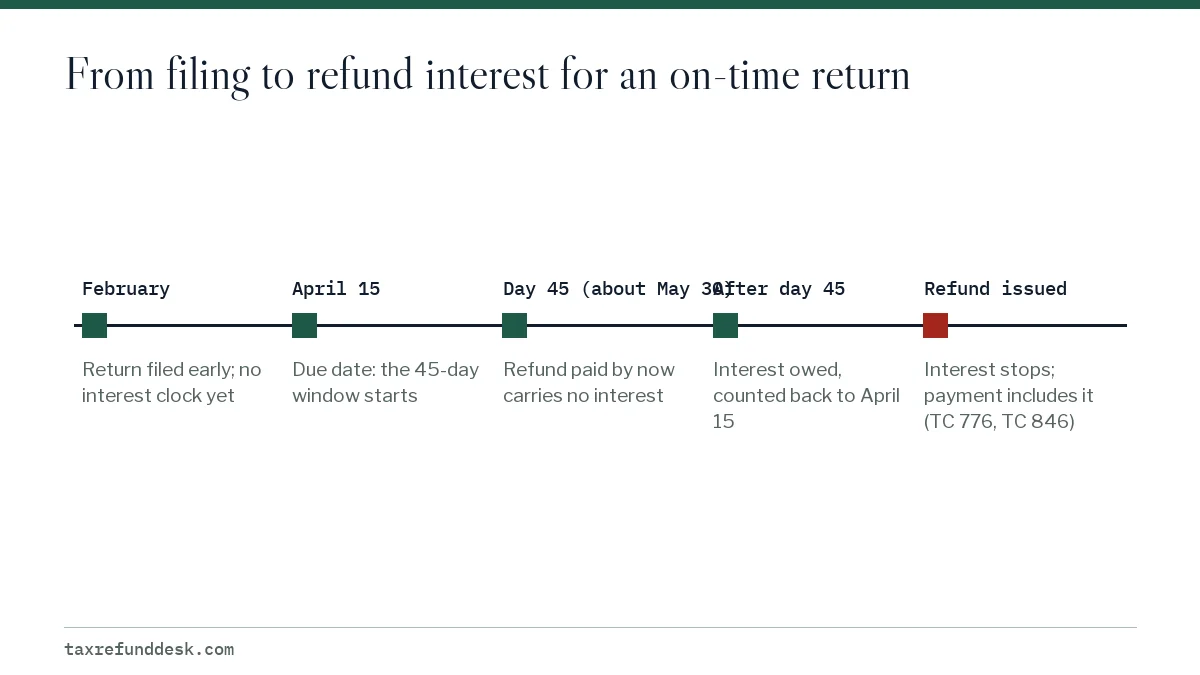
Once the window is missed, the interest generally covers the whole period from the start date, not just the days after day 45. That is why a refund that is only a few weeks overdue can still carry several weeks of interest.
What counts as a processable return?
A return is processable when the IRS has what it needs to work it, such as your signature and the information required to figure the tax. A return that has to be sent back for a missing signature, for example, only starts the interest clock once the corrected version arrives.
How is interest on a tax refund calculated?
Interest on a tax refund is calculated on the overpayment amount at the quarterly overpayment rate, compounded daily. For the quarter beginning October 1, 2026, that rate is 7% a year for individuals (IRS news release IR-2026-98, August 21, 2026). When a delay crosses a quarter boundary, each stretch of days uses that quarter's rate.
Worked example: an on-time 2025 return paid in July
Suppose you e-filed your 2025 return in February 2026 and were owed $2,400. The refund was held for a review and issued on July 15, 2026. The 45-day window from April 15 ended on May 30, so the IRS missed it and interest counts from April 15.
- April 15 to July 1, 2026 is 77 days at the second-quarter rate of 6%: about $30.57.
- July 1 to July 15, 2026 is 14 days at the third-quarter rate of 7%, compounding on the new balance: about $6.53 more.
- Estimated interest added to the refund: about $37.10, for a deposit of roughly $2,437.
Worked example: a late-filed return
Now suppose a 2025 return claiming a $3,100 refund was filed on August 3, 2026, well after the due date. The window runs 45 days from August 3, to September 17. If the refund was issued on October 20, 2026, interest ran for 78 days from August 3 at 7%, which comes to about $46.72. These figures are estimates: the IRS's own day count can differ by a few days, so treat the transcript as the final word.
How is the refund interest rate set?
The refund interest rate for individuals equals the federal short-term rate plus 3 percentage points, and the IRS resets it every quarter. Each new rate is announced in an IRS news release several weeks before the quarter starts; the October 2026 rate, for example, was announced on August 21, 2026. The rate for January to March 2027 is not yet announced; the IRS usually publishes it in late November.
Because the rate has sat between 6% and 8% for individuals since 2023, even a long delay adds a modest amount. A $1,000 refund held one full year past the due date at 7% would earn about $72.50. The refund interest rate page lists recent quarters.
Is the interest on a refund shown separately on your tax return?
No, the refund interest is not shown on the tax return you filed, because the IRS figures it after your return is processed. The deposit or check you receive is one combined amount: your refund plus interest. That is one reason a delayed refund arrives a few dollars higher than the figure on your Form 1040.
Checking whether you were paid interest
- Sign in to your IRS Individual Online Account and open the account transcript for the tax year of the refund.
- Look for transaction code 776, which is interest the IRS credited on your overpayment.
- Find transaction code 846, the refund issued. Per IRS Document 6209, that amount includes any interest.
- Compare the 846 amount with the refund on your return. The difference should roughly match the 776 line, unless an offset or adjustment also posted.
For help reading the other lines, see how to read an IRS transcript and the transaction code 846 guide.
What to do if you think the IRS owes you more interest
If the IRS paid no interest or too little, you can make an informal request or file Form 843, Claim for Refund and Request for Abatement. The IRS says the request must reach it within six years of the date of the scheduled overpayment. Before filing, check the dates: an early filer whose refund came within 45 days of April 15 is not owed anything.
- Note the date your return was received and the date the refund posted (transcript TC 150 and TC 846).
- Work out which start date applies from the table above.
- Estimate the interest with the quarterly rates for each stretch of days.
- If the gap is real, file Form 843 and explain the dates you used.
Refund interest is taxable income in the year you receive it; whether refund interest is taxable covers the 1099-INT and where it goes on your return. If you need the money before a delayed refund arrives, weigh the fees on a refund advance loan against the small amount of interest the IRS will add.
Common questions
Does the IRS pay interest if my refund takes longer than 21 days?
Not necessarily. The 21-day figure is a processing goal, not the interest trigger. Interest depends on whether the refund is issued more than about 45 days after the later of the due date or the date your return was received.
Why is my refund more than I expected?
If the refund was delayed past the 45-day window, the IRS adds interest to the payment. Check your account transcript for transaction code 776 to see the interest amount. A math error correction in your favor can also raise a refund.
Do I get interest on a refund if I filed late?
Yes, if the IRS takes more than 45 days after it receives your late return to issue the refund. In that case interest runs from the date the return was received, not from April 15.
Does the IRS pay interest on amended return refunds?
It can. Amended refunds are often paid many months after the original due date, and the refund includes any interest owed. Check the TC 776 line on your transcript once the amended refund posts, and see amended return processing time for how long they take.
Does the IRS pay interest on a refund that was offset for a debt?
Interest stops on the date the IRS applies the overpayment to another tax debt. Any interest earned up to that point becomes part of the overpayment.
How long do I have to claim unpaid refund interest?
The IRS says a request must reach it within six years of the date of the scheduled overpayment. Use Form 843 or make an informal request.
Sources
- IRS: Interest irs.gov
- IRS: Quarterly interest rates irs.gov
- IRS: Interest rates remain the same for the fourth quarter of 2026 (IR-2026-98) irs.gov
- IRS Document 6209, Section 8A, master file codes irs.gov
We check figures against these official pages. Rules change; confirm anything that affects a deadline or payment with the agency before you act.
Tell us what happened
Describe your situation and our editors will use it to improve this guide. If you leave your email, we may reply with a pointer to the right page or official contact. We never share your details.
Related guides
 IRS Refund Direct Deposit: Rules, Options and Limits
IRS refund direct deposit is now the standard way individual refunds are paid: since September 30, 2025 the IRS has been phasing…
IRS Code 846: Refund Issued and When the Money Arrives
IRS code 846 means refund of overpayment: the IRS has scheduled your refund, and the amount on the line includes any interest owe…
 Tax Refund Delay: 7 Causes, How Long Each Takes, What to Do
A tax refund delay means the IRS has pulled your return out of automatic processing, most often for an EITC or ACTC hold until mi…