
Refund advance loan: how it works and what to check first
Short answer
A refund advance loan is a short-term loan that a tax preparation company arranges against part of your expected federal refund, repaid automatically when the IRS deposits the refund. It does not make the IRS pay any faster, some versions charge fees and interest, and the Consumer Financial Protection Bureau warns you can still owe fees if the refund is smaller than expected.
- 01Who offers it
- Tax preparation firms, through a partner lender
- 02Does it speed up the IRS?
- No
- 03Refund anticipation check fees (CFPB)
- Typically $30 to $50
- 04IRS timeframe for most e-filed direct deposit refunds
- Within 21 days
- 05Earliest EITC or ACTC refund release
- After February 15 (PATH Act)
What is a refund advance loan?
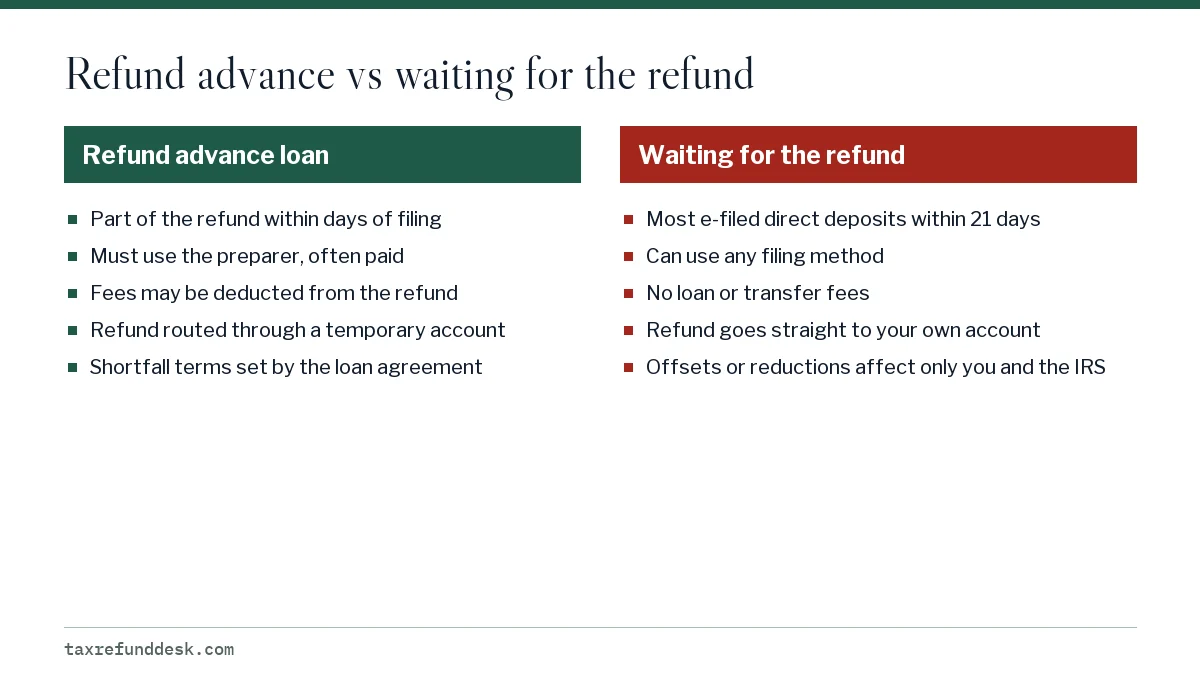
A refund advance loan is a loan against a portion of the federal refund your return shows, offered by a tax preparer and funded by a lender the preparer works with. The Consumer Financial Protection Bureau (CFPB) describes it as short-term, usually lasting less than a month, until the IRS sends the real refund. It is a loan, not an early release of your refund: no one can give you the IRS's money before the IRS issues it.
The IRS plays no part in the loan. It processes your return on the same schedule whether or not you borrowed, and it pays the refund to whatever account is on the return, which with an advance is an account the lender controls.
How refund advances work, step by step
- You have the company prepare and e-file your return, which is usually required to qualify.
- The lender reviews the return and may check your income and credit information, then approves an amount based on part of your expected refund.
- A temporary bank account is opened in your name, and your return lists it as the direct deposit account.
- The lender pays you the advance by whatever method it offers, such as a card or a deposit.
- The IRS processes the return normally and deposits the refund into the temporary account.
- The loan, the preparation fee and any other fees are taken out, and the rest is paid to you.
Because the refund is routed through the preparer's account, the direct deposit rules still apply to that account; the general rules are on the IRS refund direct deposit guide. If you planned to split your refund among your own accounts with Form 8888, ask the preparer first, since an advance normally requires the refund to go to the lender's account.
Do refund advances cost anything?
Some do and some do not. The CFPB says some firms offer advances with no fees or interest, while others charge both, and every firm is different. The real cost is often in the products bundled with the loan.
| Cost | What to ask |
|---|---|
| Loan fee or interest | Is the advance itself free, or is there a fee or APR? |
| Tax preparation fee | Is the price higher for customers who take the advance? |
| Refund anticipation check (RAC) or refund transfer fee | CFPB says these typically cost $30 to $50 and only let you pay the prep fee out of the refund |
| Card fees | Are there ATM, reload or inactivity fees on the card the advance is loaded to? |
| Other add-ons | Are any extras deducted from the refund, and can you decline them? |
Worked example
Take a refund of $3,276, the average federal refund the IRS reported through May 8, 2026. Suppose, as a hypothetical, you accept a $1,000 advance with no loan fee, a $300 preparation fee, and a $40 refund transfer fee. When the refund arrives, $1,340 is deducted and $1,936 reaches you. If you would have used a free filing option, the advance cost you $340 for early access to $1,000 of your own money.
The CFPB also points out that most e-filed refunds are issued in under 21 days, so a fee-based advance often buys only two or three weeks.
What happens if my refund is smaller than the advance?
It depends on your loan agreement, so read it before signing. The CFPB warns that you could still be responsible for fees even if the refund is smaller than expected. Look for the section that says whether the lender can collect a shortfall from you, and whether it can report the debt to credit bureaus.
A refund can shrink for reasons the preparer cannot see in advance. The most common are listed below.
- Treasury Offset Program: the Bureau of the Fiscal Service can take part or all of a refund for past-due child support, federal agency debts, state income tax debts or certain unemployment debts. See tax refund offset.
- IRS corrections: a math error or adjustment, explained in a CP12 notice, can lower the refund.
- Federal tax debt: the IRS can apply the refund to an earlier year's balance.
Risks if your refund is delayed
A delay does not change the loan, but it can change the fees and the stress. Advances are priced on the assumption that the refund comes quickly.
| Cause | Typical wait |
|---|---|
| Claiming EITC or ACTC | Whole refund held until after February 15 by law |
| Identity verification letter | Up to 9 weeks after you verify |
| IRS review of income or credits (CP05) | Allow up to 60 days |
| Refund reduced by an IRS correction (CP12) | 4 to 6 weeks after the notice if you agree |
For 2027, February 15 falls on Monday, February 15, 2027, which is also the Washington's Birthday federal holiday. The IRS has not yet announced when 2027 EITC and ACTC refunds are expected; it usually publishes projected dates in January. If the IRS pays late, interest may be owed to you, but it is paid along with the refund, into the account on the return; see interest on late refunds.
Refund advance 2027: what to check before you sign
As of September 2026, preparers' refund advance terms for the 2027 season (tax year 2026 returns) have not been published. Whatever the offer, the same checks apply.
- Get the advance amount, all fees and the APR in writing.
- Ask whether you owe anything if the refund is offset, reduced or never paid.
- Ask whether a credit check is run and whether a denial affects your credit.
- Compare the total preparation price with and without the advance.
- Confirm you can decline add-ons such as refund transfers.
Alternatives to a tax refund advance
The cheapest way to get money sooner is to shorten the IRS's clock: file electronically and choose direct deposit, which the IRS says delivers most refunds within 21 days. The CFPB notes that more than nine in ten direct deposit refunds are issued in under 21 days.
- File early with accurate numbers to avoid a CP12 or identity hold.
- Use a prepaid card or app account with routing and account numbers if you have no bank account; see refund without a bank account.
- Check for offsets before borrowing if you know you owe child support or a federal debt.
- Talk to your bank or credit union about a small, low-cost loan if you need cash now.
Common questions
Is a refund advance a loan?
Yes. A refund advance is a loan from a lender working with your tax preparer, secured by your expected refund. The IRS does not pay you early; the lender is repaid from the refund when the IRS deposits it.
Does a refund advance affect my credit?
The CFPB says the lender may consider your income and credit information when deciding. Ask the preparer whether a credit check is run and whether the lender reports to credit bureaus.
Can I get a refund advance if I claim the Earned Income Tax Credit?
Eligibility depends on the lender, but the IRS cannot release any refund that includes EITC or ACTC before February 15, so the loan stays outstanding at least until then.
What happens to a refund advance if my refund is offset for child support?
The offset is taken before the refund reaches the lender's account, leaving less to repay the loan. Whether you owe the difference depends on your agreement, and the CFPB warns fees can apply even when the refund is smaller than expected.
Will a refund advance get my refund faster from the IRS?
No. The CFPB states that advances and refund anticipation checks do not make the IRS issue your refund any sooner.
Sources
- Tax refund tips: understanding refund advance loans and checks, CFPB consumerfinance.gov
- Guide to filing your taxes, CFPB consumerfinance.gov
- Tax Topic 203, Reduced refund irs.gov
- Tax Topic 152, Refund information irs.gov
- When to expect your refund if you claimed the EITC or ACTC irs.gov
- Filing season statistics for week ending May 8, 2026 irs.gov
We check figures against these official pages. Rules change; confirm anything that affects a deadline or payment with the agency before you act.
Tell us what happened
Describe your situation and our editors will use it to improve this guide. If you leave your email, we may reply with a pointer to the right page or official contact. We never share your details.
Related guides
 IRS Refund Direct Deposit: Rules, Options and Limits
IRS refund direct deposit is now the standard way individual refunds are paid: since September 30, 2025 the IRS has been phasing…
Does the IRS Pay Interest on Late Refunds? The 45-Day Rule
Yes. The IRS pays interest on a late refund when it takes longer than its administrative window, typically 45 days, to issue it.…
Form 8888: How to Split Your Tax Refund Into Accounts
Form 8888, Allocation of Refund, tells the IRS to split one federal refund by direct deposit into two or three accounts at US fin…
Tax Refund Offset: Why Your Refund Was Taken and Next Steps
A tax refund offset happens when the government uses some or all of your federal refund to pay a past-due debt, such as child sup…
PATH Act Refund Hold: Why EITC and ACTC Refunds Wait
A PATH Act refund is any refund on a return that claims the Earned Income Tax Credit or the Additional Child Tax Credit. Federal…