
IRS refund schedule chart: estimated dates by filing week
Short answer
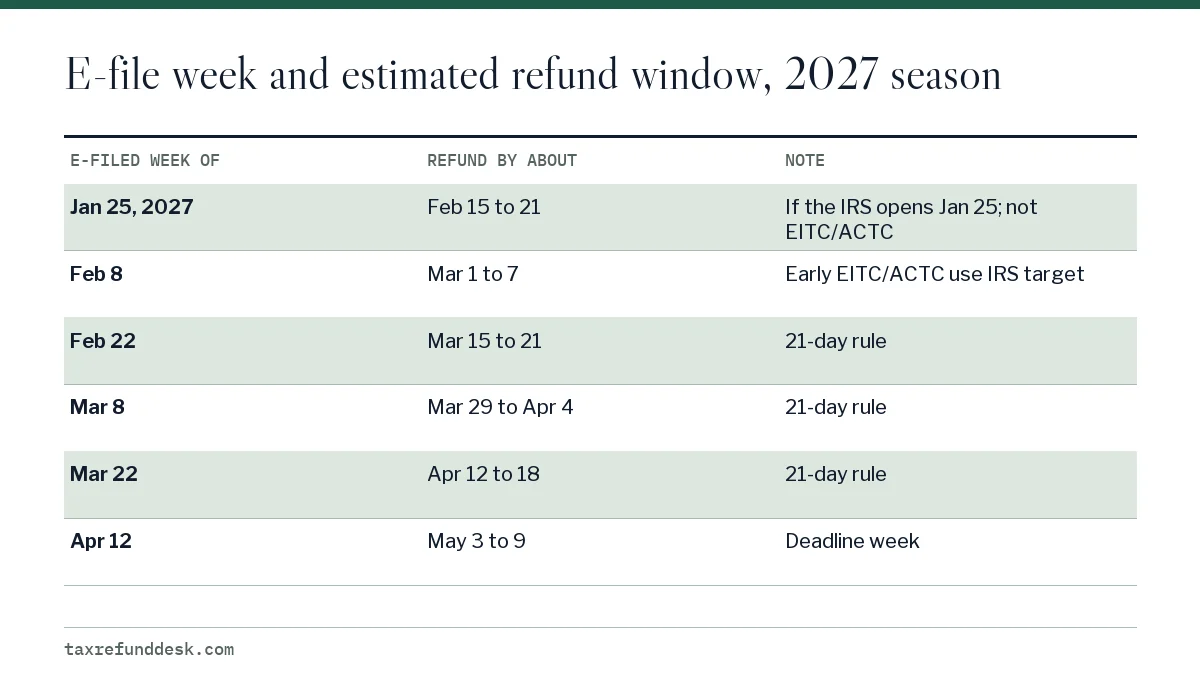
The IRS does not publish an official refund schedule chart. It gives one benchmark, most e-filed refunds within 3 weeks of e-filing, and a personal date in Where's My Refund once your refund is approved. The chart below applies that 21-day rule, and the 6-week rule for paper returns, to each filing week of the 2027 season.
- 01Official IRS refund chart
- None; the IRS gives a 21-day guideline
- 02E-file estimate
- E-file date plus 21 days
- 03Paper estimate
- IRS receipt date plus at least 42 days
- 04EITC/ACTC earliest release
- February 15, 2027 (a federal holiday)
- 052027 opening day
- Not yet announced (usually January)
Does the IRS publish a refund schedule?
No. The IRS has no public chart that maps filing dates to deposit dates. What it publishes is a rule of thumb: most refunds for e-filed returns are issued within 3 weeks of the e-file date, and mailed returns take 6 weeks or more from the day the IRS receives them.
The only exact date the IRS gives you is your own. Once your return is processed, Where's My Refund switches to Refund Approved and shows the date the refund will be sent. Charts that circulate online, including this one, are estimates built on the published guideline, and they should say so.
Estimated IRS refund schedule by acceptance week, 2027 season
Method: for e-filed returns we add 21 days to the first and last day of each filing week. For paper returns we add 42 days (6 weeks) to the week the IRS receives the envelope, which is the minimum the IRS quotes. The weeks start on Monday, January 25, 2027, the last Monday of January, because the IRS has opened on the last Monday of January in each of the past three seasons. The actual 2027 opening day is not yet announced.
| Filed or accepted in week of | E-file with direct deposit: by about | Paper return received that week: not before about |
|---|---|---|
| Jan 25 to Jan 31, 2027 | Feb 15 to Feb 21 | Mar 8 to Mar 14 |
| Feb 1 to Feb 7 | Feb 22 to Feb 28 | Mar 15 to Mar 21 |
| Feb 8 to Feb 14 | Mar 1 to Mar 7 | Mar 22 to Mar 28 |
| Feb 15 to Feb 21 | Mar 8 to Mar 14 | Mar 29 to Apr 4 |
| Feb 22 to Feb 28 | Mar 15 to Mar 21 | Apr 5 to Apr 11 |
| Mar 1 to Mar 7 | Mar 22 to Mar 28 | Apr 12 to Apr 18 |
| Mar 8 to Mar 14 | Mar 29 to Apr 4 | Apr 19 to Apr 25 |
| Mar 15 to Mar 21 | Apr 5 to Apr 11 | Apr 26 to May 2 |
| Mar 22 to Mar 28 | Apr 12 to Apr 18 | May 3 to May 9 |
| Mar 29 to Apr 4 | Apr 19 to Apr 25 | May 10 to May 16 |
| Apr 5 to Apr 11 | Apr 26 to May 2 | May 17 to May 23 |
| Apr 12 to Apr 18 | May 3 to May 9 | May 24 to May 30 |
Many clean e-filed returns are paid before the 21-day mark, so read the middle column as a latest-normal date rather than a target. If your date falls on a weekend or federal holiday, the deposit usually posts on the next business day. February 15, 2027 is Washington's Birthday, a federal holiday, so a refund due that day would likely show up on Tuesday, February 16.
Adjustments for EITC and ACTC filers
The weekly chart does not apply to early filers who claim the Earned Income Tax Credit or the Additional Child Tax Credit. The PATH Act bars the IRS from issuing those refunds before February 15, and it holds the whole refund, not only the credit. The IRS instead publishes a separate target each season.
| Season | Projected dates in Where's My Refund by | Most refunds in accounts by |
|---|---|---|
| 2024 | February 17, 2024 | February 27, 2024 |
| 2025 | February 22, 2025 | March 3, 2025 |
| 2026 | February 21, 2026 | March 2, 2026 |
| 2027 | Not yet announced (usually January) | Not yet announced (usually January) |
Those targets assume e-filing, direct deposit and no other problems. If you file an EITC or ACTC return after mid-February, the normal 21-day row for your filing week is a better guide, although returns with these credits can still get extra review. The EITC refund date page will carry the 2027 target once the IRS posts it.
Direct deposit refund schedule versus paper checks
Direct deposit is now the default rather than an option. The IRS started phasing out paper refund checks on September 30, 2025, so the paper column above assumes you still gave bank details or qualified for an exception.
- Bank details included and valid: follow the chart row for your filing week.
- Bank details missing or rejected: the refund is frozen and a CP53E notice arrives. You have 30 days to fix it online; without a response a paper check goes out after 6 weeks, which pushes you well past the chart. See our CP53E notice guide.
- Deposit bounced by the bank: most rejected deposits are now frozen rather than reissued automatically, so you must act before anything else happens.
How to use the tax refund schedule chart
- Find the row that contains your e-file date. For a paper return, use the date the IRS most likely received it.
- Read across to the column for your filing method. That is your latest-normal window.
- If you claimed EITC or ACTC and filed before February 15, ignore the row and use the season target in the EITC table instead.
- Check Where's My Refund once a day. When it shows Refund Approved with a date, stop using the chart.
- If the window passes with no approval and no letter, read what happens after your return is accepted before calling anyone.
Example: you e-file on Wednesday, March 10, 2027 and choose direct deposit. Your row is the week of March 8, so the estimate runs from March 29 to April 4. Adding 21 days to March 10 gives Wednesday, March 31, 2027, which is the date to watch.
How accurate are refund schedule charts?
They are accurate for the typical case and wrong for everyone else. The 21-day rule describes most returns, but the IRS summary of the National Taxpayer Advocate's 2026 mid-year report says more than 14 million individual returns were suspended during processing that season. A suspended return drops off any chart.
Charts also cannot see offsets, identity checks, math error corrections or a missing prior-year return. For the full list of what slows a refund, see the tax refund timeline overview, and for day counts by case, how long a tax refund takes.
IRS refund schedule 2026: how the last season started
The 2026 season opened on Monday, January 26, 2026 with a filing deadline of Wednesday, April 15, 2026. Under the same 21-day method, a clean return e-filed on opening day would have reached the 21-day mark on Monday, February 16, 2026, which was itself the Washington's Birthday holiday, so bank posting would have slipped to the next business day. For the next season's key dates as they are announced, see tax refund dates for 2027.
Common questions
When will I get my refund if I filed in February?
For a clean e-filed return with direct deposit, add 21 days to your e-file date: a February 1 to 7 filing points to about February 22 to 28, and a late-February filing points to mid-March. EITC and ACTC filers follow the IRS target for early filers instead.
Is the refund schedule different for direct deposit and paper checks?
Yes. E-filed returns with direct deposit follow the 21-day guideline. Paper returns take at least 6 weeks from IRS receipt, and a refund frozen for missing bank details can take 6 more weeks if you do not respond to the CP53E notice.
Why did someone who filed after me get their refund first?
Each return is processed on its own. Credits that trigger holds, identity filters, reviews, offsets and bank posting times can all put a later filer ahead of you.
Does the IRS send refunds on specific days of the week?
The IRS does not publish fixed payment days for refunds. Your date comes from Where's My Refund once the refund is approved, and banks may not post deposits on weekends or federal holidays.
Will a refund schedule for 2027 be released by the IRS?
The IRS is not expected to release a week-by-week chart. It usually announces the season opening date and the EITC/ACTC target in January, and those are the only official schedule points.
Sources
- Tax Topic 152, Refund information irs.gov
- Where's My Refund irs.gov
- When to expect your refund if you claimed the EITC or ACTC irs.gov
- 2025 tax filing season starts (IR-2025-18) irs.gov
- 2024 tax filing season set for January 29 (IR-2024-04) irs.gov
- IRS opens 2026 filing season irs.gov
We check figures against these official pages. Rules change; confirm anything that affects a deadline or payment with the agency before you act.
Tell us what happened
Describe your situation and our editors will use it to improve this guide. If you leave your email, we may reply with a pointer to the right page or official contact. We never share your details.
Related guides
 Tax Refund Timeline: How Long Each Filing Method Takes
Most federal tax refunds for e-filed returns are issued within 3 weeks (21 days) of the e-file date, while mailed paper returns t…
Tax Refund Status 2027: When to Check and Expected Dates
You can check your 2027 tax refund status in Where's My Refund about 24 hours after you e-file your tax year 2026 return, once th…
How Long Does It Take to Get Your Tax Refund? Timelines
Most people get their tax refund within 3 weeks (21 days) of e-filing a correct return with direct deposit, according to the IRS.…
EITC Refund Date: When PATH Act Refunds Arrive in 2027
Your EITC refund date cannot fall before February 15, because the PATH Act bars the IRS from refunding any return that claims the…
Tax Refund How Long After Accepted: Typical Wait Times
Most tax refunds arrive about three weeks after an e-filed return is accepted, because the IRS says to expect a refund within 3 w…