
Tax return rejected due to IP PIN: how to get the right number and refile
Short answer
A tax return rejected due to IP PIN means the IRS has an Identity Protection PIN on file for you, your spouse or a dependent, and the e-file had no PIN or the wrong one. The IP PIN is 6 digits and changes every calendar year. Retrieve the current one in your IRS online account, enter it for the right person, and resubmit.
- 01IP PIN length
- 6 digits, new every calendar year
- 02Viewable online
- Generally mid-January to mid-November
- 03Codes by person
- IND-181-01 primary, IND-183-01 spouse, IND-996 dependent
- 04Form 15227 income limit
- AGI under $84,000 single or $168,000 joint
- 05Lost IP PIN by phone
- Mailed to your address of record within 21 days
Why was my tax return rejected due to IP PIN?
An Identity Protection PIN (IP PIN) is a 6-digit number the IRS issues to lock a Social Security number or ITIN against fraudulent returns. Once a number is enrolled, every e-filed federal return that lists it must carry the current IP PIN. If it is missing, mistyped or from an earlier year, the IRS IP PIN FAQ says the return is rejected and must be e-filed again with the correct PIN.
The reject code tells you whose PIN caused the problem. That matters because many people check their own PIN when the failure was actually a spouse's or a child's. Codes for other problems are in our IRS reject codes list.
| Code | Whose IP PIN | What the IRS says to do |
|---|---|---|
| IND-181-01 | Primary taxpayer | Re-enter this year's 6-digit IP PIN or retrieve it |
| IND-183-01 | Spouse | Enter the spouse's IP PIN in the spouse field |
| IND-996 | Dependent or qualifying person | Enter the dependent's current IP PIN or retrieve it |
Why is my IP PIN being rejected when I typed it correctly?
When the IRS IP PIN is rejected even though the digits look right, the cause is usually one of these:
- It is last year's number. A new IP PIN is generated every year. A CP01A notice or online account screen from last January will not work in 2027.
- It is in the wrong box. The primary taxpayer's PIN went into the spouse field, or the other way around.
- A dependent's PIN is missing. If a child you claim has an IP PIN, it must be entered on Form 1040 and, where they apply, on Form 2441 and Schedule EIC.
- It is a different PIN. The five-digit self-select PIN you sign with, or a PIN from a state agency, is not the IRS IP PIN.
- You opted out recently. After a voluntary opt-out, the IRS says to allow up to 72 hours before e-filing without an IP PIN.
For the primary taxpayer's code in detail, see reject code IND-181-01.
How do I get my IP PIN?
The fastest route is your IRS online account. Sign in, go to the Profile page and open the IP PIN section; the IRS says the current year's number is generally viewable there from mid-January through mid-November. Signing in requires identity verification, which our ID.me verification guide walks through.
| Method | Who can use it | How long it takes |
|---|---|---|
| IRS online account | Anyone who can verify identity online | Immediate |
| Form 15227 and a phone call | AGI under $84,000 (individual) or $168,000 (joint) on the last filed return | Mailed, usually 4 to 6 weeks |
| In person at a Taxpayer Assistance Center | Anyone with a photo ID plus one more ID | Mailed, usually within 3 weeks |
| Phone reissue of a lost IP PIN | People already in the program | Mailed within 21 days |
The mail routes rule out a same-day fix, so they suit someone who has time before the deadline or who is setting up for next season. People who get their PIN by Form 15227 or in person then receive it by mail each year, while voluntary online enrollees must retrieve it online every year because no CP01A notice is mailed to them.
What if I never had an IP PIN?
If the IRS rejected your tax return for an IP PIN and you never had one, the IRS has assigned one to you. Its FAQ says that a rejection for a missing IP PIN is how you learn you were assigned one. Assignment usually follows a case where the IRS identified you as a victim of tax-related identity theft, so treat it as a signal to check your records.
- Confirm from the reject code whose SSN has the IP PIN; it may be a spouse or dependent, not you.
- Look for an IRS CP01A notice, which the IRS mails to assigned participants with the new PIN.
- If you cannot find it, retrieve the PIN in your online account or use one of the mail options above.
- If you did not know your identity was stolen, review the IRS identity theft guidance before filing.
Dependents with IP PINs
Parents can enroll children, and some children are enrolled because their number was misused. When you claim a dependent who has an IP PIN, an e-filed return must include that PIN, and a wrong or missing one produces IND-996. Our IND-996 guide covers that code on its own.
To get a child's IP PIN, the parent generally has to verify the child's identity. The online account route is not open to anyone under 18: the IRS says minors must use one of its alternative enrollment options instead. At a Taxpayer Assistance Center the IRS asks for two forms of identification for the dependent, such as a birth certificate and Social Security card. If the reason your dependent was locked is that someone else claimed them, see dependent already claimed.
If you cannot get your IP PIN in time
You can file on paper. The IRS FAQ says dependents' IP PINs are not needed on a paper return. For the primary taxpayer and spouse, a missing or incorrect IP PIN on paper does not stop the return, but it will take longer to process while the IRS validates it.
Before choosing paper, weigh the refund delay. The IRS says refunds on mailed returns take 6 weeks or more, compared with most e-filed refunds within 21 days. If you only need a few days to get into your online account, waiting and e-filing is usually faster overall. If the deadline is close, the e-file rejection grace period gives you extra calendar days to resubmit.
Filing after October 15, 2026: which IP PIN do you need?
Use your 2026 IP PIN on any federal return you file before the end of 2026, including a late 2025 return or a return for an earlier year. The IRS says an IP PIN is valid for one calendar year and must be used on every federal return filed during that year, prior-year returns included. The 2027 IP PIN will be the one for returns filed in 2027, such as your 2026 return due April 15, 2027.
- Retrieve it before mid-November. The IRS says the IP PIN is generally viewable in the online account from mid-January through mid-November, so get the number now if you still have a return to file this year.
- Rejected on October 15, 2026? The 5-day window to resubmit an extended 2025 return electronically closed on October 20, 2026. A paper return mailed within 10 calendar days of the rejection notice can still count as on time under IRS Publication 1345, and dependents' IP PINs are not needed on paper. For an October 15 rejection that window ends October 25, 2026; the grace period guide explains what to enclose.
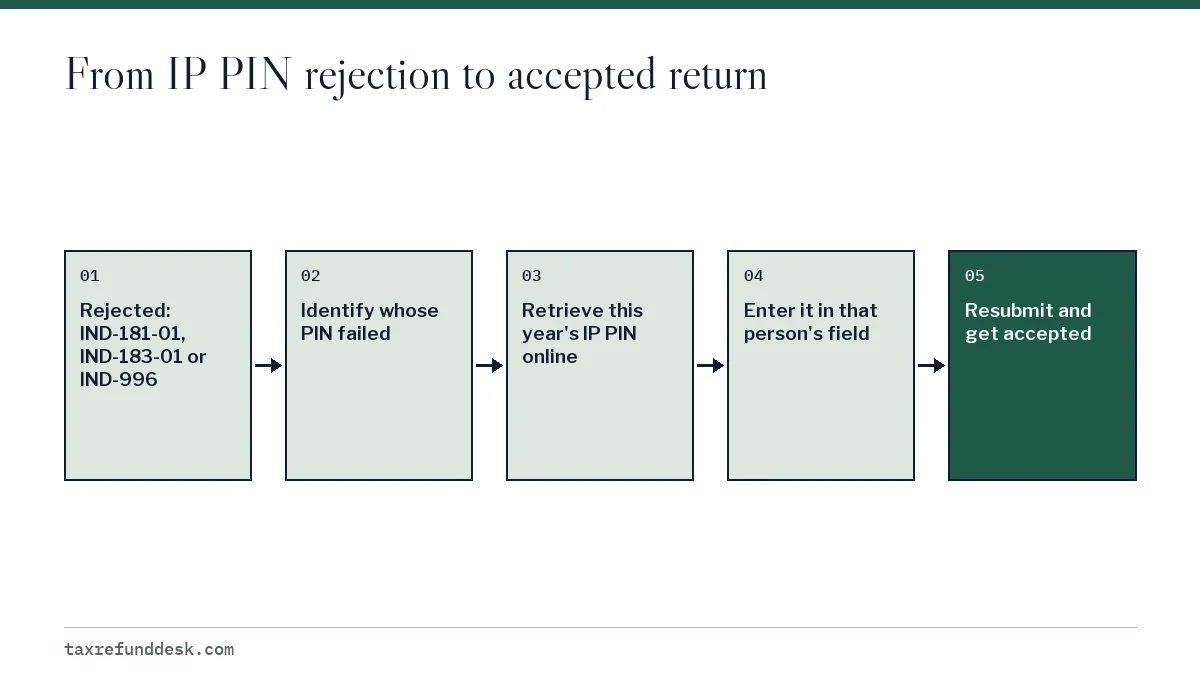
Step by step
Read the code
IND-181-01 is the primary taxpayer, IND-183-01 the spouse, IND-996 a dependent.
Get the current IP PIN
Open the IP PIN section of the Profile page in the IRS online account, or use a mail option.
Enter it in the right field
Place each 6-digit PIN next to the matching person.
Resubmit
Send the return again, or file on paper if you cannot get the PIN in time.
Common questions
Do I need an IP PIN for my state tax return?
No. The IRS says the IP PIN is used only on federal Forms 1040, 1040-NR, 1040-PR, 1040-SR, 1040-SS and 1040-X. Do not enter it on a state return or on Form 4868.
Can I use the same IP PIN for a prior-year return?
Yes, within the same calendar year. The IRS says the current IP PIN confirms your identity on your current return and on any prior-year returns you file during that calendar year.
When will my 2027 IP PIN be available?
The IRS says IP PINs are generally viewable in the online account from mid-January through mid-November, and assigned participants receive a CP01A notice from mid-December through early January. The exact 2027 date has not been announced, and neither has the opening day of the 2027 filing season.
Can I turn off my IP PIN?
Only if you joined voluntarily and have not been a victim of tax-related identity theft. After opting out, allow up to 72 hours before e-filing without an IP PIN.
Does an amended return need an IP PIN?
Yes. Form 1040-X is one of the federal returns that uses the IP PIN, so each person on it who has one must enter it.
I lost my CP01A notice. What now?
Retrieve the number in your IRS online account. If you cannot sign in, call the IRS at 800-908-4490 (Monday to Friday, 7 a.m. to 7 p.m. local time); an assistor verifies your identity and mails the IP PIN to your address of record within 21 days. Do not file Form 15227 to replace a lost IP PIN.
Will the IRS ever ask for my IP PIN?
No. The IRS says it will never ask for your IP PIN, and phone calls, emails or texts asking for it are scams. Give it only to the tax professional preparing your return, when you are ready to sign and submit. The IRS Cybersecurity Awareness Month reminder (IR-2026-119, October 2, 2026) also points to the IP PIN as a way to stop someone else filing a return with your SSN or ITIN.
Sources
- Frequently asked questions about the IP PIN irs.gov
- Get an Identity Protection PIN irs.gov
- Business rule IND-181-01 irs.gov
- Business rule IND-183-01 irs.gov
- Business rule IND-996 irs.gov
We check figures against these official pages. Rules change; confirm anything that affects a deadline or payment with the agency before you act.
Tell us what happened
Describe your situation and our editors will use it to improve this guide. If you leave your email, we may reply with a pointer to the right page or official contact. We never share your details.