
Tax return rejected because a dependent was already claimed
Short answer
When a tax return is rejected because a dependent was already claimed, another return using that child's Social Security number reached the IRS first. First check the SSN for typos. If it is right and you are entitled to the dependent, e-file with the primary taxpayer's current IP PIN or mail a paper return; the IRS then sorts out the duplicate claim by letter.
- 01Reject codes
- IND-507-01 (claimed as a dependent) and IND-517-02 (filed as a taxpayer)
- 02E-file option
- Allowed for the current year if the primary taxpayer has a current IP PIN
- 03Paper return processing
- Up to 6 to 8 weeks, per the IRS
- 04Duplicate-claim letter
- CP87A, about two months after filing
- 05Documentation request
- CP75A, with Form 886-H-DEP listing acceptable proof
Why a tax return is rejected when a dependent was already claimed
The IRS e-file system allows each Social Security number to be used as a dependent on only one accepted return per tax year. The first return to arrive is accepted and every later one listing the same number is rejected, whether or not the first filer had the right to claim the child. Being second does not mean you lose the dependent; it only means you cannot e-file the normal way.
Two codes cover the situation, and they point to different causes.
| Code | What the IRS found | Most likely cause |
|---|---|---|
| IND-507-01 | The dependent's SSN is already a dependent on another accepted return | Another parent, relative or ex-partner claimed the child, or a typo on someone's return |
| IND-517-02 | The dependent's SSN is the primary or spouse SSN on another return | Your dependent filed their own return, often for a first job, without indicating someone can claim them |
The detailed fixes for each are on our pages for IND-507-01 and IND-517-02. The full IRS reject codes list covers the other codes.
Checking your own entries first
The IRS notes that a duplicate can come from a typo on another return, not just a competing claim. Your own typo can do the same thing by matching a stranger's number. Before assuming someone took your dependent, run through these checks:
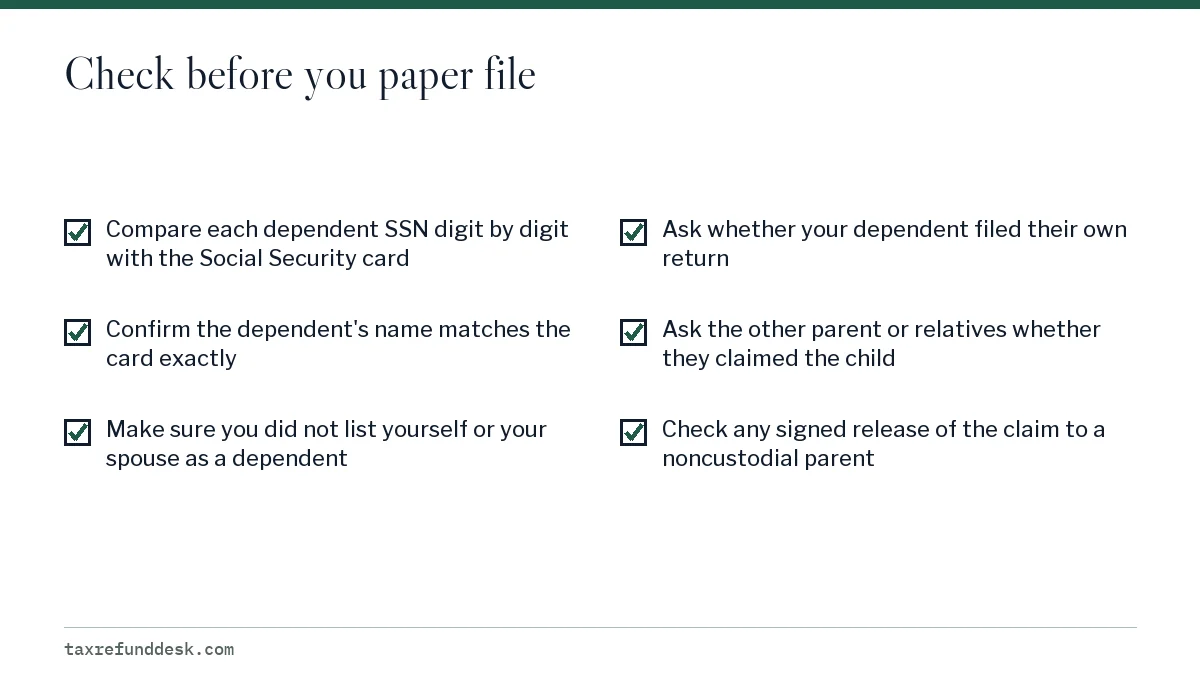
If your teenager filed their own return and forgot to mark that they can be claimed as a dependent, the IRS guidance for IND-517-02 gives three paths: take the dependent off your return, wait until they file an amended return that is accepted and then e-file, or print and mail your return. Their amended return is a Form 1040-X, which our Form 1040-X guide explains.
Can I still e-file if someone else claimed my dependent?
Yes, for the current tax year, if the primary taxpayer on your return has a current-year Identity Protection PIN. The IRS e-file FAQ on duplicate dependent SSNs says a return with a verified dependent SSN can be e-filed when the primary taxpayer includes that IP PIN. Prior-year returns with the same problem must go on paper.
Anyone who can verify their identity can get an IP PIN in their IRS online account. Our IP PIN rejection guide shows how, including the mail options if you cannot get online. The IP PIN route keeps you on the faster e-file refund track, where most refunds are issued within 21 days.
Can I paper file to claim my dependent?
Yes. You can mail your return with the dependent listed, and the IRS will process it. The IRS identity theft for dependents page says paper returns can take up to 6 to 8 weeks to process.
- Print the full return with the dependent included, exactly as you would have e-filed it.
- Sign and date it by hand; spouses on a joint return both sign.
- Do not attach birth certificates, school records or letters proving the child is yours. The IRS says not to, and will ask later if it needs them.
- Mail it to the address for your state listed in the Form 1040 instructions, using a trackable method.
- Keep a complete copy and the mailing receipt.
If you were rejected close to the deadline, a paper return is timely if mailed by the later of the due date or 10 calendar days after the rejection notice. Our grace period page explains how to note the late filing on the return.
What happens after two people claim the same child?
Once both returns are on file, the IRS works out who is entitled to the dependent. According to the IRS, the sequence usually runs like this:
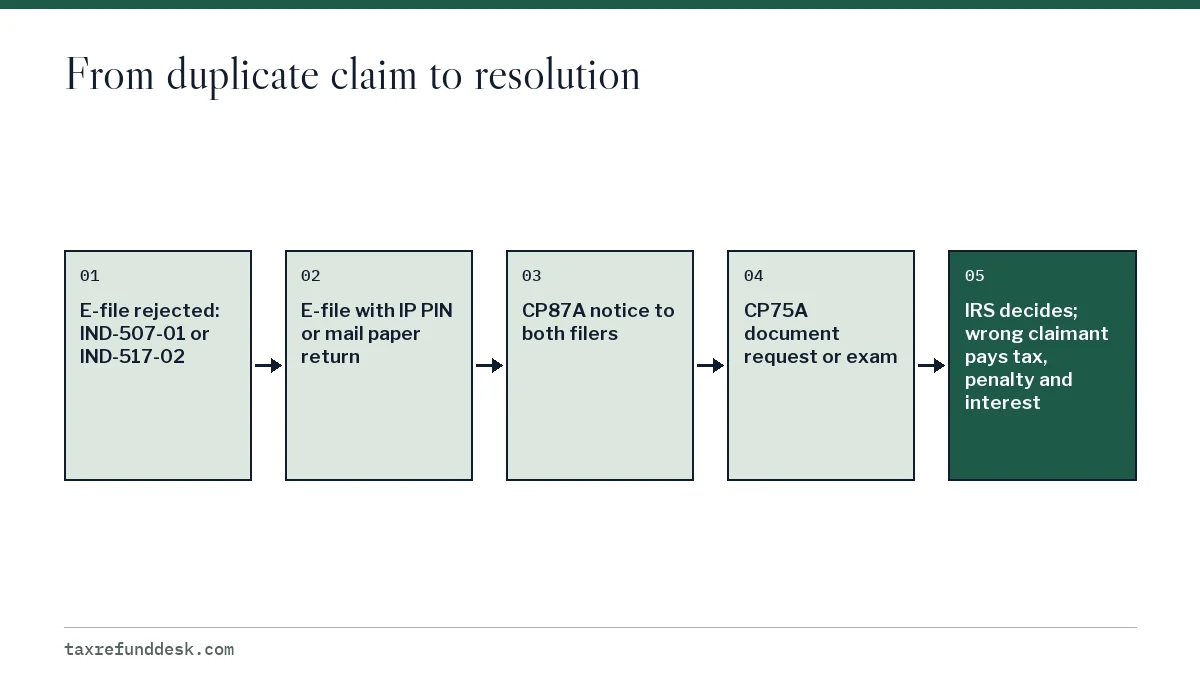
- CP87A: about two months after filing, both filers may get a notice that the child was claimed on another return. It asks each to review eligibility and either file an amended return or take no action if they are sure they qualify.
- CP75A: if the IRS needs proof, it asks for documents. Form 886-H-DEP lists what counts, such as birth certificates and records showing the child lived with you for more than half the year.
- Examination: if neither person amends, the IRS may audit to decide who can claim the dependent.
- Outcome: the IRS assesses additional tax, penalties and interest on the person who claimed the dependent incorrectly.
If your return is the one selected for review, its refund can be held while the review is open; the Taxpayer Advocate Service lists reviews of credits among the common reasons refunds are held. That review is a separate stage from the rejection, and our returns under review page covers what the status tools show during it.
Who has the right to claim the child?
When a child could be the qualifying child of more than one person, Publication 501 sets tiebreaker rules. Within these rules the people involved may be able to choose who claims the child, but when more than one of them actually claims the same child, the IRS applies the rules to decide.
| Situation | Who gets the child |
|---|---|
| Only one claimant is a parent | The parent |
| Both parents claim, not filing jointly | The parent the child lived with longer during the year |
| Child lived with each parent equally | The parent with the higher AGI |
| No parent can claim the child | The person with the highest AGI |
| A parent could claim but does not | A non-parent only if their AGI is higher than any eligible parent's |
Separate rules let a custodial parent release the claim to a noncustodial parent in writing. If that applies to you, the signed release decides who claims the child, not the order in which returns arrived.
Common questions
What do I do if someone else claimed my dependent?
Check the SSN and your eligibility first. If both are right, e-file with the primary taxpayer's current IP PIN or mail a paper return listing the dependent. The IRS will then contact both filers to resolve it.
Will I get in trouble if my ex claimed our child too?
Not for filing a correct claim. The IRS decides using the tiebreaker rules and any signed release, and it assesses tax, penalties and interest only on the person who claimed the child incorrectly.
My child filed their own return. Can I still claim them?
Possibly. If they meet the dependent tests, they can file a Form 1040-X showing that someone else can claim them. Once that amended return is accepted, e-file yours, or mail your return now.
Should I send proof with my paper return?
No. The IRS says not to attach extra documents to prove you can claim a dependent. If it needs them, it will ask by letter, usually a CP75A.
Does IND-507-01 mean my child's identity was stolen?
Not necessarily. It can be a relative's claim or a typo on another return. If no one should be claiming the child, review the IRS guidance on dependent identity theft and consider getting the child an IP PIN.
How long does the IRS take to resolve a duplicate dependent claim?
The IRS does not publish a fixed timeline. The first notice, CP87A, typically arrives about two months after filing, and an examination can take longer.
Sources
- IRS e-file FAQ: dependent SSN used on another return irs.gov
- Identity theft: dependents irs.gov
- Business rule IND-507-01 irs.gov
- Business rule IND-517-02 irs.gov
- Publication 501, Dependents, Standard Deduction, and Filing Information irs.gov
We check figures against these official pages. Rules change; confirm anything that affects a deadline or payment with the agency before you act.
Tell us what happened
Describe your situation and our editors will use it to improve this guide. If you leave your email, we may reply with a pointer to the right page or official contact. We never share your details.