
Tax return under review: what the IRS is checking, how long it takes and what to do
Short answer
A tax return under review means the IRS pulled your return out of automatic processing to check something by hand before releasing the refund, usually income, withholding, credits or your identity. It is not an audit. CP05 notices and Letter 4464C ask you to wait 60 days before calling, and the Taxpayer Advocate Service puts review times at 45 to 180 days depending on how many issues are involved.
- 01Is it an audit?
- No. CP05 and Letter 4464C reviews are verification, not examination
- 02Wait before calling (CP05, 4464C)
- 60 days from the notice date
- 03TAS review guideline
- 45 to 180 days
- 04Returns suspended in the 2026 season
- More than 14 million
What a tax return under review means
When your tax return is under review, a computer filter or an IRS employee has flagged something that needs a closer look before the refund can be released. The return has been received and posted, but the refund is frozen until the check is finished. You usually learn about it in one of three ways: a letter in the mail, a message in Where's My Refund, or a hold code on your account transcript.
Reviews are common. The National Taxpayer Advocate reported that more than 14 million individual returns were suspended during processing in the 2026 filing season. Being in that group does not mean you made a mistake. The IRS says plainly in its CP05 guidance that selection does not mean you were dishonest or made an error.
Why is my tax return under review? Common triggers
The IRS does not tell you exactly which filter caught your return, but its notices and the Taxpayer Advocate Service list the usual reasons.
| Trigger | What the IRS is checking | Letter you may get |
|---|---|---|
| Income or withholding does not match employer and bank filings | Wages and federal tax withheld against W-2 and 1099 data | CP05 or Letter 4464C |
| Refundable credits | Eligibility for EITC, ACTC and similar credits | Letter asking for documents, or a CP05 |
| Possible identity theft | Whether you actually filed the return | Letter 5071C, 4883C, 5747C or a CP5071 notice |
| Math or entry errors | Arithmetic and amounts carried between lines | CP11 or CP12 explaining the change |
| Unfiled prior-year returns or a name/address mismatch | Account history and SSA records | Varies |
| Debts or an election to apply the refund to next year | Offsets and estimated tax credits | BFS offset notice or CP49 |
Identity checks are a separate track with their own letters and steps. If your letter is a 5071C, start with the Letter 5071C guide rather than waiting, because nothing moves until you verify.
Read the video transcript
Under review is not an audit
Under review means the IRS pulled your return out of automatic processing to check something by hand.
It usually checks income, withholding, credits or your identity. It is verification, not examination.
A CP05 notice or Letter 4464C asks you to wait 60 days from the notice date before calling.
More than 14 million returns were suspended for review during the 2026 filing season.
If the letter asks for documents, send exactly what it lists and keep a copy of everything.
If the wait causes real financial hardship, the Taxpayer Advocate Service may be able to help.
Tax return under review vs audit
A pre-refund review and an audit are handled by different parts of the IRS and have different stakes. A review confirms that the numbers on your return match what the IRS already has, then releases the refund, sometimes with a correction. An audit (examination) looks at whether you are entitled to deductions or income treatment and can produce a formal tax bill.
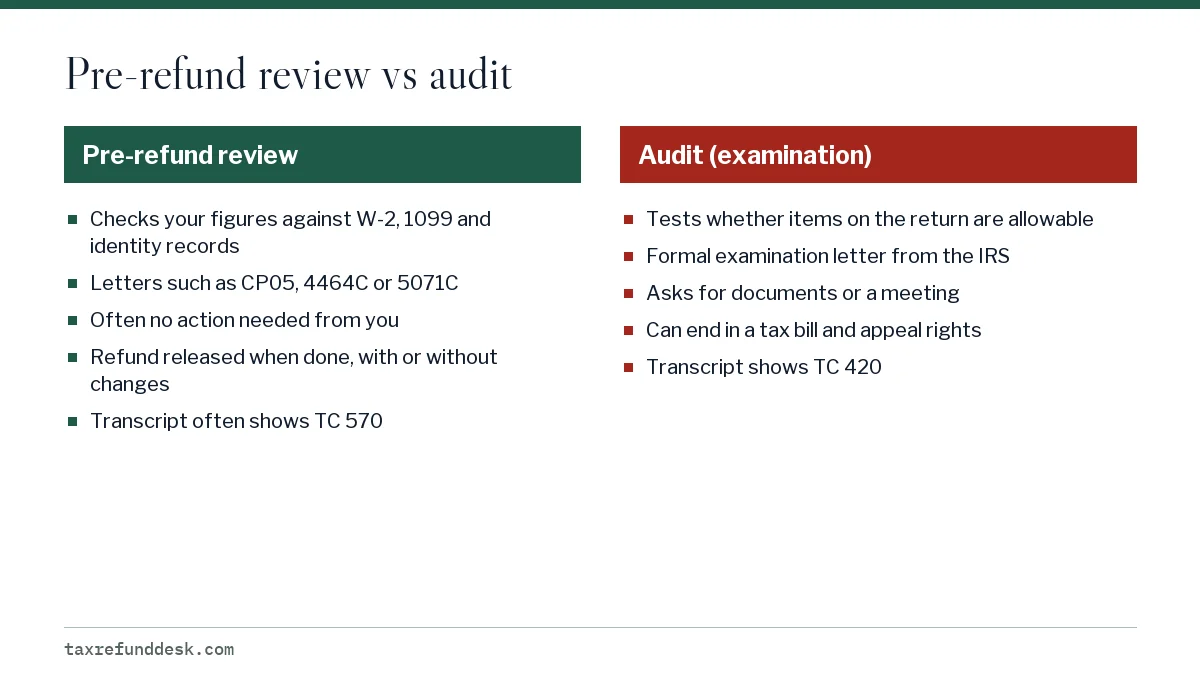
One practical clue: a CP05 or Letter 4464C says you do not need to take action if you filed the return. An audit letter asks you for documents or a meeting. On a transcript, a review often shows as a TC 570 hold, while a return sent to Examination shows a TC 420. See transaction code 570 for how the hold posts and later releases.
How long an IRS review of a tax refund takes
The wait depends on the kind of review. Income and withholding letters ask you to allow 60 days from the notice date before calling. The Taxpayer Advocate Service guideline range for reviews is 45 to 180 days, depending on complexity and how many issues are open.
| Situation | Published time frame | Source |
|---|---|---|
| CP05 income or withholding review | Allow up to 60 days before contacting the IRS | IRS CP05 page |
| Letter 4464C review | Do not call until 60 days after the letter date | IRS Letter 4464C page |
| General IRS review of wages, withholding or credits | 45 to 180 days | Taxpayer Advocate Service |
| After you send information the IRS asked for | About 60 days | Taxpayer Advocate Service |
| After identity verification is complete | Up to 9 weeks | IRS Letter 4883C page |
Worked example: you e-file on February 20 and receive a CP05 dated March 16. The 60-day window runs to about May 15. If no refund or further letter has arrived by then, that is the point to call. Calling on April 1 will not speed things up, because the review is still inside its normal window.
How to respond to a review letter
- Read the notice number in the top or bottom corner (CP05, 4464C, 5071C and so on). The number decides what you do next.
- If it is an identity letter, verify as the letter directs. Nothing else happens until you do.
- If it asks for documents, send copies (never originals) of the exact items listed, with the letter's response page on top, before the reply date.
- If it says no action is needed, compare your return with your W-2s and 1099s. If you find a real error, the IRS Letter 4464C page suggests filing a corrected or amended return.
- If you did not file the return at all, send Form 14039, Identity Theft Affidavit, as the CP05 and 4464C pages direct.
- Mark the 60-day date on a calendar and check Where's My Refund once a day, not more.
When the review ends, one of three things happens: the refund is released as filed, it is released with a change explained in a notice such as a CP12, or the IRS writes asking for more. If the delay is causing a serious financial hardship, the Taxpayer Advocate Service may be able to help.
Common questions
What does it mean if my tax return is under review?
It means the IRS has paused your refund to verify something on the return, such as income, withholding, credits or your identity. The return was received. The refund is released once the check is complete, sometimes with an adjustment.
Is under review the same as an audit?
No. A pre-refund review compares your return to information the IRS already holds and is usually settled by letter. An audit is a formal examination handled by a different unit and shows as a TC 420 on your transcript.
How long does an IRS review take?
CP05 and Letter 4464C reviews ask you to allow 60 days. The Taxpayer Advocate Service puts general review times at 45 to 180 days, and about 60 days after you send any information the IRS requested.
Can I get interest if my refund is under review for months?
It can. The IRS generally has 45 days to issue a refund without paying interest. After that, overpayment interest (7% a year for the quarter starting October 1, 2026) is added to the refund payment.
Should I file an amended return while my return is under review?
Only if you find a genuine error. The IRS suggests amending in that case, but a second return can add processing time, so do not amend just to prompt action.
Sources
- Understanding your CP05 notice irs.gov
- Understanding your Letter 4464C irs.gov
- Held or stopped refunds (Taxpayer Advocate Service) taxpayeradvocate.irs.gov
- National Taxpayer Advocate 2026 mid-year report irs.gov
- Interest irs.gov
- Tax Topic 152, Refund information irs.gov
We check figures against these official pages. Rules change; confirm anything that affects a deadline or payment with the agency before you act.
Tell us what happened
Describe your situation and our editors will use it to improve this guide. If you leave your email, we may reply with a pointer to the right page or official contact. We never share your details.
Related guides
 Where's My Refund: How to Check Your Federal Refund Status
Where's My Refund is the free IRS tracker for your federal refund. Enter your SSN or ITIN, filing status, tax year and exact whol…
Tax Return Still Processing: What It Means and How Long
A tax return still processing message means the IRS has your return but has not finished it, so no refund date exists yet. Inside…
IRS CP05 Notice: Refund Held While Income Is Verified
An IRS CP05 notice tells you the IRS needs more time to verify the income, federal withholding, tax credits or business income on…
Where's My Refund Status Not Available: What to Do
If Where's My Refund says status not available, the IRS system either has not loaded your return yet or cannot match the details…
IRS Letter 5071C: How to Verify and Release Your Refund
IRS Letter 5071C means the IRS stopped processing a return filed under your SSN or ITIN until you confirm you filed it. You can a…