
E-file rejection grace period: 5 days after the due date to resubmit, or 10 days after the reject to mail
Short answer
The e-file rejection grace period gives you until the fifth calendar day after the due date to resubmit a rejected return and keep it on time, if the original was transmitted by the due date. For 2025 returns rejected on the October 15, 2026 extended deadline, that e-file window closed on October 20, 2026. A paper return mailed within 10 calendar days of the rejection, by October 25, 2026 for an October 15 reject, can still count as on time (IRS Publication 1345).
- 01Corrected e-file window
- By the 5th calendar day after the due date
- 02Paper fallback window
- Later of the due date or 10 calendar days after the reject notice
- 03Corrected e-file window, October 15, 2026 extension
- Closed Tuesday, October 20, 2026 (our calculation)
- 04Paper window, return rejected October 15, 2026
- Ends Sunday, October 25, 2026; postmark by Friday, October 23 to be safe
- 052027 due date (tax year 2026)
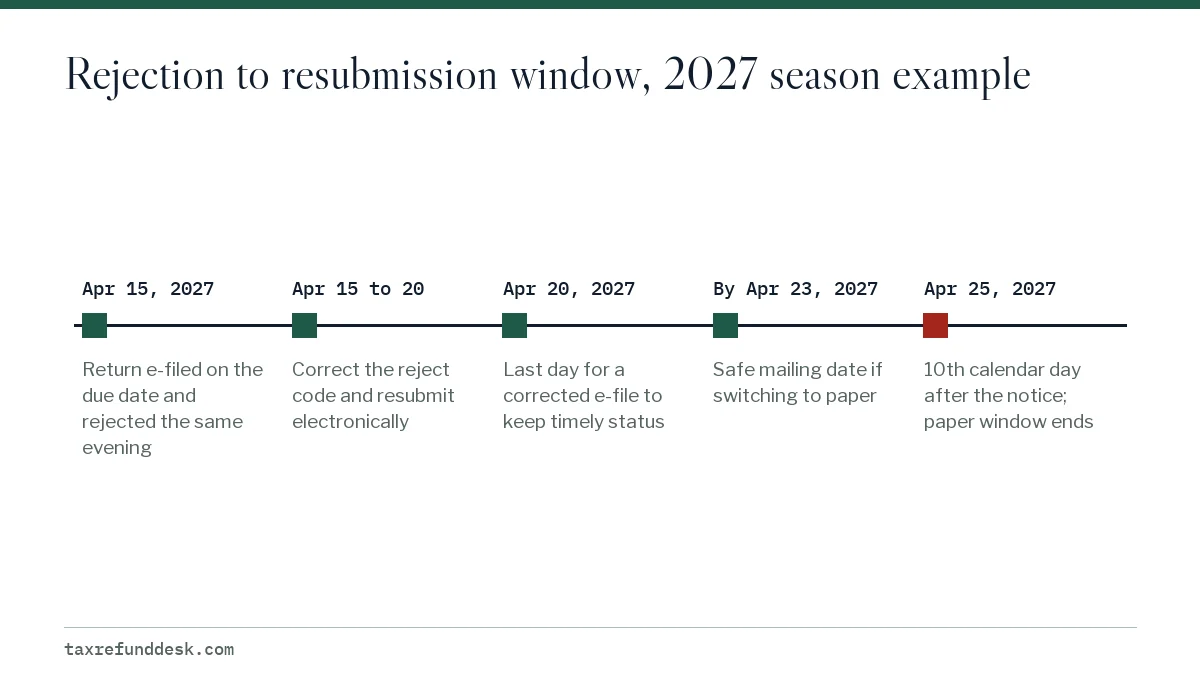
- Thursday, April 15, 2027
- 06Last day for a corrected e-file in 2027
- Tuesday, April 20, 2027 (our calculation)
- 07Rule source
- IRS Publication 1345 (Rev. 12-2025)
What is the e-file rejection grace period?
The e-file rejection grace period, often called the perfection period, is an IRS rule that treats a rejected return as filed on time if you fix it quickly. It applies only when the original e-file went out on or before the due date. The rule is written into Publication 1345, the handbook for authorized e-file providers, current revision December 2025.
The period exists because a rejected return is not a filed return. Publication 1345 says an e-filed return is not considered filed until the IRS acknowledges it has accepted it. Without the grace period, anyone rejected on the evening of April 15 would be late through no real fault of their own.
The window is short and it is counted in calendar days, so weekends count. It covers any reject code, from a prior-year AGI mismatch like IND-031-04 to a missing IP PIN like IND-181-01.
How many days do I have to resubmit a rejected return?
You have until the fifth calendar day after the due date to get a corrected electronic return resubmitted, or until the later of the due date or the tenth calendar day after the rejection notice to mail a paper return instead. Both windows are in Publication 1345's section on resubmitting rejected returns.
| Situation | Due date | Corrected e-file by | Paper return by |
|---|---|---|---|
| Extended 2025 return, rejected October 15, 2026 | Thu, Oct 15, 2026 | Tue, Oct 20, 2026 (closed) | Sun, Oct 25, 2026 (10 days after the notice) |
| Regular return, rejected April 15 | Thu, Apr 15, 2027 | Tue, Apr 20, 2027 | Sun, Apr 25, 2027 (10 days after the notice) |
| Regular return, rejected April 3 | Thu, Apr 15, 2027 | Tue, Apr 20, 2027 | Thu, Apr 15, 2027 (the due date is later than the 10th day, April 13) |
| Extended return, rejected October 15 | Fri, Oct 15, 2027 | Wed, Oct 20, 2027 | Mon, Oct 25, 2027 (10 days after the notice) |
Publication 1345 counts calendar days and does not mention moving the paper window when it ends on a weekend. The ordinary rule in Tax Topic 301 shifts due dates that fall on a weekend or legal holiday, but it is safer not to rely on that for the 10-day window. In the April 15, 2027 example, get the envelope postmarked by Friday, April 23, 2027, and in the October 15, 2026 example by Friday, October 23, 2026.
Missed the October 20, 2026 e-file window? What to do now
If your 2025 return was first sent by the October 15, 2026 extended due date and rejected, the 5-day window for a corrected e-file closed on Tuesday, October 20, 2026. A corrected e-file sent after that date no longer keeps the October 15 filing date: it counts as filed when it is sent and accepted, which makes it a late return. One route to an on-time filing remains, a paper return mailed within 10 calendar days of the rejection notice.
- Check the date on your rejection notice. For a rejection on October 15, 2026, the paper window ends on Sunday, October 25, 2026; for a later notice, count 10 calendar days from its date.
- Print, sign and date the complete return, and add the explanation Publication 1345 asks for: it was e-filed on time, rejected on a stated date, and is now being filed on paper.
- Mail it with a postmark by Friday, October 23, 2026 if you can, using a method that gives you a mailing receipt.
- If the paper window has also passed, file anyway, as soon as you can. E-file if your software still lets you transmit the return; otherwise mail it.
- Keep the original transmission record and the rejection notice. They are your evidence if you later ask the IRS to remove a late-filing penalty.
What filing late costs after the grace period
If the return shows a refund, filing late costs no failure-to-file penalty, because that penalty is a percentage of unpaid tax. The refund simply waits until the return is processed, and you have until April 15, 2029 to claim a 2025 refund at all.
If you owe tax, the failure-to-file penalty is 5% of the unpaid tax for each month or part of a month the return is late, up to 25%, counted from the October 15, 2026 extended due date. In a month when the 0.5% failure-to-pay penalty also applies, the 5% is reduced by that amount. A return more than 60 days late faces a minimum penalty of $525 or 100% of the unpaid tax, whichever is less, for returns due in 2026. The extension never covered payment, so interest on any unpaid tax has run since April 15, 2026.
The IRS can remove or reduce a failure-to-file penalty when you show reasonable cause and that you acted in good faith. An on-time transmission record plus a dated rejection notice shows you tried to file by the deadline. If a penalty notice arrives, follow its instructions: some requests can be made by phone, and a written request uses Form 843 (IRS penalty relief).
Is a rejected tax return late if it is rejected after the deadline?
Not if it was first sent on time and you meet the resubmission window. A tax return rejected after the deadline, but originally transmitted on or before April 15, keeps its timely status once the corrected version is resubmitted within the grace period and accepted.
The protection does not help a return first transmitted after the due date. That return is simply late, and a rejection only pushes the filing date later. Whether lateness matters depends on the numbers: it can trigger a failure-to-file penalty when you owe tax, but a return that shows a refund does not produce that penalty. See refunds on late returns for how timing affects the refund itself.
Paper filing after an e-file rejection
Switch to paper when the fix cannot be done electronically in time. Typical cases are a dependent already claimed on another return, an IP PIN you cannot retrieve quickly, or the same reject code coming back twice with data you know is right.
- Print the complete return, including every schedule and form that was part of the e-file.
- Sign and date it. A paper return needs a handwritten signature from each filer on a joint return.
- Add a short written explanation that the return was e-filed on time, rejected on a stated date, and is being filed on paper within the period allowed by Publication 1345. Publication 1345 says taxpayers should include an explanation of why the return is filed after the due date.
- We suggest also enclosing a printed copy of the rejection notice that shows the date and reject code.
- Mail it to the address for your state and form listed in the Form 1040 instructions, using a method that gives you a postmark receipt.
A mailed return is slower to produce a refund. The IRS says to allow 6 weeks or more; our page on paper return refund times sets out what to expect. For dependent disputes, the process after mailing is covered on the dependent already claimed page.
Proving timely filing after a rejection
The IRS relies on dates it can see, so keep a record of each step. If a penalty notice arrives later, these documents show the return qualified for the grace period.
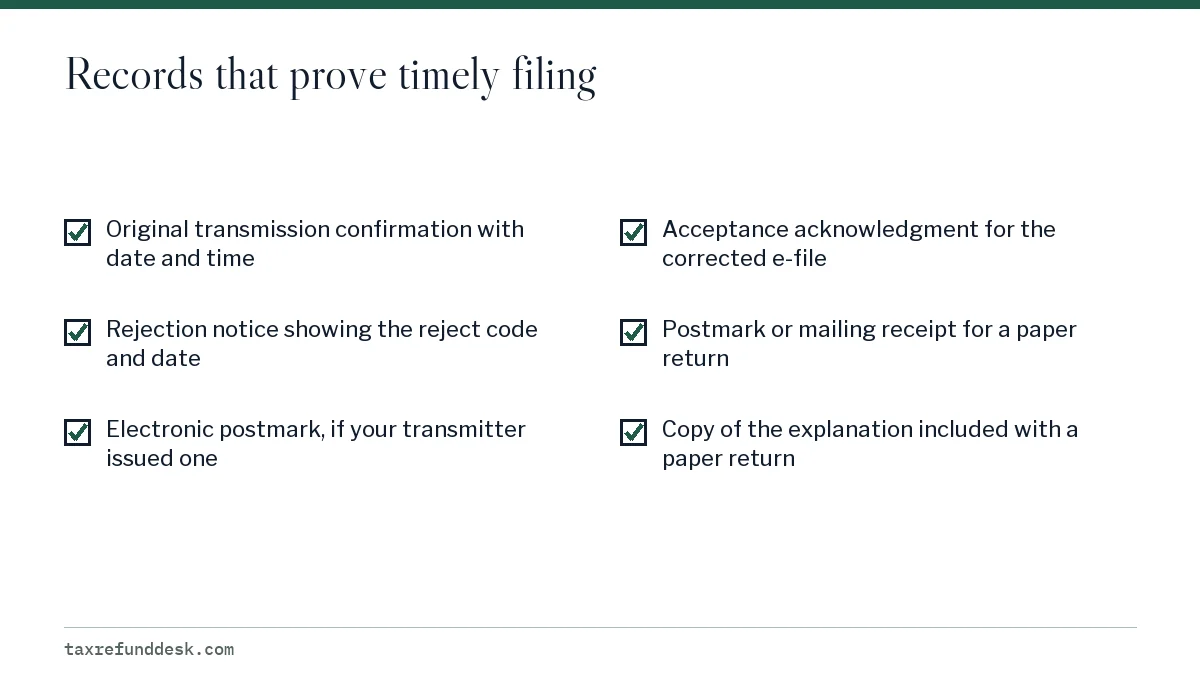
Tax Topic 301 says a mailed return is on time if it is properly addressed, has enough postage, and is postmarked and deposited in the mail on or before the due date. For e-file, the date and time in your own time zone when the return is transmitted controls. Publication 1345 adds that some transmitters issue an electronic postmark, and that postmark counts as the filing date only if the rejected return is then resubmitted within the rules above.
Step by step
Note the rejection date
Save the reject message showing the code and the date and time of the rejection.
Correct and resubmit
Fix the named item and resubmit by the fifth calendar day after the due date.
Or mail a paper return
If e-file will not work, mail the signed return with an explanation by the later of the due date or 10 calendar days after the rejection.
Keep proof
Keep the original transmission record, the rejection notice, the acceptance or postmark receipt and a copy of the return.
Common questions
What if my return is rejected on the deadline?
Fix the reject code and resubmit. For tax year 2026 returns first sent by April 15, 2027, a corrected e-file resubmitted by April 20, 2027 is treated as timely under the Publication 1345 rule.
My extended return was rejected on October 15, 2026. How long do I have?
The corrected e-file window closed on Tuesday, October 20, 2026. If the return was first transmitted by the October 15, 2026 extended due date, you can still keep it on time by mailing a signed paper return with an explanation within 10 calendar days of the rejection: by Sunday, October 25, 2026, with a postmark by Friday, October 23 as the safer target. After that, it is a late return.
What happens if I miss the e-file rejection grace period?
Once both the e-file and the paper windows have passed, the return is late, so file it as soon as you can. A return that shows a refund owes no failure-to-file penalty. If you owe tax, the penalty is 5% of the unpaid tax for each month or part of a month late, up to 25%, and you can ask for relief if your rejection records show you tried to file on time.
Does the grace period apply to state returns?
Each state sets its own rules for rejected returns, and Publication 1345 covers only the federal return. Check your state revenue department's e-file guidance, and remember a linked state return must be resent once the federal return is accepted.
Can I use the grace period if I e-filed for the first time on April 16?
No. The grace period applies only to a return first transmitted on or before the due date. A first transmission after the due date is a late return.
Do I need to write anything on a paper return filed after an e-file rejection?
Yes. Publication 1345 says to include an explanation of why the return is being filed after the due date. State that it was e-filed on time and rejected, and give the rejection date.
How many times can I resubmit within the grace period?
The IRS does not set a number in Publication 1345. What counts is that a corrected return is resubmitted within the window, so switch to paper early if the same rejection keeps returning.
Sources
- Publication 1345, Handbook for Authorized IRS e-file Providers (Rev. 12-2025) irs.gov
- Tax Topic 301, When, how and where to file irs.gov
- Frequently asked questions about the Identity Protection PIN irs.gov
- Free File Fillable Forms irs.gov
- IRS, Failure to file penalty irs.gov
- IRS, Penalty relief irs.gov
- IRS, Tax relief in disaster situations irs.gov
We check figures against these official pages. Rules change; confirm anything that affects a deadline or payment with the agency before you act.
Tell us what happened
Describe your situation and our editors will use it to improve this guide. If you leave your email, we may reply with a pointer to the right page or official contact. We never share your details.