
IND-507-01: your dependent is already on another accepted return
Short answer
IND-507-01 means the Social Security number of a dependent on your return was already used on another return the IRS accepted for the same tax year. First confirm the SSN is typed correctly. If it is, you can e-file again only if the primary taxpayer has a current IP PIN; otherwise mail a paper return and the IRS will decide who can claim the dependent.
- 01What IND-507-01 checks
- Each dependent SSN may appear on only one accepted return per year
- 02E-file fix if the SSN is right
- Primary taxpayer adds a current-year IP PIN (tax year 2024 and later)
- 03Paper return processing
- 6 to 8 weeks, per the IRS dependent identity theft page
- 04When the IRS starts sorting it out
- About 2 months after the paper return is filed
- 05Notice you may receive
- CP87A
What does reject code IND-507-01 mean?
IND-507-01 is the IRS e-file rule that allows each dependent's Social Security number (SSN) on only one accepted return per tax year. When your return lists a dependent whose SSN is already on a return the IRS has accepted, yours is rejected. The IRS page for business rule IND-507-01 names the fix: check the number, and if it is right, file electronically with an Identity Protection PIN (IP PIN).
The code does not say the other person was entitled to the dependent. It only says they filed first. Who actually has the right to claim the child or relative is decided later, and only if both returns stay in the system.
This code is one of two duplicate-dependent rejects. The other, IND-517-02, fires when the dependent's SSN was used as a filer on someone's return rather than as a dependent. The full list sits in our IRS reject codes guide.
Who claimed my dependent?
The IRS will not tell you who filed the other return, either in the rejection or by phone. You have to work it out from the people who could plausibly have listed the same person.
- The other parent. Separated, divorced and never-married parents claiming the same child is a common situation behind this code.
- A grandparent or relative in the household. Someone who also lived with and supported the child may have claimed them without asking.
- A paid preparer error. A preparer who files for several relatives may have reused a dependent from another family member's file.
- A stranger. If nobody you know could have claimed the dependent, the SSN may have been used fraudulently, which the IRS treats as dependent identity theft.
A quick conversation often settles it before any paperwork. If the other person agrees they claimed the dependent by mistake, they can file Form 1040-X to remove the dependent; once that amended return is processed, your e-file can go through. Waiting for an amended return can take months, so most people in a hurry use one of the routes below.
Check the dependent SSN before anything else
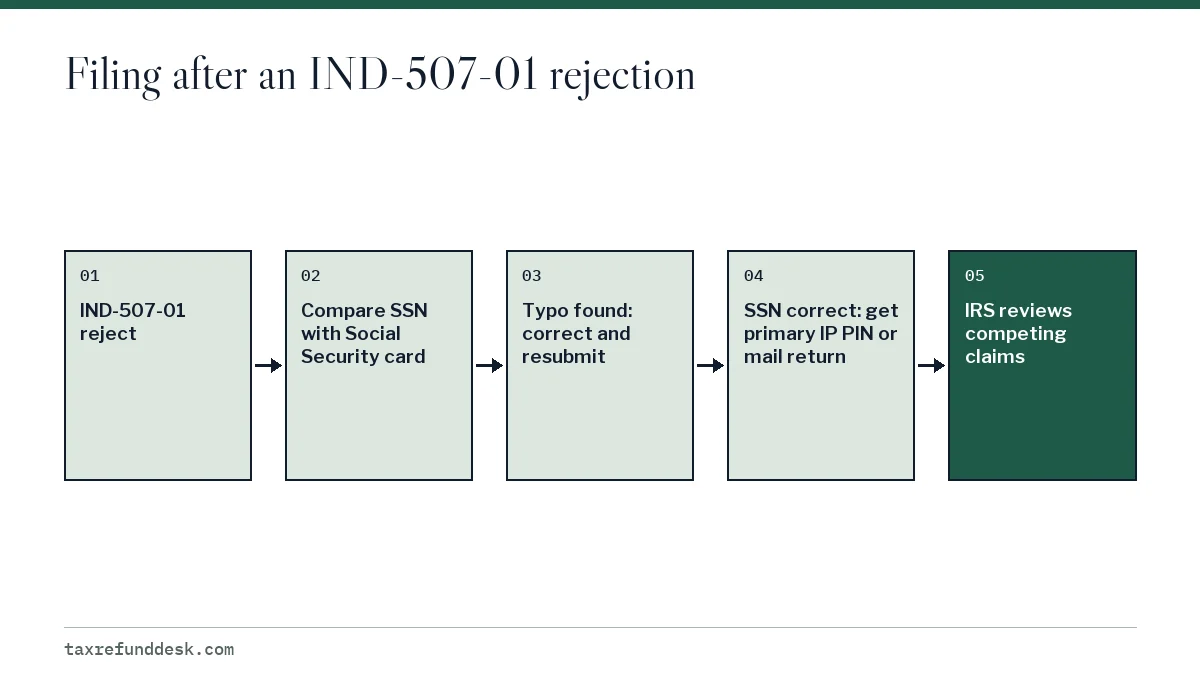
A mistyped SSN can land on a real person's number that is already claimed somewhere else. Before you assume anyone did anything wrong, compare the dependent's SSN on the return, digit by digit, with the Social Security card.
- Pull out the dependent's Social Security card, not an old tax return or a school form.
- Compare all nine digits and the spelling of the name on the return.
- Check that you did not enter one child's SSN twice, or swap SSNs between two children.
- If you find an error, correct it and resubmit electronically. No IP PIN is needed in that case.
How do I file after IND-507-01 if the SSN is correct?
You have two options once the SSN checks out. The IRS dependent identity theft page says returns for tax year 2024 and later can be e-filed when the primary taxpayer has a current calendar-year IP PIN, or you can mail a paper return.
| Route | What you do | Trade-off |
|---|---|---|
| E-file with an IP PIN | Primary taxpayer gets an IP PIN at irs.gov/getanippin, enters it, and resubmits | Faster processing; you must pass IRS identity verification |
| Paper return | Print, sign and mail the full Form 1040 with the dependent included | No IP PIN needed; the IRS says to allow 6 to 8 weeks |
Note that the IP PIN belongs to you, the filer, not to the dependent. Our IND-181-01 page explains what happens if that new PIN is later entered wrong. When mailing, do not attach birth certificates or school records at first; the IRS says it will ask for supporting documents if it needs them.
What happens next when two returns claim one dependent?
Once both returns are in, the IRS begins sorting out who may claim the dependent about two months after filing, according to its dependent identity theft page. If the review ends with the dependent disallowed on your return, the IRS adjusts the credits tied to that person.
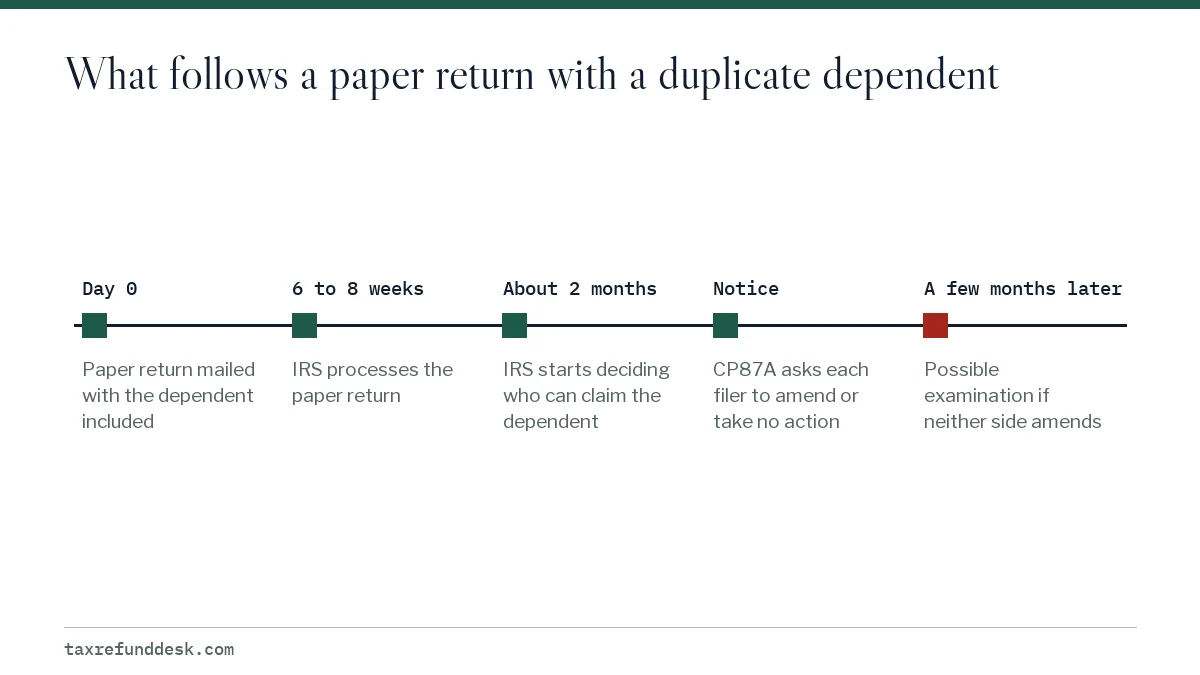
The IRS sends a CP87A notice saying the dependent was claimed on another return. It asks each filer to review the claim and either amend or take no action if they are sure they are entitled. If neither side removes the dependent, the IRS may open an examination, with letters arriving a few months later.
In an examination the IRS uses Form 886-H-DEP to list the proof it accepts: birth certificates, proof of the child living with you, and records on letterhead from a school, medical provider, daycare or social service agency. Collect these as soon as you mail the return. The longer walkthrough of the CP87A stage is on our dependent already claimed page.
An example with two parents
Suppose parents who live apart both expect to claim their 9-year-old. One e-files on February 3 and is accepted. The other e-files on February 20 and gets IND-507-01 within a day. The first return stays accepted because it arrived first, not because that parent is correct.
The second parent confirms the SSN, gets an IP PIN through an online account, and e-files again on February 22. Both returns are now in the IRS system. Roughly two months later each parent can expect a CP87A, and whoever is not entitled to the claim should amend. Parents who cannot agree should keep records showing where the child lived during the year.
Step by step
Verify the SSN
Compare the dependent's SSN on the return with the Social Security card and correct any typo.
Ask who may have claimed the dependent
Check with the other parent or relatives who could have listed the same person.
Choose a filing route
Get an IP PIN for the primary taxpayer and e-file again, or print and mail the return.
Prepare for CP87A
Keep proof of relationship and residency ready for the IRS review that starts about two months later.
Common questions
Can IND-507-01 happen if my dependent filed their own return?
That situation usually produces IND-517-02 instead, because the dependent's SSN appears as a filer rather than as a dependent. IND-507-01 means another filer listed the same person as their dependent.
Will the IRS tell me who claimed my child?
No. Taxpayer privacy rules prevent the IRS from sharing another person's return information. You will need to ask the people who might have claimed the child.
Does my child need an IP PIN to fix IND-507-01?
No. The IRS fix for IND-507-01 is an IP PIN for the primary taxpayer on your return. A dependent's own IP PIN is only needed on your return if the dependent has one, which is a different reject, IND-996.
Will mailing my return after IND-507-01 delay my refund?
Yes, compared with e-file. The IRS says to allow 6 to 8 weeks for a paper return in this situation. The competing claim is reviewed as a separate step, starting about two months after filing.
Should I file Form 14039 after IND-507-01?
Only if you believe someone used the dependent's SSN fraudulently, meaning nobody you know could have claimed them. If it was the other parent or a relative, this is a claim dispute, not identity theft.
Sources
- Business rule IND-507-01 irs.gov
- Identity theft: dependents irs.gov
- Get an Identity Protection PIN irs.gov
- Business rule IND-517-02 irs.gov
We check figures against these official pages. Rules change; confirm anything that affects a deadline or payment with the agency before you act.
Tell us what happened
Describe your situation and our editors will use it to improve this guide. If you leave your email, we may reply with a pointer to the right page or official contact. We never share your details.