
IRS rule changes that can delay tax refunds in the 2027 season
Short answer
The IRS rule changes that cause tax refund delays for millions of filers are mostly about how money is paid, not how tax is figured. Paper refund checks are being phased out, so a return without usable bank details now freezes the refund until you act. EITC and ACTC holds still apply, and new deductions for tax year 2026 add entries that must be supported.
- 01Paper check phase-out began
- September 30, 2025 (Executive Order 14247)
- 02Time to answer a CP53E
- 30 days, then a paper check after 6 weeks
- 03Returns suspended in 2026
- More than 14 million
- 04Direct deposit notices issued by April 27, 2026
- About 4 million
- 052027 season opening date
- Not yet announced; usually announced in early January
Do IRS rule changes cause tax refund delays for millions of filers?
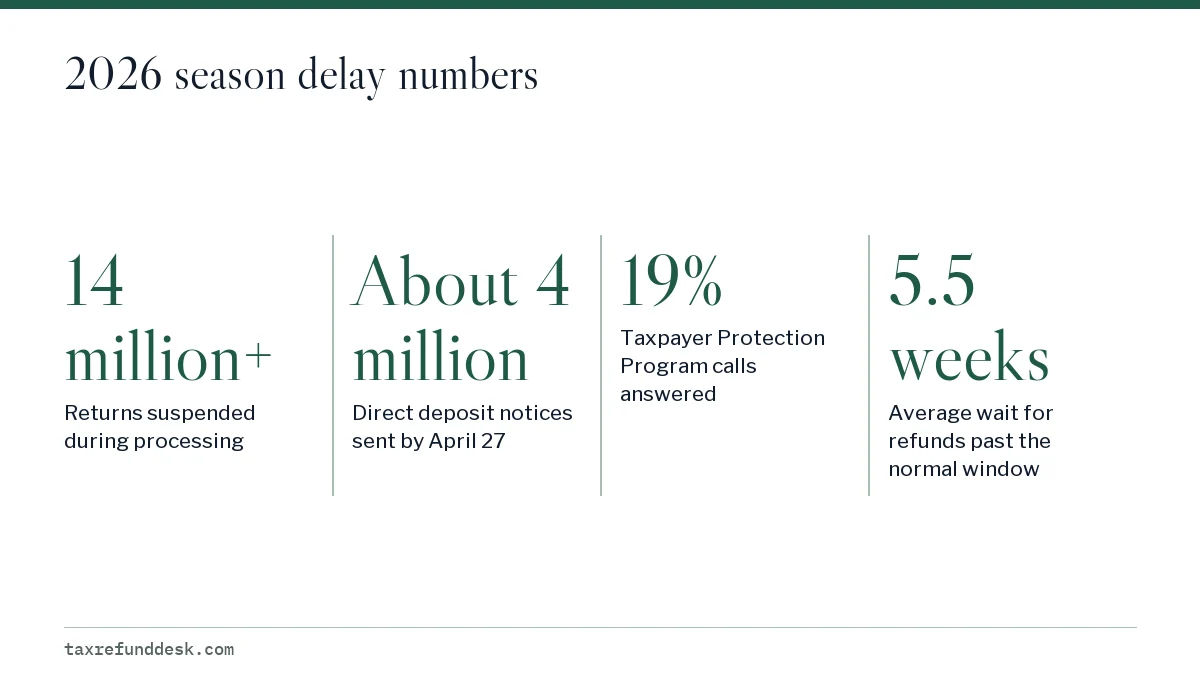
Yes, for a specific group. The 2026 season showed that IRS rule changes cause tax refund delays for millions when a return lacks valid bank information. The National Taxpayer Advocate reported that by April 27, 2026 the IRS had sent about 4 million notices for returns with missing or incorrect direct deposit details, and that more than 14 million individual returns were suspended during processing for all reasons.
Most filers who e-file with a correct bank account saw no change. The delays land on people who used to get a paper check by default, people whose bank rejected a deposit, and people claiming credits that already carried a hold.
This page covers what changed and what it means for returns filed in 2027 for tax year 2026. For the general list of causes, see tax refund delayed.
The direct deposit requirement and frozen refunds
Executive Order 14247, signed March 25, 2025, directs federal agencies to stop issuing paper checks. The IRS began phasing out paper refund checks for individuals on September 30, 2025. You can still file a return without bank details, but the IRS now freezes the refund until you supply an account or request a paper check.
What happens when bank information is missing or rejected
- The IRS processes the return but holds the refund.
- It sends a CP53E notice explaining that bank information is missing, invalid or was rejected.
- You have 30 days to add or update an account, or choose a paper-check exception, in your IRS online account.
- After an online update, allow 2 to 5 business days for the refund status to change.
- If you do nothing, the IRS issues a paper check after 6 weeks.
Two details catch people out. You get only one chance to add or change the account online, and IRS phone staff cannot make the change for you. The full walk-through is on our CP53E notice page and the guide to updating bank info in your IRS online account.
Rejected deposits no longer turn into checks automatically
Before the change, a deposit bounced by a bank usually came back as a mailed check. TAS now says most rejected deposits are frozen and wait for the taxpayer to act. A closed account, a typo in the routing number, or a name that does not match the account can each trigger this.
Paper checks are not gone for everyone. Exceptions cover hardship, legal or procedural requirements, and people with no electronic option, and alternatives include prepaid debit cards and some mobile apps. See getting a refund without a bank account and the paper check phase-out page.
Popular tax credits that still trigger refund holds
The headline 'IRS new rules and popular tax credits could delay refunds' mixes an old rule with new ones. The EITC and ACTC hold is not new: the PATH Act has barred refunds on those returns before February 15 since 2017, and it holds the entire refund.
What changes each year is the calendar. February 15, 2027 falls on a Monday that is also the Washington's Birthday federal holiday, a calendar fact rather than an IRS announcement. The IRS has not yet published projected 2027 deposit dates for early EITC and ACTC filers; it usually posts them in January. For comparison, in 2026 most early filers saw a projected date by February 21 and most refunds were expected by March 2.
Do the new deductions trigger reviews?
Tax year 2026 returns are filed under One Big Beautiful Bill Act rules, including new Schedule 1-A deductions for tips, overtime, car loan interest and a senior deduction. The IRS has not said these deductions are singled out for review. Any claim that does not match your records can still lead to a correction notice, so keep pay stubs, employer statements and loan documents that support each figure.
Returns suspended for review: IRS refunds delayed this year
Beyond bank problems, the 2026 mid-year report found that more than one million taxpayers did not receive refunds within the normal processing time and waited about 5 and a half weeks on average. Identity checks were a large share of the pain: the Taxpayer Protection Program line took about 2.4 million calls and the IRS answered only 19% of them, with an average wait of about 20 minutes.
| Measure | 2026 season figure |
|---|---|
| Individual returns suspended during processing | More than 14 million |
| Notices for missing or incorrect direct deposit details (to April 27) | About 4 million |
| Taxpayers who waited past normal processing time | More than 1 million |
| Average wait for those taxpayers | About 5 and a half weeks |
| Taxpayer Protection Program calls answered | 19% of about 2.4 million |
If your status tool says your refund is late, our page on a refund delayed beyond the normal timeframe explains what to expect next.
How to avoid the new delays in 2027
- E-file and enter a checking or savings account in your own name, your spouse's name, or a joint account.
- Copy routing and account numbers from your bank's app or a check, not from memory. The IRS does not take responsibility for bank errors made by you or your preparer.
- Do not send more than three refunds into one account. The IRS will not deposit a fourth.
- If you want to split the refund, use Form 8888, which allows deposits into up to three accounts.
- Set up your IRS online account before filing, so you can answer a CP53E within the 30-day window.
- Get an IP PIN from your online account in January if you want an extra identity safeguard; you must enter it on your return once you have one.
- Keep records for any new Schedule 1-A deduction you claim.
Still waiting on a refund from this year? Our list of reasons a tax refund is taking so long helps you pin down which one applies.
Common questions
Will the paper check phase-out slow my refund?
Only if your return lacks valid bank details or the bank rejects the deposit. Then the refund is frozen until you add an account online or request a paper-check exception, or until a paper check is issued after 6 weeks with no response.
Which new IRS rules can delay refunds?
The main one is the direct deposit requirement under Executive Order 14247, which replaced automatic paper checks with a freeze and a CP53E notice. Rejected deposits are now also frozen instead of being reissued as checks.
Can I still get a paper refund check in 2027?
Yes in limited cases. Exceptions cover hardship, legal or procedural requirements, and people with no electronic payment option, and you request one through your IRS online account when you answer a CP53E.
Why were so many IRS refunds delayed this year?
The National Taxpayer Advocate reported more than 14 million suspended returns and about 4 million direct deposit notices in the 2026 season. Identity checks and bank detail problems were major drivers.
Are EITC refunds delayed in 2027?
The PATH Act hold still applies, so no EITC or ACTC refund can be issued before February 15, 2027. The IRS has not yet announced projected 2027 deposit dates; it usually does in January.
Sources
- IRS to phase out paper tax refund checks, starting with individual taxpayers irs.gov
- Questions and answers about Executive Order 14247 irs.gov
- Understanding your CP53E notice irs.gov
- National Taxpayer Advocate issues 2026 mid-year report to Congress irs.gov
- When to expect your refund if you claimed the EITC or ACTC irs.gov
- Direct deposit refunds and refund offsets (TAS tax tip) taxpayeradvocate.irs.gov
We check figures against these official pages. Rules change; confirm anything that affects a deadline or payment with the agency before you act.
Tell us what happened
Describe your situation and our editors will use it to improve this guide. If you leave your email, we may reply with a pointer to the right page or official contact. We never share your details.
Related guides
 Tax Refund Delay: 7 Causes, How Long Each Takes, What to Do
A tax refund delay means the IRS has pulled your return out of automatic processing, most often for an EITC or ACTC hold until mi…
Refund Delayed Beyond Normal Timeframe: What It Means
An IRS refund delayed beyond normal timeframe is one that has passed the 21-day e-file window, or 6 weeks for a paper return, wit…
Why Is My Tax Refund Taking So Long? 9 Real Reasons
A tax refund usually takes longer than the IRS's 21-day e-file window (6 weeks or more for paper) because of one of nine things:…
IRS CP53E Notice: Add Bank Details to Release Your Refund
A CP53E notice tells you the IRS owes you a refund but is holding it because your bank information was missing, invalid or reject…
IRS Paper Refund Checks: Phase-Out Rules and Exceptions
The IRS began phasing out paper checks for individual tax refunds on September 30, 2025, under Executive Order 14247. It still ma…