
IRS refund delayed beyond normal timeframe: what it means and how long it lasts
Short answer
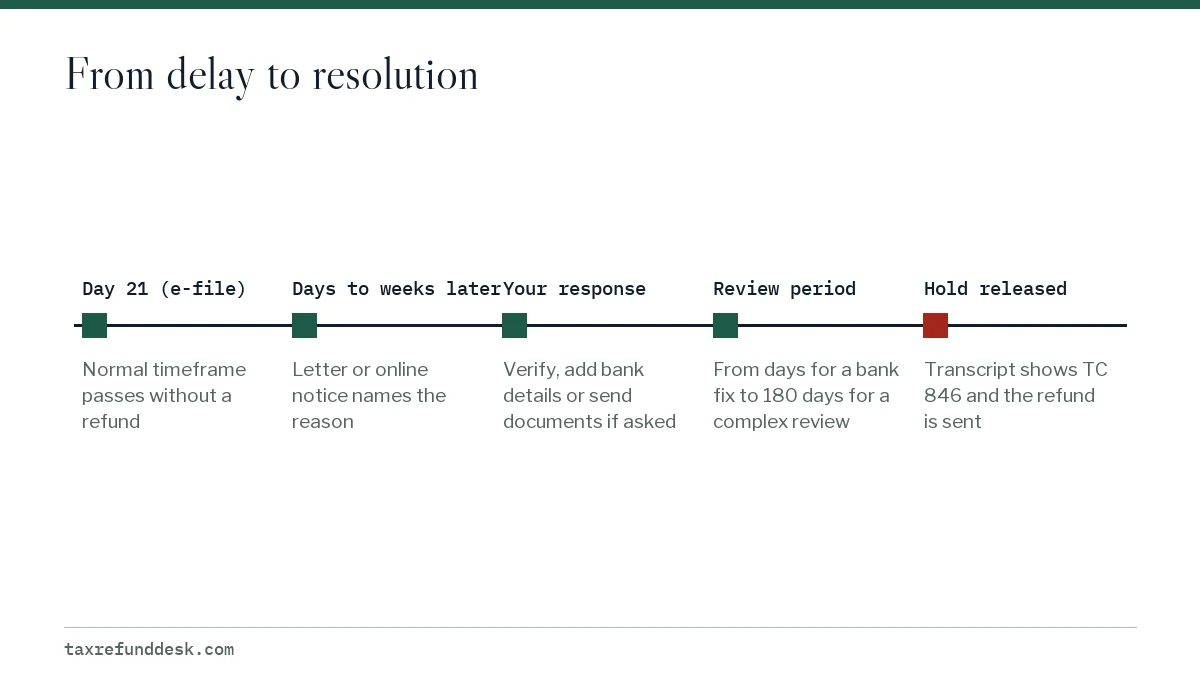
An IRS refund delayed beyond normal timeframe is one that has passed the 21-day e-file window, or 6 weeks for a paper return, without being issued. It means the return left automatic processing for a check, not that the refund is lost or denied. The wait after that point depends on the cause, from a few days for a bank fix to 180 days for a complex review.
- 01Normal timeframe, e-file
- 21 days
- 02Normal timeframe, paper
- 6 weeks or more from IRS receipt
- 03Average extra wait in 2026 for delayed refunds
- About 5 and a half weeks
- 04Interest starts
- Generally after 45 days
What an IRS refund delayed beyond normal timeframe means
The normal timeframe is the IRS's own benchmark: most e-filed refunds within 21 days and paper returns in 6 weeks or more after receipt. An IRS refund delayed beyond normal timeframe is simply one that has passed that mark. The return is still in the system; something about it has sent it to a slower lane.
The wording can differ between Where's My Refund, the IRS2Go app, your IRS online account and your account transcript. What matters is not the exact phrase but whether a letter, a notice or a transcript code tells you the reason.
It is also common. The National Taxpayer Advocate reported that in the 2026 season more than one million taxpayers did not get refunds within normal processing time, and those taxpayers waited about 5 and a half weeks on average.
Why a tax refund is delayed beyond the normal timeframe
A refund slips past the normal window when an automated filter or a person flags the return. The flag usually falls into one of four buckets, and each points to a different next step.
- A legal hold. Returns claiming the EITC or ACTC cannot be refunded before February 15. Early filers with these credits often pass day 21 while still inside the hold; see the PATH Act refund hold.
- A verification step. The IRS needs to confirm your identity or check income and withholding against employer and payer records.
- A correction. A math error or a missing form means the IRS has to fix the return or ask you for something, often by Letter 12C.
- A payment problem. Missing or rejected bank details now freeze the refund under the direct deposit rules described in IRS rule changes that delay refunds.
The fastest way to see which bucket applies without waiting for mail is your account transcript. A TC 570 shows a hold on the account, a TC 810 shows a refund freeze, and a TC 846 shows the refund has been issued. Our guide on how to read an IRS transcript explains the layout.
How long after the delay message will I get my refund?
Once a refund is past the normal window, the clock that matters is the one attached to the cause. Use the event in the middle column as your start date.
| Cause | Clock starts | Typical wait |
|---|---|---|
| Bank details updated after a CP53E | Your online update | 2 to 5 business days for status to change |
| Error corrected, CP12 you agree with | Notice date | 4 to 6 weeks |
| Missing information, Letter 12C | IRS receives your reply | About 6 to 8 weeks |
| Income or withholding check, CP05 | Notice date | Up to 60 days |
| Identity verified | Successful verification | Up to 9 weeks |
| Broader IRS review | Start of the review | 45 to 180 days |
A worked example: a CP05 dated April 10 means you should not expect movement or call until about June 9, 60 days later. If identity verification is also required and you complete it on May 1, allow until early July, since the refund can take up to 9 weeks after verification. For that path, see refund after identity verification.
Refund delayed beyond normal timeframe: do I need to do anything?
Sometimes no. Your job is to find out which kind of delay you have and only act where action is required.
- Check your mail and the notices tab of your IRS online account for anything dated after you filed.
- If a letter asks you to verify identity, add bank details or send documents, do it before the deadline printed on it. These holds do not lift on their own.
- If a letter says no action is needed, as a CP05 does for people who filed the return, mark the date and wait out the stated period.
- If there is no letter after about 4 weeks past the normal window, order your account transcript to look for a hold code.
- Do not refile the return or send Form 1040-X to push it along. Duplicate filings can add weeks.
When to contact the IRS about a delayed refund
Wait until the normal processing time has passed, 21 days after e-filing or 6 weeks after the IRS receives a mailed return, before calling about a refund with no letter. Once you have a letter, use the phone number or address printed on that letter rather than a general line, because it routes you to the unit holding your case.
Before you call, have your notice, a copy of the return, your filing status and the exact refund amount ready. Our page on the IRS refund phone number lists which official line fits which situation.
If the IRS has passed its own stated timeframe, or the delay is causing financial hardship, the Taxpayer Advocate Service may take the case. The hub page on a tax refund delayed explains how TAS decides and what it cannot change.
Common questions
What does delayed beyond normal timeframe mean on my refund?
It means your refund has passed the IRS's normal window of 21 days for e-filed returns or 6 weeks for paper returns. The return is still being handled, but something sent it to manual review or a hold.
How long after this message will I get my refund?
It depends on the cause. Bank fixes clear in days, a CP05 review takes up to 60 days, identity verification up to 9 weeks after you verify, and complex reviews 45 to 180 days.
Is a refund delayed beyond the normal timeframe being audited?
Usually not. Most of these delays are pre-refund checks. An audit comes with a formal examination letter, and a TC 420 would appear on your transcript.
Should I file my return again if my refund is delayed?
No. Sending a second copy or an amended return while the first is in process tends to add time. Wait for a letter or check your transcript instead.
Does the IRS pay interest when a refund is delayed?
Generally yes once more than 45 days have passed from the due date or the date the IRS received the return, whichever is later. The rate is 7% a year for individuals for the quarter starting October 1, 2026.
Sources
- Where's My Refund irs.gov
- Taxpayer Advocate Service: Held or stopped refunds taxpayeradvocate.irs.gov
- National Taxpayer Advocate issues 2026 mid-year report to Congress irs.gov
- Understanding your CP05 notice irs.gov
- Understanding your Letter 12C irs.gov
- Interest irs.gov
We check figures against these official pages. Rules change; confirm anything that affects a deadline or payment with the agency before you act.
Tell us what happened
Describe your situation and our editors will use it to improve this guide. If you leave your email, we may reply with a pointer to the right page or official contact. We never share your details.
Related guides
 Tax Refund Delay: 7 Causes, How Long Each Takes, What to Do
A tax refund delay means the IRS has pulled your return out of automatic processing, most often for an EITC or ACTC hold until mi…
PATH Act Refund Hold: Why EITC and ACTC Refunds Wait
A PATH Act refund is any refund on a return that claims the Earned Income Tax Credit or the Additional Child Tax Credit. Federal…
IRS Rule Changes That Can Delay Tax Refunds for Millions
The IRS rule changes that cause tax refund delays for millions of filers are mostly about how money is paid, not how tax is figur…
How to Read Your IRS Transcript to Track Your Refund
To track a refund, use the IRS tax account transcript, not the tax return transcript: it is the only IRS transcript that lists da…
When Will I Get My Tax Refund After Verifying Identity?
The IRS says your tax refund may take up to 9 weeks to arrive after you successfully verify your identity, and it asks you to wai…