
When is a state tax refund taxable on your federal return?
Short answer
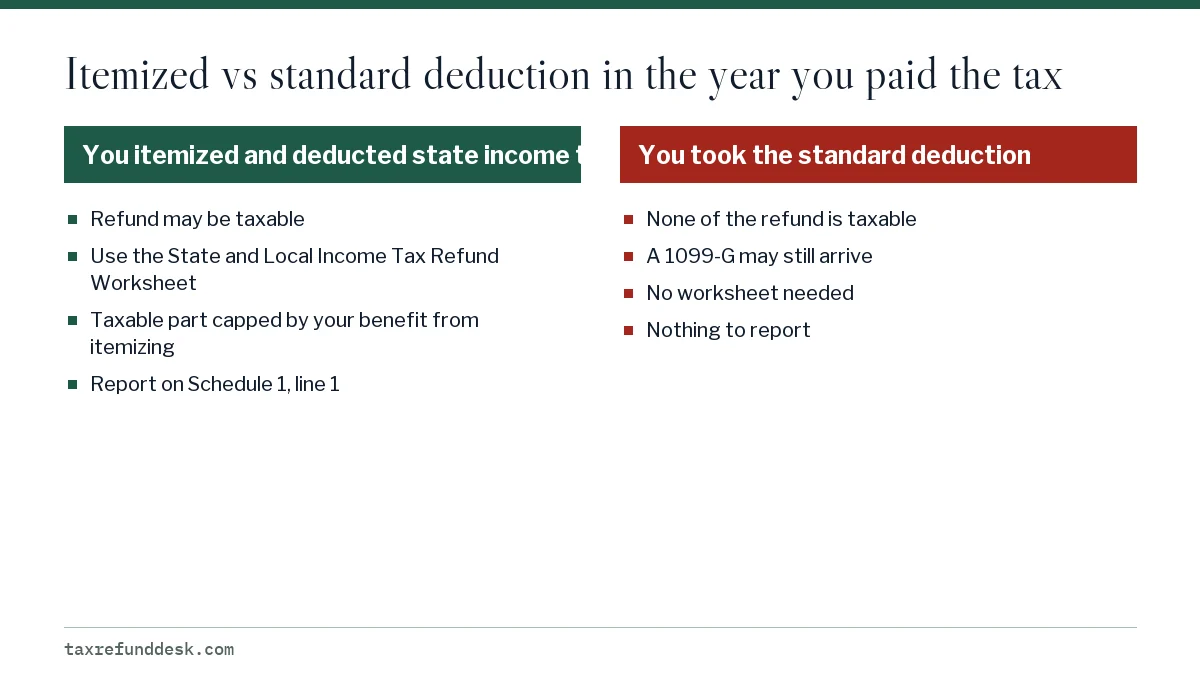
A state tax refund is taxable on your federal return only if you itemized deductions and deducted state income tax in the year you paid that tax, and then only to the extent the deduction cut your federal tax. If you took the standard deduction, or deducted sales tax instead, none of it is taxable (IRS, Instructions for Form 1040, Schedule 1 line 1).
- 01Taxable only if
- You itemized and deducted state income tax the year you paid it
- 02Where it is reported
- Schedule 1 (Form 1040), line 1
- 03Information form
- Form 1099-G, box 2 (amount) and box 3 (tax year)
- 042025 SALT deduction limit
- $40,000 ($20,000 married filing separately)
- 052025 standard deduction
- $15,750 single, $31,500 joint, $23,625 head of household
When is a state tax refund taxable on your federal return?
A state tax refund is taxable on your federal return when two things are true: you itemized deductions on Schedule A for the year you paid the tax, and you chose to deduct state income tax rather than state sales tax. Even then, only the part of the refund that actually lowered your federal tax counts as income.
This follows the tax benefit rule. IRS Publication 525 defines a recovery as the return of an amount you deducted in an earlier year, and says you include it in income only up to the amount the deduction reduced your tax. Your federal income tax refund, by contrast, is never taxable, because federal income tax is never deductible.
Timing matters for the 2027 filing season. On the 2026 return you file in early 2027, you report state refunds you received during 2026, which are usually refunds of 2025 state tax. So the question is whether you itemized on your 2025 federal return, not your 2026 one.
Do I have to report my state refund if I took the standard deduction?
No. If you claimed the standard deduction for the year the refund relates to, none of the refund is taxable and you leave it off your federal return. Publication 525 gives exactly this case: a filer who took the standard deduction for one year and got that year's state refund the next year reports none of it.
The same is true if you itemized but elected to deduct state and local general sales taxes instead of income taxes. You never deducted the income tax, so getting some of it back is not a recovery.
Most filers fall into this group. For 2025, the standard deduction is $15,750 for single filers and married people filing separately, $31,500 for joint filers and qualifying surviving spouses, and $23,625 for heads of household (IRS, Instructions for Form 1040).
Why did I get a Form 1099-G for my state refund?
States report income tax refunds, credits and offsets of $10 or more on Form 1099-G, Certain Government Payments. Box 2 shows the amount and box 3 shows the tax year it relates to. A 1099-G does not mean the refund is taxable; it only tells you and the IRS that the payment happened.
Under the IRS instructions for Form 1099-G, a state does not have to send you a copy if it can tell you did not itemize for that year, but it must file the form with the IRS in every case. Some states make the form available only electronically, so you may need to download it from your state's revenue site. Getting one when you took the standard deduction is normal and needs no action.
What counts as a state refund on the 1099-G
- A refund check or direct deposit of state income tax.
- An overpayment you applied to next year's estimated state tax. The IRS treats it as received in the year you applied it.
- An offset, where the state used your refund to pay a debt. You still received the benefit, so it counts.
- Refundable state tax credits paid out by the state tax agency.
If your state refund was taken for a debt, see our explanation of how the IRS can take a state refund; the amount taken is still reportable if the refund is taxable.
How the state tax refund worksheet works
If you itemized, the IRS State and Local Income Tax Refund Worksheet in the Instructions for Form 1040 (under Schedule 1, line 1) tells you how much is taxable. It starts with the refund, subtracts any state and local tax you paid above the deduction limit (the SALT cap), and then caps the result at the amount by which your itemized deductions beat the standard deduction. Whatever is left is the taxable part.
The 2026 Form 1040 instructions, which cover returns filed in 2027, are not yet published; the IRS usually releases them in December or January. The examples below use the published 2025 figures, which are the ones a 2026 worksheet would look back to if it keeps its current structure.
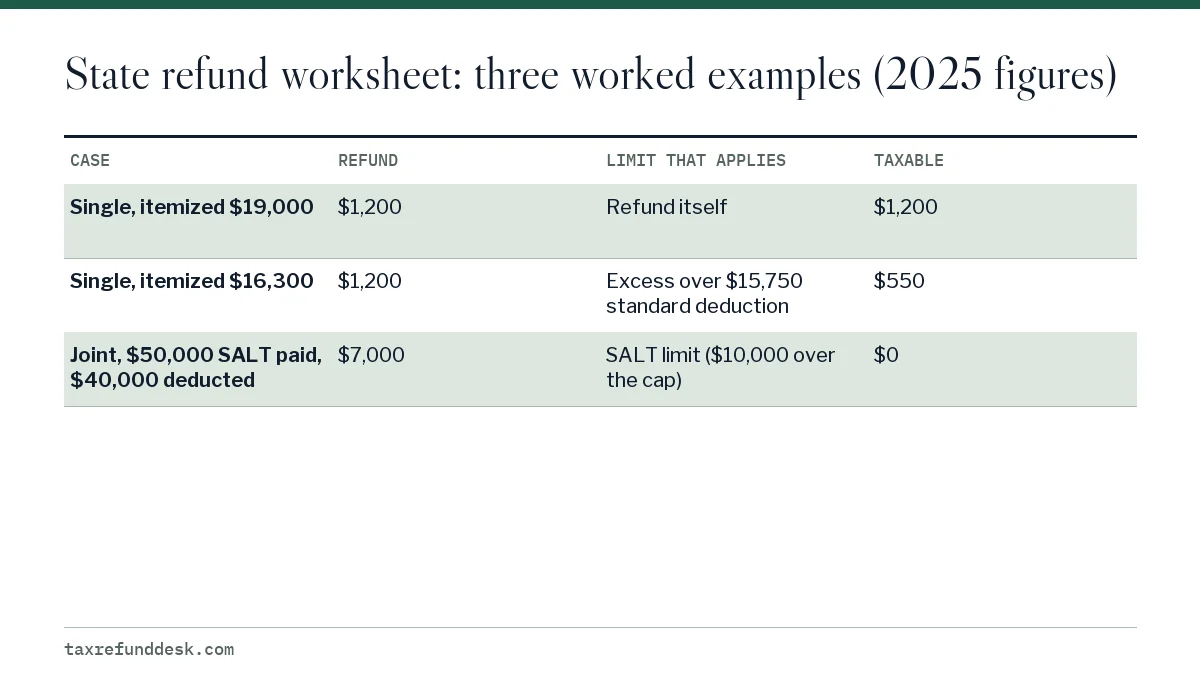
Example 1: fully taxable refund
A single filer itemized $19,000 on her 2025 return, including $6,500 of state income tax and $3,500 of property tax. In 2026 she gets a $1,200 state refund. Her itemized deductions beat the $15,750 standard deduction by $3,250, which is more than the refund, and her $10,000 of state and local taxes was under the limit. All $1,200 is taxable.
Example 2: partly taxable refund
Same facts, except her 2025 itemized deductions totaled $16,300. They beat the standard deduction by only $550. Had she paid $1,200 less state tax, she would have taken the standard deduction and lost just $550 of benefit, so only $550 of the refund is taxable.
Example 3: SALT limit, nothing taxable
A married couple filing jointly paid $36,000 of state income tax and $14,000 of property tax in 2025, $50,000 in total. The 2025 limit on state and local tax deductions let them deduct $40,000 (their income was under the $500,000 phase-down threshold). They get a $7,000 state refund in 2026. Even without that $7,000, they would still have hit the $40,000 limit, so the deduction gave them no extra benefit and none of the refund is taxable.
When can't you use the IRS worksheet?
Some situations need Worksheet 2 in Publication 525 instead of the Form 1040 worksheet. Based on the 2025 instructions, the main ones are:
- The refund is for a year other than the immediately preceding one, for example a 2023 refund from an amended state return.
- You made your last estimated state tax payment for the year in January of the following year, so the refund must be split between two years.
- You owed alternative minimum tax (AMT) in the earlier year.
- Someone else could claim you as a dependent in the earlier year.
- The refund comes from a joint state return but you are not filing a joint federal return with the same person.
- The refund is of sales tax or real property tax, not income tax.
Publication 525 walks through the January estimated-payment case: a filer who paid 75% of the year's estimated tax in one year and 25% in the next treats only 75% of the refund as a recovery item.
Where does a taxable state refund go on the return?
The taxable amount goes on Schedule 1 (Form 1040), line 1, Taxable Refunds, Credits, or Offsets of State and Local Income Taxes, which flows to Form 1040. Report the taxable part even if no 1099-G arrived. If your taxable amount is less than the 1099-G figure, Publication 525 suggests attaching your calculation.
Interest paid on a late state refund is a separate item: it is interest income, not a refund, and is reported with your other interest. States such as Missouri pay interest after a set number of days; see Missouri refund status and our page on whether refund interest is taxable.
To track the refund itself, use your state's tool; the state tax refund status overview links to each one, and California refund status shows a high-tax state example.
Common questions
Is my state tax refund taxable if I took the standard deduction?
No. If you claimed the standard deduction for the year the refund relates to, none of the refund is taxable on your federal return.
Do I have to report a 1099-G state refund if I didn't itemize?
No. The state files a 1099-G with the IRS in every case, but the refund is not taxable if you did not itemize that year, so you leave it off your return.
What box on Form 1099-G shows my state refund?
Box 2 shows state or local income tax refunds, credits or offsets, and box 3 shows the tax year the box 2 amount is for.
Is a state refund applied to next year's estimated tax taxable?
It can be. The IRS treats an overpayment applied to next year's estimated tax as received in the year you applied it, and the normal itemizing rules then decide whether it is taxable.
I didn't get a 1099-G. Do I still report my state refund?
Yes, if it is taxable. The IRS says to report a taxable refund even without the form, and some states issue the 1099-G only electronically.
Does the SALT cap affect whether my state refund is taxable?
Yes. If your state and local taxes exceeded the deduction limit by more than the refund, the refund gave you no extra deduction and is not taxable. For 2025 the limit is $40,000, or $20,000 if married filing separately.
Sources
- IRS Publication 525, Taxable and Nontaxable Income (Recoveries) irs.gov
- IRS, Instructions for Form 1040 (Schedule 1, line 1 worksheet) irs.gov
- IRS, Instructions for Form 1099-G irs.gov
- IRS, Instructions for Schedule A (Form 1040) irs.gov
We check figures against these official pages. Rules change; confirm anything that affects a deadline or payment with the agency before you act.
Tell us what happened
Describe your situation and our editors will use it to improve this guide. If you leave your email, we may reply with a pointer to the right page or official contact. We never share your details.