
IRS transcript code 290: additional tax assessment or a released hold
Short answer
IRS transcript code 290 records an additional tax assessment made after your return posted. When the amount is $0.00, the IRS usually finished a review without changing your tax and released a hold such as TC 570. When it shows a dollar amount, your tax went up by that figure, which shrinks the refund or creates a balance due.
- 01TC 290 meaning
- Additional tax assessment after an adjustment (Document 6209)
- 02TC 290 for $0.00
- Adjustment with no tax change; often releases a 570 hold
- 03Reverse of a 290
- TC 291, abatement of a prior assessment
- 04Interest
- A positive TC 290 can generate TC 196 interest where applicable
- 05CP12 dispute window
- Generally 60 days from the notice date
What does IRS transcript code 290 mean?
IRS transcript code 290 is an "Additional Tax Assessment," a change the IRS makes to a tax year that already has a posted return (TC 150). IRS Document 6209 describes it as additional tax resulting from an adjustment to that year's account. It is how the IRS records the outcome of a review, a math correction or a manual adjustment.
The key to reading a code 290 on your IRS transcript is the amount. A zero-dollar 290 and a 290 with a positive number mean very different things for your refund, so read the amount column before anything else. For a list of the other codes around it, see our IRS transcript codes guide.
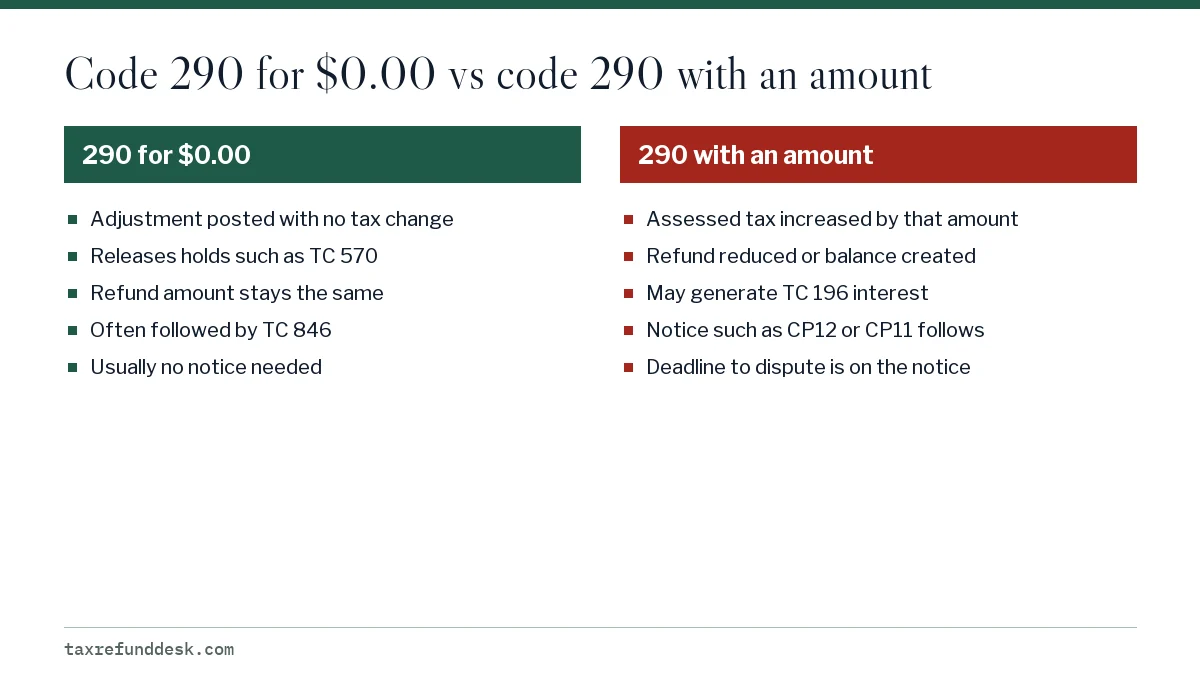
Is a code 290 for $0.00 good news?
Usually, yes. A TC 290 for $0.00 means the IRS posted an adjustment that did not change your tax, and Document 6209 lists the freezes a 290 releases. Among them are the 570 hold, the refund hold, the math error freeze, the duplicate return freeze and the manual refund freeze.
In practice, a zero 290 often appears after a return was held with TC 570 while the IRS checked wages, withholding or credits. The 290 closes that review. If the account now shows a credit balance and no other freeze, a TC 846 refund usually follows.
When a zero 290 is not the end of the story
- A TC 810 refund freeze stays in place until a TC 811 posts, because the 290 does not release it.
- A TC 898 offset can still take part of the refund for a debt after the hold is released.
- Document 6209 notes that a zero 290 blocked in the 96X series shows a penalty abatement request was considered and rejected. That concerns a penalty, not your refund amount.
Does code 290 mean I owe more?
A TC 290 with a positive amount means your assessed tax went up by that amount. If you were due a refund, the refund drops by the same figure. If the increase is larger than the refund, you end up with a balance due.
Worked example
A filer expected a $3,100 refund. The IRS matched a Form 1099-NEC that was missing from the return and increased the tax by $660. The transcript shows TC 290 for $660.00, and the refund falls to $2,440 ($3,100 minus $660). A notice explaining the change arrives by mail, and a TC 971 line may mark the notice date.
| Situation | Transcript shows | Likely notice |
|---|---|---|
| Tax increase smaller than the refund | TC 290 plus a smaller TC 846 | CP12 (refund changed) |
| Tax increase larger than the refund | TC 290 and a balance due | CP11 (balance due after corrections) |
| Tax decrease | TC 291 instead of 290 | Notice explaining the change |
| No tax change | TC 290 for $0.00 | Often none; the refund is released |
Document 6209 adds that a positive 290 can generate an interest assessment (TC 196) where it applies. A refund reduced this way is explained on the CP12 notice page, and a change that creates a bill is covered on the CP11 notice page.
What to do if you disagree with a code 290
- Wait for the notice. It explains which line changed and why, which the transcript cannot tell you.
- Compare the notice with your return and your income documents (W-2s, 1099s, Form 1095-A).
- If the IRS is right, no reply is needed on a CP12. The IRS says the adjusted refund should arrive in 4 to 6 weeks unless you owe other tax or debts.
- If the IRS is wrong, contact it by the date on the notice, generally 60 days for a CP12. Missing that date costs you the right to appeal the change in Tax Court.
- Keep copies of everything you send and note the date.
What follows a code 290 on the IRS transcript?
What comes next depends on the amount and on any holds left on the account:
- TC 846: refund issued. The most common next line after a zero 290 that cleared a hold.
- TC 571: the 570 hold is reversed. It may post near the 290, although a 290 can release the 570 hold on its own.
- TC 971: a notice was issued. The action code tells you which kind, as covered on our TC 971 page.
- TC 766 or TC 767: a refundable credit allowed or reversed as part of the same adjustment. See TC 766.
- TC 196: interest charged when the 290 created or increased a balance.
If the account shows a 290 but no 846 after several weeks, and no notice has come, the refund may be held for another reason. Our guide to why a refund was reduced walks through the other causes.
Common questions
What does a 290 with zero dollars mean on my transcript?
The IRS made an adjustment without changing your tax. It usually marks the end of a review and releases holds such as the 570 hold, so a refund can follow if nothing else is blocking it.
Does code 290 mean I am being audited?
Not by itself. A 290 records an adjustment, which can come from a math correction or a routine review. A referral to an examination shows separately as TC 420.
Why do I have code 290 and code 570 on the same transcript?
The 570 put a hold on the account while the IRS checked something, and the 290 records the result of that check. If a 571 or 846 also appears, the hold has cleared.
How long after a code 290 will I get my refund?
The IRS publishes no fixed gap between a zero 290 and TC 846; if no other freeze remains, the refund can be scheduled in the next posting cycles. After a CP12 change, the IRS says to expect the adjusted refund in 4 to 6 weeks.
What is the difference between code 290 and code 291?
TC 290 increases the assessed tax. TC 291 abates, or reduces, a prior assessment in whole or in part, which increases a refund or lowers a balance.
Sources
- IRS Document 6209, Section 8A: Master File Codes irs.gov
- Understanding your CP12 notice irs.gov
- Understanding your CP11 notice irs.gov
- Tax Topic 203, Reduced refund irs.gov
- File an amended return irs.gov
We check figures against these official pages. Rules change; confirm anything that affects a deadline or payment with the agency before you act.
Tell us what happened
Describe your situation and our editors will use it to improve this guide. If you leave your email, we may reply with a pointer to the right page or official contact. We never share your details.