
Code 768 on an IRS transcript: your earned income credit has posted
Short answer
Code 768 on an IRS transcript means the Earned Income Tax Credit (EITC) from your return has posted to your account as a credit. It shows the EITC amount processed, not an approval of the refund. Because of the PATH Act, no refund on an EITC return can be issued before February 15, so a 768 posted in January still waits.
- 01TC 768 meaning
- Earned income credit, generated from the processed return (Document 6209)
- 02Reversal code
- TC 765 reverses a TC 768 or TC 764
- 03Earliest EITC refund
- Not before February 15 (PATH Act)
- 042026 season
- Most early EITC and ACTC refunds expected in accounts by March 2, 2026
- 052027 projected dates
- Not yet announced; the IRS usually posts them in January
What does code 768 mean on an IRS transcript?
Code 768 on an IRS transcript is the transaction that posts your earned income credit. IRS Document 6209 describes TC 768 as an earned income credit generated from the information captured when your return was processed. The amount matches the EITC the IRS processed from your Form 1040, shown as a negative number because it is a credit.
The Earned Income Tax Credit is a refundable credit for workers with low to moderate income. Because it is refundable, the 768 can create a refund even when the tax on the TC 150 line is $0.00. The EITC gets its own code, so it is never lumped into TC 766, which holds other refundable credits such as the Additional Child Tax Credit.
Does code 768 mean my EITC was approved?
Code 768 means the EITC was processed as claimed, not that the IRS finished checking it. The credit can post and still be held by a TC 570 freeze, and a later review can reverse it. The refund is released only when TC 846 appears with a date.
The IRS lists EITC claims among the common reasons a refund takes longer, and reviews of wages and credits are among the hold reasons the Taxpayer Advocate Service names. A CP05 or similar letter explains a review if one starts.
How the PATH Act affects a code 768 refund
The PATH Act bars the IRS from issuing any refund on a return that claims the EITC or the ACTC before February 15, and it holds the entire refund, not only the credit portion. Neither the IRS nor the Taxpayer Advocate Service can release it early, even in a hardship case.
That is why a transcript can show TC 150, TC 806 and TC 768 in late January with no TC 846 yet. The account is complete, but the law stops the payment date from coming before mid-February.
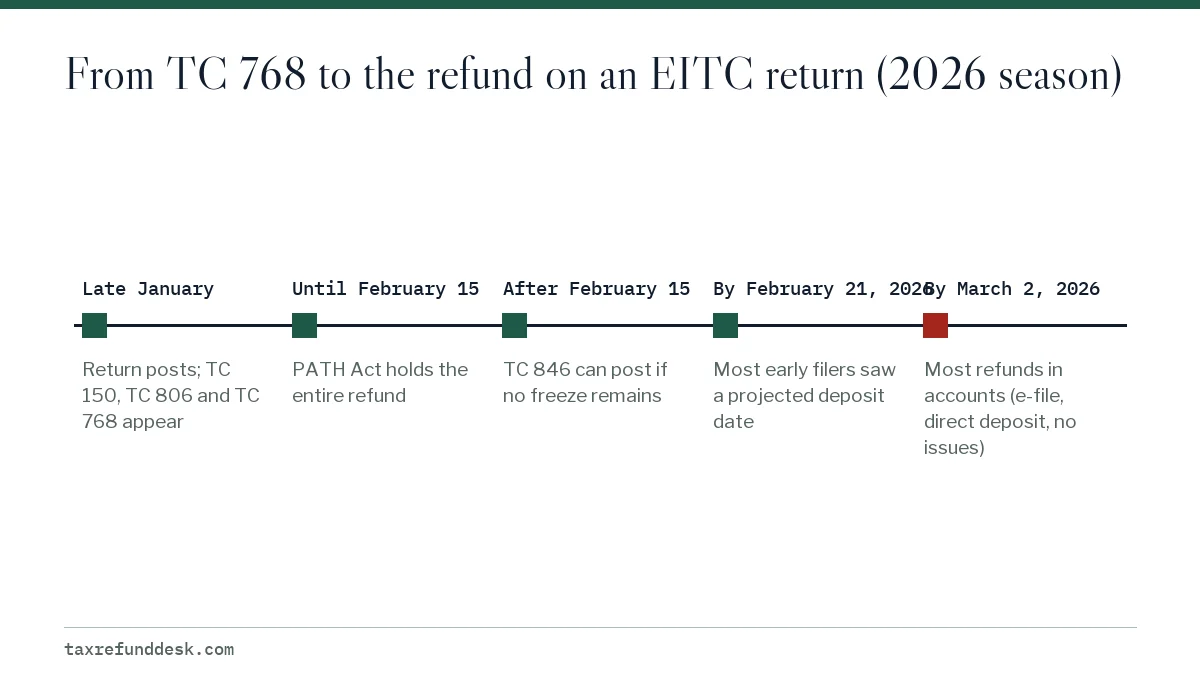
| Milestone | 2026 season (actual) | 2027 season |
|---|---|---|
| Filing season opened | January 26, 2026 | Not yet announced (usually early January) |
| Earliest legal refund date | After February 15, 2026 | After February 15, 2027 (a Monday and a federal holiday) |
| Projected deposit dates in Where's My Refund | By February 21, 2026 for most early filers | Not yet announced (usually posted in January) |
| Most refunds in accounts | By March 2, 2026 (e-file, direct deposit, no issues) | Not yet announced |
For more on the 2027 season, see our EITC refund date page, which we update when the IRS publishes its projections.
When is a code 768 refund released?
A code 768 refund is released when TC 846 posts after the February 15 PATH Act date and no freeze remains. The IRM computes the refund payment date as the posting date plus four business days for direct deposit, or plus six business days for a paper check.
Banks may not post deposits on weekends or federal holidays, so money can land a day or two after the date on TC 846. The posting week printed near your return entry is explained on our IRS cycle codes page.
What usually follows a 768
- TC 846 with a date after February 15: the refund is scheduled.
- TC 570: a hold, often while the IRS checks income or qualifying children.
- TC 971: a notice was issued, often a verification letter.
- TC 765: the EITC was reversed, in whole or in part.
What if code 768 disappears or is reversed?
Transcript lines rarely vanish. When the IRS removes or reduces an earned income credit, it adds a TC 765 that reverses the 768, and the net effect is shown by the two lines together. Document 6209 also lists TC 764, an earned income credit posted through an adjustment, which can appear if the IRS allows EITC after a review.
- Check for a TC 765 and compare its amount with the 768. Equal amounts mean the full credit was removed.
- Wait for the notice that explains the change, and note the reply deadline on it.
- Gather proof of earned income and, for each qualifying child, proof of relationship and residency.
- If you disagree, respond by the deadline on the notice with copies of your documents.
- If a 768 seems to be missing from a transcript you pulled before, confirm you are viewing the same tax year and the account transcript, not the return transcript.
Common questions
Why do I have code 768 but no 846 yet?
If it is before February 15, the PATH Act is holding the refund. After that date, look for a TC 570 or TC 810 freeze, which means a review or other hold is stopping the refund.
Is the 768 amount my refund?
No. It is the earned income credit only. Your refund is the total of all credits minus your tax, shown on TC 846.
Can I get my EITC refund before February 15 for a hardship?
No. The Taxpayer Advocate Service says neither it nor the IRS can release an EITC or ACTC refund before February 15, even for hardship.
What does code 768 with code 570 mean?
The credit posted, but the account is frozen while the IRS checks something. Watch for a notice, and for a TC 571 or TC 290 that releases the hold.
When will 2027 EITC refunds be released?
The IRS has not yet announced the 2027 projections. By law no EITC refund can go out before February 15, 2027, and the IRS usually publishes expected deposit dates in January.
Sources
- IRS Document 6209, Section 8A: Master File Codes irs.gov
- When to expect your refund if you claimed the EITC or ACTC irs.gov
- Taxpayer Advocate Service: held or stopped refunds taxpayeradvocate.irs.gov
- IRM 3.30.123, Processing Timeliness: Cycles, Criteria and Critical Dates irs.gov
- IRS opens 2026 filing season irs.gov
We check figures against these official pages. Rules change; confirm anything that affects a deadline or payment with the agency before you act.
Tell us what happened
Describe your situation and our editors will use it to improve this guide. If you leave your email, we may reply with a pointer to the right page or official contact. We never share your details.