
IRS transcript code 150: your return has posted and the tax is assessed
Short answer
IRS transcript code 150 means your original return has posted to the IRS master file and the tax liability on it has been assessed. The dollar amount beside it is your total tax, not your refund, and a code 150 alone does not mean the refund is approved. The refund appears later as code 846.
- 01TC 150 meaning
- Return filed and tax liability assessed (IRS Document 6209)
- 02Amount shown
- Your total tax from the return, which can be $0.00
- 03Refund issued code
- TC 846, usually listed after TC 150 and the credit codes
- 04Freeze to watch for
- TC 570 (hold); released by TC 571 or TC 290
- 05Account transcript history
- Current year plus 9 prior years online
What does IRS transcript code 150 mean?
IRS transcript code 150 is the transaction code the IRS posts when your original return is processed and your tax is assessed. IRS Document 6209, the agency's internal code manual, titles it "Return Filed & Tax Liability Assessed" and says the assessment from the original return establishes the tax module for that year. In plain terms, the return now exists on your account and the IRS has recorded what you owe in tax before credits and payments are applied.
You see code 150 on the tax account transcript, which you can view free in your IRS Individual Online Account. It lists every transaction on one tax year. For help with the layout and columns, see how to read an IRS transcript.
What the code 150 amount on your IRS transcript shows
The amount next to TC 150 is the total tax from your return, the figure on the "total tax" line of Form 1040, as the IRS processed it. It is a debit, meaning it adds to what you owe. Your withholding, estimated payments and refundable credits then post as separate credit lines that pull the balance below zero if you overpaid.
Worked example: from TC 150 to a refund
Suppose a single filer's return shows total tax of $2,480 and W-2 withholding of $5,100. The account transcript would carry these lines for that year:
| Code | Explanation | Amount | Effect |
|---|---|---|---|
| 150 | Tax return filed | $2,480.00 | Adds tax owed |
| 806 | W-2 or 1099 withholding | -$5,100.00 | Credit |
| 846 | Refund issued | $2,620.00 | Pays out the overpayment |
The math is $5,100 minus $2,480, which leaves a $2,620 overpayment, and TC 846 pays out exactly that. If the numbers on your transcript do not net to your expected refund, a later adjustment or an offset is the usual reason.
Why the code 150 amount can be zero
A TC 150 of $0.00 is normal when the tax on your return is zero. That happens when deductions and nonrefundable credits wipe out the income tax, which is common for lower-income filers who file mainly to get withholding back or to claim the Earned Income Tax Credit (EITC) or Additional Child Tax Credit (ACTC).
A zero does not mean the IRS rejected or ignored anything. Your refund comes from the credit lines that follow, such as TC 806 for withholding, TC 768 for the EITC or TC 766 for other refundable credits.
What does the date next to code 150 mean?
The date on the TC 150 line is the assessment date, which can be later than the day you look at the transcript. IRS scheduling tables tie each weekly processing cycle to an assessment date, also called the 23C date, about 19 days after the cycle's Wednesday cutoff.
For example, the 2026 IDRS schedule in the Internal Revenue Manual (IRM 3.30.123) lists cycle 202608 with a Wednesday cutoff of February 25, 2026 and an assessment date of Monday, March 16, 2026. A future-dated TC 150 is therefore expected and is not a sign of trouble. The cycle number printed near the return entry is explained on our IRS cycle codes page.
What comes after code 150?
After code 150, a clean return usually shows its credit lines and then TC 846 with the refund amount and date. The IRM says the refund payment date on TC 846 is computed as the posting date plus four business days for direct deposit and plus six business days for a paper check.
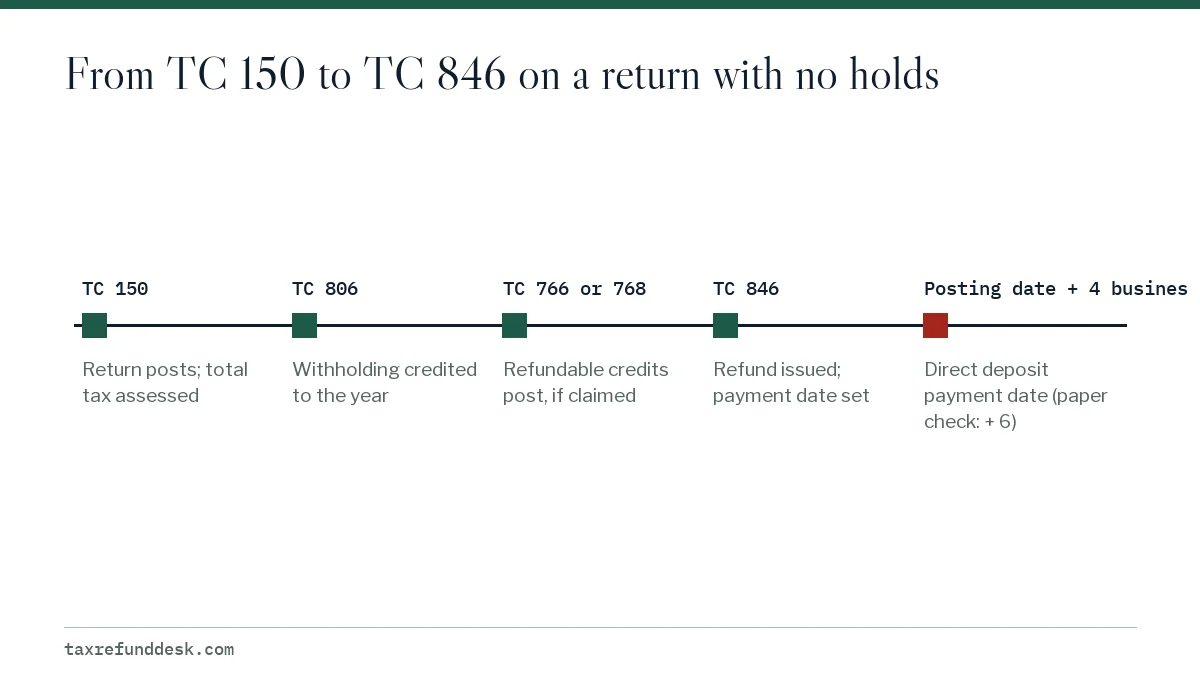
Where's My Refund and the transcript update on different schedules, so one can move before the other. The IRS says its refund status tools update once a day, usually overnight.
When code 150 appears with holds
Code 150 often posts alongside a hold code. The return is on file, but something stops the refund from going out. These are the combinations people most often find:
| Code | Meaning (Document 6209) | What it does to the refund |
|---|---|---|
| 570 | Additional liability pending or credit hold | Freezes refunds and offsets until reversed |
| 571 | Reversal of TC 570 | Releases the 570 freeze |
| 971 | Miscellaneous transaction; meaning set by action code | Often a notice issued; read the action code |
| 810 | Refund freeze | Blocks the refund until TC 811 |
| 420 | Examination indicator | Return referred to Examination; TC 421 reverses it |
If you see TC 150 followed by TC 570, watch your mail. A notice such as a CP05 (income and credit verification) or an identity verification letter usually explains the hold. The Taxpayer Advocate Service guideline for IRS reviews is 45 to 180 days depending on complexity.
What to do if code 150 has not appeared
- Check the tax year. The account transcript for the tax year the return covers (for example tax year 2026 for a return filed in 2027) is the one that will show TC 150.
- Give it time. The IRS says most e-filed refunds are issued within 21 days, and a paper return takes 6 weeks or more from the date it is received.
- Confirm acceptance. An e-filed return that was rejected never reaches the master file, so no TC 150 will post.
- Look for letters. An identity verification letter (5071C, 4883C or 5747C) stops processing before the return posts.
- Use Where's My Refund in parallel. It shows Return Received once the IRS has the return, even before the transcript fills in.
Common questions
Does code 150 mean my refund is approved?
No. Code 150 means the return posted and your tax was assessed. Approval shows when TC 846 appears with a refund date, or when Where's My Refund moves to Refund Approved.
Why does my transcript show code 150 with a future date and an amount?
The date is the scheduled assessment (23C) date, which the IRS schedule sets about 19 days after the processing cycle closes, so a future date is normal and does not delay the refund by itself. The amount beside it is your total tax before payments and credits, not your refund.
Is the amount next to code 150 what I owe?
It is your total tax before payments and credits. Your withholding (TC 806) and refundable credits (TC 766 or TC 768) are subtracted to reach the balance or the overpayment.
How long after code 150 does the refund come?
There is no fixed gap; it depends on whether any hold codes post. Once TC 846 posts, the IRS computes the payment date as the posting date plus four business days for direct deposit or six for a check, and most e-filed refunds are issued within 21 days of filing.
Can a return have two code 150 entries?
Only one original return assessment posts per tax year. An amended return shows as TC 977, and later changes show as TC 290 or TC 291, not a second TC 150.
Sources
- IRS Document 6209, Section 8A: Master File Codes irs.gov
- IRM 3.30.123, Processing Timeliness: Cycles, Criteria and Critical Dates irs.gov
- Transcript types for individuals and ways to order them irs.gov
- Tax Topic 152, Refund information irs.gov
- Taxpayer Advocate Service: held or stopped refunds taxpayeradvocate.irs.gov
We check figures against these official pages. Rules change; confirm anything that affects a deadline or payment with the agency before you act.
Tell us what happened
Describe your situation and our editors will use it to improve this guide. If you leave your email, we may reply with a pointer to the right page or official contact. We never share your details.