
IRS cycle codes: what the eight digits on your transcript mean, including 05 and 03
Short answer
IRS cycle codes show when your return posted, not when your refund will arrive. The eight digits read YYYYCCDD: four for the year, two for the weekly processing cycle and two for the posting day, where 01 is Friday, 02 Monday, 03 Tuesday, 04 Wednesday and 05 Thursday. An ending of 05 matches the Thursday weekly posting; 01 to 04 point to a daily account.
- 01Format
- YYYYCCDD (year, cycle, day)
- 02Day digits
- 01 Fri, 02 Mon, 03 Tue, 04 Wed, 05 Thu
- 03IRS example
- 20263102 = Monday, August 3, 2026
- 04Weekly accounts post
- Thursday
- 05Refund payment date
- Posting date plus 4 business days (direct deposit)
What IRS cycle codes are
An IRS cycle code is the eight-digit number that records when a transaction posted to the Individual Master File, the IRS system that holds individual tax accounts. The Internal Revenue Manual (IRM 3.30.123.4.9) describes it as the year, a two-digit cycle number and a two-digit day-of-week number.
Cycle codes matter mainly as a timestamp. They show that your return has posted and which day of the IRS processing week it posted on. They are one of several IRS transcript codes worth checking, but they do not show your refund date.
Where the cycle code appears on your transcript
On a tax account transcript, the cycle usually appears on the line for TC 150 (return filed and tax assessed) in the transactions list, and many transcripts show a cycle for other lines as well. A cycle appears only after the return posts, so a transcript with no TC 150 has no cycle yet.
If you have not pulled a transcript before, our guide to reading an IRS transcript shows where each part sits and how to order one free.
How to read the eight digits
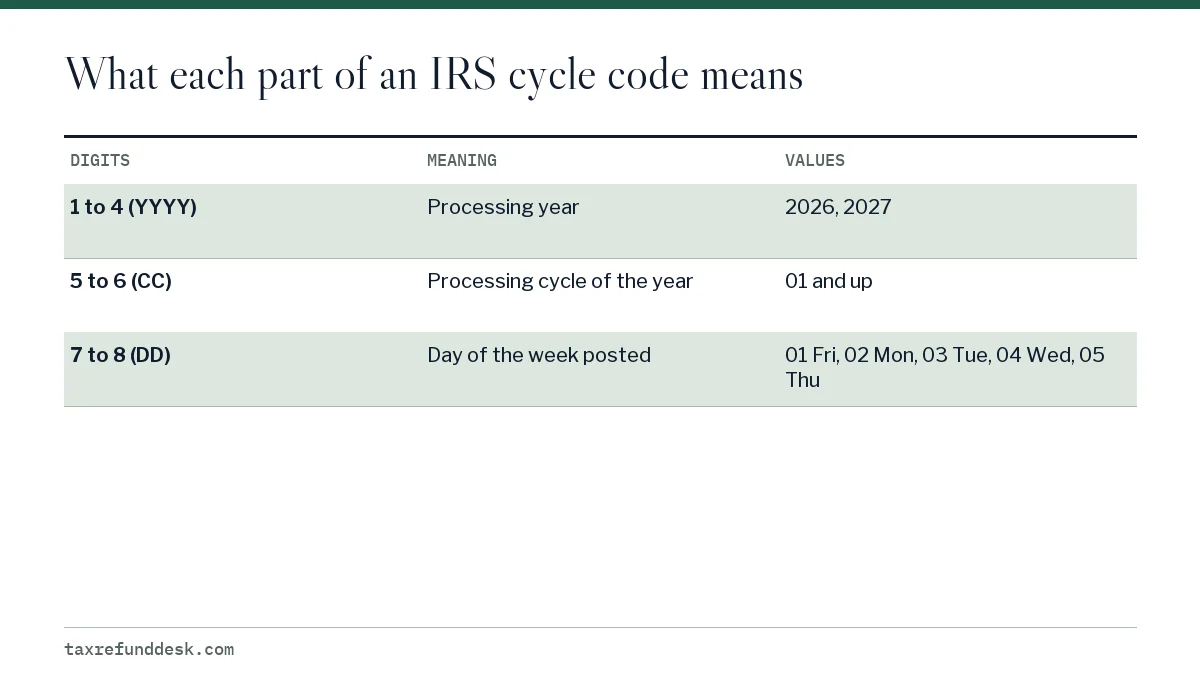
Split the number into three parts: 4 digits, 2 digits, 2 digits. The IRM defines each part, and the last two digits map to a fixed day of the week.
Worked example: 20263102
The IRM itself uses this example. 2026 is the processing year, 31 is the 31st cycle of that year, and 02 means Monday. The IRM says daily transactions released on Monday, August 3, 2026 carry this cycle.
Because 01 is Friday and 05 is Thursday, one cycle runs Friday through Thursday. Applying the IRM's day values to cycle 31 of 2026 gives the dates below. This is our calculation from the IRM example, not an IRS table; the full year appears on our IRS cycle code chart.
| Cycle code | Day | Date |
|---|---|---|
| 20263101 | Friday | July 31, 2026 |
| 20263102 | Monday | August 3, 2026 |
| 20263103 | Tuesday | August 4, 2026 |
| 20263104 | Wednesday | August 5, 2026 |
| 20263105 | Thursday | August 6, 2026 |
Daily vs weekly processing: IRS cycle code 05 and 03
Individual accounts are processed on one of two schedules. The IRM says IMF processing runs daily on weekdays for accounts marked daily, while other accounts are processed weekly, on Thursday. IMF periodically re-analyzes accounts to mark them daily or weekly.
IRS cycle code ending in 05
A cycle code ending in 05 means the transaction posted on a Thursday. That matches the weekly schedule, which is why many filers read an 05 as a weekly account. But daily accounts also post on Thursdays, so an 05 alone does not prove which schedule your account is on. If later lines on your transcript also post only on Thursdays, a weekly schedule is the likely explanation.
IRS cycle code 03
A cycle code ending in 03 means the transaction posted on a Tuesday. Only daily accounts post on days other than Thursday, so an 01, 02, 03 or 04 points to a daily account. New transactions on a daily account can appear on any business day.
Does the cycle code tell me my refund date?
No. The cycle code on the TC 150 line records when the return posted; it does not schedule the refund. A refund date exists only when TC 846 posts. At that point the IRM says the payment date is set at the posting date plus four business days for direct deposit, or six for a paper check, as our page on code 846 explains.
Holds break any prediction. A TC 570 or TC 810 stops the refund regardless of cycle, and returns claiming the EITC or Additional Child Tax Credit cannot be refunded before February 15 under the PATH Act. The date the earned income credit code 768 appears has no bearing on that legal hold. The 2027 PATH Act release dates are not yet announced; the IRS usually publishes them in January.
What an IRS cycle code cannot predict
- Whether the return will be selected for review after it posts.
- Whether an offset will reduce the refund.
- How long a hold will last once one posts.
- The day your bank makes the money available.
Online charts that turn a cycle code into a refund date are estimates built by third parties, not IRS schedules. Use the cycle to confirm your return posted and which weekday your account updates, then watch for TC 846 or the Refund Sent status in Where's My Refund.
Common questions
What does my IRS cycle code mean?
It is the year, the weekly processing cycle number and the day of the week your transaction posted. For example, 20263105 would be Thursday of cycle 31 in 2026.
Is cycle code 05 good or bad?
Neither. It only means the transaction posted on a Thursday, which is the day weekly accounts post. It says nothing about holds or refund amount.
Can my cycle code change from weekly to daily?
Yes. The IRM says IMF periodically re-analyzes accounts to mark them daily or weekly, so later transactions can post on a different schedule.
Why does my transcript have no cycle code?
The return has not posted yet. The cycle appears with TC 150 once initial processing finishes.
Do all IRS cycle numbers match calendar weeks?
They run Friday through Thursday rather than Monday through Sunday, so a cycle straddles two calendar weeks. Holidays can also merge days.
Sources
- IRM 3.30.123, Processing Timeliness: Cycles, Criteria and Critical Dates irs.gov
- Transcript types and ways to order them irs.gov
- Document 6209, Section 8A, Master File Codes irs.gov
- When to expect your refund if you claimed the EITC or ACTC irs.gov
We check figures against these official pages. Rules change; confirm anything that affects a deadline or payment with the agency before you act.
Tell us what happened
Describe your situation and our editors will use it to improve this guide. If you leave your email, we may reply with a pointer to the right page or official contact. We never share your details.