
Amend tax return time limit: how far back you can claim a refund
Short answer
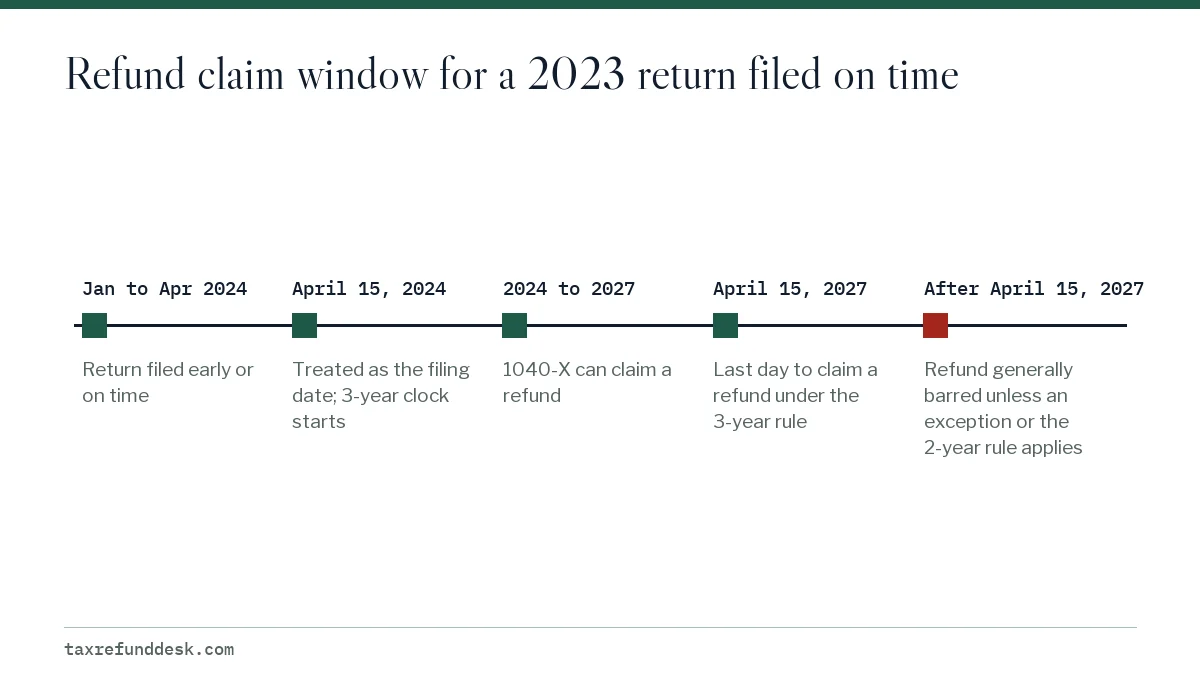
The time limit to amend a tax return for a refund is 3 years after you filed the original return or 2 years after you paid the tax, whichever is later. An early return counts as filed on the April due date. As of late October 2026, on-time 2023, 2024 and 2025 returns are still open, and 2023 closes next, on April 15, 2027. Tax year 2022 is closed for on-time filers and for those who filed on the October 16, 2023 extension date.
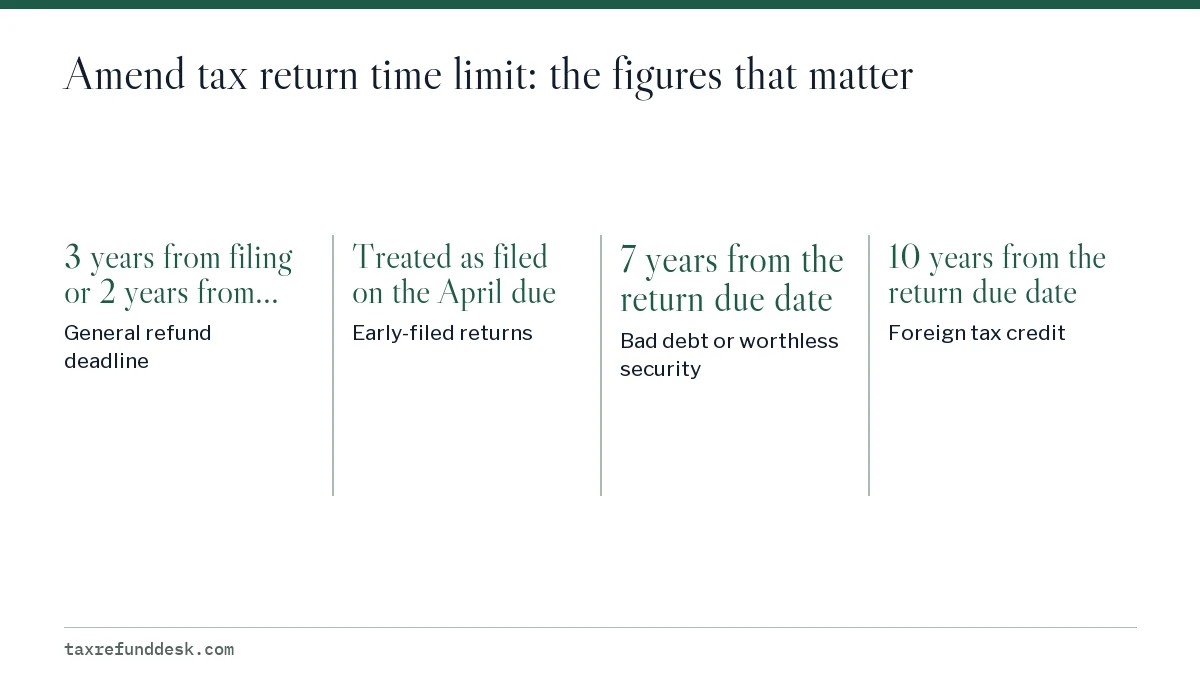
- 01General refund deadline
- 3 years from filing or 2 years from payment, whichever is later
- 02Early-filed returns
- Treated as filed on the April due date
- 03Bad debt or worthless security
- 7 years from the return due date
- 04Foreign tax credit
- 10 years from the return due date
- 05Tax year 2023 on-time returns
- Refund claim open until April 15, 2027
What is the time limit to amend a tax return for a refund?
The time limit to amend a tax return and get money back is the later of two dates: 3 years after you filed the original return, or 2 years after you paid the tax (IRS, File an amended return). This is the amended return statute of limitations for refund claims, set out in Publication 556. If your Form 1040-X arrives after both dates, the IRS generally will not pay the refund, however carefully the Form 1040-X was prepared.
Two details change the math. A return you filed early is treated as filed on the April due date, so filing in February does not start the clock sooner. And tax withheld from your pay or sent as estimated payments is treated as paid on the original due date, not on the day it left your paycheck.
How far back can you amend a tax return as of 2026?
As of late October 2026, you can still claim a refund for tax years 2023, 2024 and 2025 if you filed those returns on time. Tax year 2022 is now closed for anyone who filed by the April 2023 deadline or on the October 16, 2023 extension date, whose window ended on October 16, 2026. A 2022 claim is still possible only if you filed that return after October 16, 2023, counting 3 years from your actual filing date, or if the 2-year rule covers tax you paid more recently.
| Tax year | Original due date | If filed on time or early, claim by | If filed on the October extension date, claim by |
|---|---|---|---|
| 2022 | April 18, 2023 | April 2026 (passed) | October 16, 2026 (passed) |
| 2023 | April 15, 2024 | April 15, 2027 | October 15, 2027 |
| 2024 | April 15, 2025 | April 15, 2028 | October 15, 2028 |
| 2025 | April 15, 2026 | April 15, 2029 | October 15, 2029 |
The extension column assumes the return was filed on the last day of the extension. If you filed on another date, count 3 years from that actual date. Check the filing date on your records or your account transcript, which shows the date the IRS received the return.
How to count the dates and the refund amount
Meeting the deadline is only half the rule. Publication 556 also caps how much can be refunded. If you file within the 3-year window, the refund cannot exceed the tax you paid in the 3 years before the claim, plus the length of any filing extension. If you rely on the 2-year window instead, the refund is limited to tax paid in the 2 years before the claim.
Worked example: why the extension matters
Say you filed your 2022 return on October 16, 2023 under an extension, and all your 2022 tax was withheld from wages, which counts as paid on April 18, 2023. You e-file a 1040-X on October 1, 2026, inside the 3-year window. The look-back period is 3 years plus the 6-month extension, reaching back to April 1, 2023, so the withholding is covered and the full extra refund can be paid.
Without the extension, a look-back of 3 years from October 1, 2026 would stop at October 1, 2023 and miss withholding deemed paid in April 2023. That is why the extension period is added. The dates in this example are illustrative.
When the 2-year rule helps
The 2-year rule matters when you paid tax well after filing, such as a balance paid through an installment agreement. A payment made in March 2025 can be claimed back until March 2027 even if the 3-year window for that return has closed, but only up to the amount paid in those 2 years.
Are there exceptions to the 3-year rule?
Yes. Publication 556 and the Form 1040-X instructions list several situations with longer or suspended deadlines.
| Situation | Time limit | What to know |
|---|---|---|
| Bad debt or worthless security | 7 years from the return due date | Applies to the part of the claim tied to the loss |
| Foreign tax paid or accrued | 10 years from the return due date | For claims based on the foreign tax credit |
| Net operating loss or credit carryback | Special periods tied to the carryback year | Write "Carryback Claim" at the top of the 1040-X |
| Financial disability | Clock suspended while you could not manage your finances | Impairment must last 12 months or more or be expected to end in death; physician statement required |
| Federally declared disaster or combat zone service | Extra time to file | The IRS announces relief dates for each disaster |
Financial disability does not apply if someone, such as a spouse or a person with power of attorney, was authorized to handle your financial matters during that time. The claim must include a physician's statement and your own statement about who could act for you.
What happens after the deadline passes?
If you file a 1040-X for a refund after the time limit, the IRS generally disallows the refund claim and tells you so by letter. The money stays with the Treasury, even when the overpayment is not in dispute.
The deadline for refund claims does not stop you from correcting a return that understated your tax; that is a different limitation period, and owing money is outside the scope of this site. If you are unsure whether a claim is still open, the amended return guide explains the full process, and our page on amended return refund direct deposit shows how the refund is paid once allowed.
Common questions
Can I still get a refund on a 2022 tax return?
Only if your 3-year window is still open. If you filed the 2022 return by April 18, 2023, the window closed in April 2026, and if you filed it on the October 16, 2023 extension date, it closed on October 16, 2026. If you filed later than that, you have until 3 years after your actual filing date. The 2-year rule can still cover 2022 tax you paid within the last 2 years.
Can I amend a tax return from 5 years ago?
You can file the form, but you generally cannot get a refund from it unless an exception applies, such as a bad debt (7 years) or a foreign tax credit (10 years), or you paid tax on that year within the last 2 years.
Does the 3-year limit start on the day I filed or on April 15?
It starts on the day you filed, unless you filed early. An early return is treated as filed on the due date, so the clock starts then.
Does filing an extension give me more time to amend?
Indirectly, yes. The 3-year window counts from the date you actually filed, so a return filed in October starts a later clock, and the extension period is added to the look-back that caps the refund amount.
Does the time limit apply if I never filed the original return?
That is a different situation. A first-time late return claiming a refund follows its own 3-year rule; see our page on late tax return refunds.
Sources
- IRS, File an amended return irs.gov
- IRS Tax Topic 308, Amended returns irs.gov
- IRS Publication 556, Examination of Returns, Appeal Rights, and Claims for Refund irs.gov
- Instructions for Form 1040-X (Rev. December 2025) irs.gov
We check figures against these official pages. Rules change; confirm anything that affects a deadline or payment with the agency before you act.
Tell us what happened
Describe your situation and our editors will use it to improve this guide. If you leave your email, we may reply with a pointer to the right page or official contact. We never share your details.