
IRS Letter 5071C scam or real: how to check an identity letter
Short answer
A real IRS Letter 5071C arrives by postal mail, asks you to confirm your identity and your return, and never asks for money, gift cards or a reply by text. The scam versions usually arrive as texts or emails with a link, or as letters with a payment demand. Confirm any letter by typing IRS.gov yourself or checking your IRS online account, and report fakes to [email protected].
- 01How real identity letters arrive
- US Postal Service mail
- 02What a real letter asks for
- Identity and return verification, never payment
- 03Report scam emails
- [email protected]
- 04Report scam texts
- Forward to 7726, then email [email protected]
- 05Safe way to verify online
- Type irs.gov/verifyreturn yourself
Is my IRS identity letter a scam?
Most IRS identity letters that arrive in a mailbox are real. Return screening is common: the National Taxpayer Advocate reported more than 14 million individual returns were suspended for review in the 2026 season, for identity checks and other reasons. The risk of an IRS Letter 5071C scam is less about the paper letter and more about the texts, emails and fake phone numbers that copy its wording.
A genuine Letter 5071C says a return was filed under your SSN or ITIN and asks you to confirm it before the IRS processes it. It points you to the IRS online verification service or the Taxpayer Protection Program number on the letter. It does not threaten arrest, demand a payment, or ask you to reply to an email.
Signs of a real IRS identity verification letter
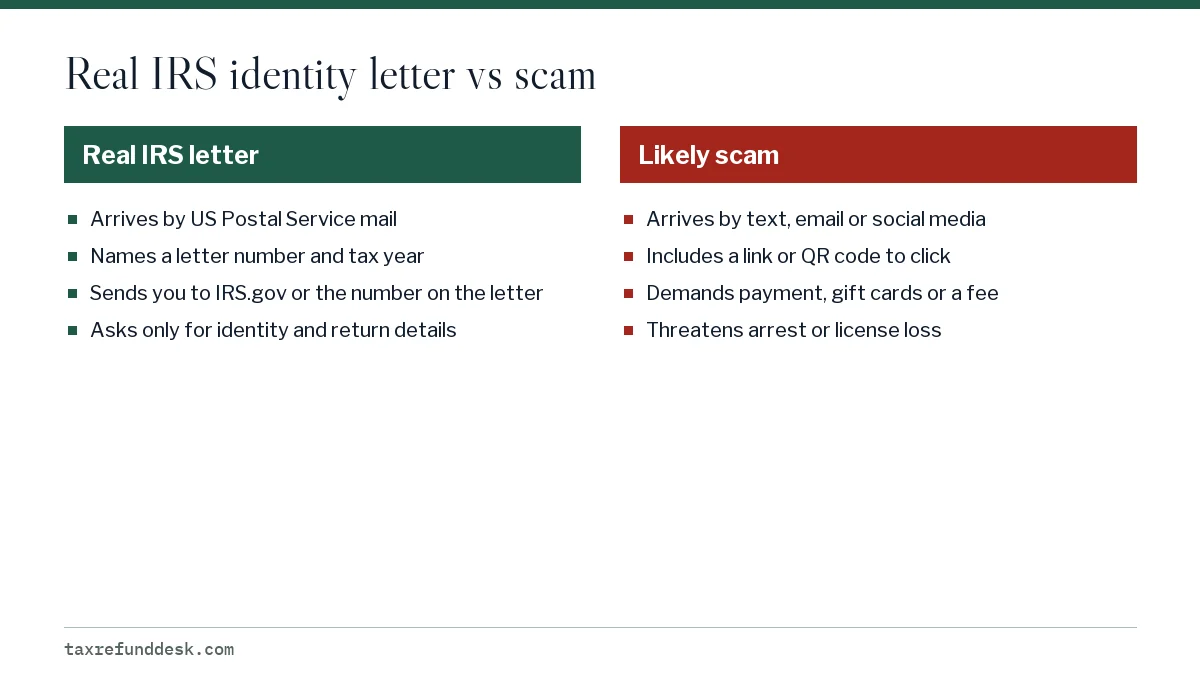
The IRS says it starts most contact through regular mail from the US Postal Service. It does not email or text you without your permission and does not start contact through social media messages. So a message on your phone that claims to be your "5071C" is a warning sign on its own.
Details worth checking on the paper letter
- The letter number, such as 5071C, 4883C, 5747C, 6331C or CP5071, and a tax year that matches a return you really filed or did not file.
- Instructions to verify at irs.gov/verifyreturn or by calling the hotline on the letter, or for a 5747C, to book an office visit.
- No request for a card number, bank login, gift card or wire transfer.
- No threat of arrest or of losing a driver's license; the IRS lists those tactics as things it never does.
Common IRS identity verification scam patterns
Scammers borrow the real letter's language because the real letter makes people anxious about their refund. These are the patterns to watch for.
| What you receive | Why it is suspicious |
|---|---|
| Text saying your refund is on hold until you verify at a link | The IRS does not text without your permission |
| Email with a PDF titled Letter 5071C or 4883C | The IRS does not start contact by email |
| Letter that asks for a fee or payment to release a refund | Identity letters ask only for verification |
| Caller who says they are from the Taxpayer Protection Program | Real letters tell you to call the TPP; an unexpected call is a red flag |
| Social media message offering to fix an IRS identity hold | The IRS does not start contact through direct messages |
IRS letter 4883C scam and 5747C scam variants
With an IRS letter 4883C scam, the thing to watch is a phone number that differs from the one on your paper letter, since the 4883C is answered by phone. With an IRS letter 5747C scam, be wary of any message saying you must pay, or follow a link, to book the office visit. A real Letter 5747C is booked through the number printed on it, with no charge.
How to confirm a letter is real, safely
The rule is simple: reach the IRS through a route you found yourself, never through a link or number inside a message you doubt.
- Sign in to your IRS online account by typing IRS.gov into your browser. Digital copies of many IRS notices appear there.
- Type irs.gov/verifyreturn yourself if your letter offers online verification. Do not use a QR code or link sent by text or email.
- Compare the hotline number on your paper letter with any number you were given elsewhere. If they differ, trust neither until you check.
- Call the IRS using a number from its official telephone assistance page and ask whether a verification letter was issued to you.
- Read our Taxpayer Protection Program hotline guide before you call, so you know what the real line does and does not ask.
Reporting an IRS identity letter scam
- Emails: forward to [email protected], ideally as an attachment so the headers are kept.
- Texts: forward to 7726 (SPAM), then email [email protected] with the sender's number, the message, and the date and time.
- Phone calls: note the number and report the call to the Treasury Inspector General for Tax Administration.
- Fake paper letters: report to the US Postal Service or the Federal Trade Commission at reportfraud.ftc.gov.
- Online fraud losses: the IRS also points to the Internet Crime Complaint Center at ic3.gov.
If you already answered a fake
If you gave a scammer your SSN or tax details, act the same day. Use IdentityTheft.gov for a recovery plan, and consider requesting an Identity Protection PIN, a 6-digit number without which an e-filed return under your SSN is rejected. If a real IRS identity letter later arrives for a return you did not file, say so during verification; the identity verification overview covers what follows.
Common questions
Is IRS Letter 5071C a scam?
No, 5071C is a real IRS letter sent by mail to confirm your identity before a return is processed. Scams copy its wording in texts and emails, so verify through IRS.gov rather than any link you received.
Does the IRS email or text about identity verification?
The IRS says it does not email or text you without your permission and starts most contact by postal mail. Treat an unexpected text or email about a 5071C or 4883C as suspicious.
How do I know if an IRS letter is real?
Check that it came by mail, names a real letter number, and asks only for verification through IRS.gov or the number on the letter. Then confirm through your IRS online account or an IRS number you look up yourself.
Where do I report a fake IRS identity verification text?
Forward the text to 7726 and email the details, including the sender's number and time received, to [email protected].
Will a real IRS identity letter ask me to pay anything?
No. Identity verification letters ask you to confirm who you are and whether you filed the return. Any request for payment, gift cards or a fee is a sign of fraud.
Sources
- Report phishing and online scams irs.gov
- How to know it's really the IRS calling or knocking on your door irs.gov
- The IRS alerts taxpayers of suspected identity theft by letter irs.gov
- Identity and Tax Return Verification Service irs.gov
- National Taxpayer Advocate issues 2026 mid-year report to Congress irs.gov
We check figures against these official pages. Rules change; confirm anything that affects a deadline or payment with the agency before you act.
Tell us what happened
Describe your situation and our editors will use it to improve this guide. If you leave your email, we may reply with a pointer to the right page or official contact. We never share your details.